
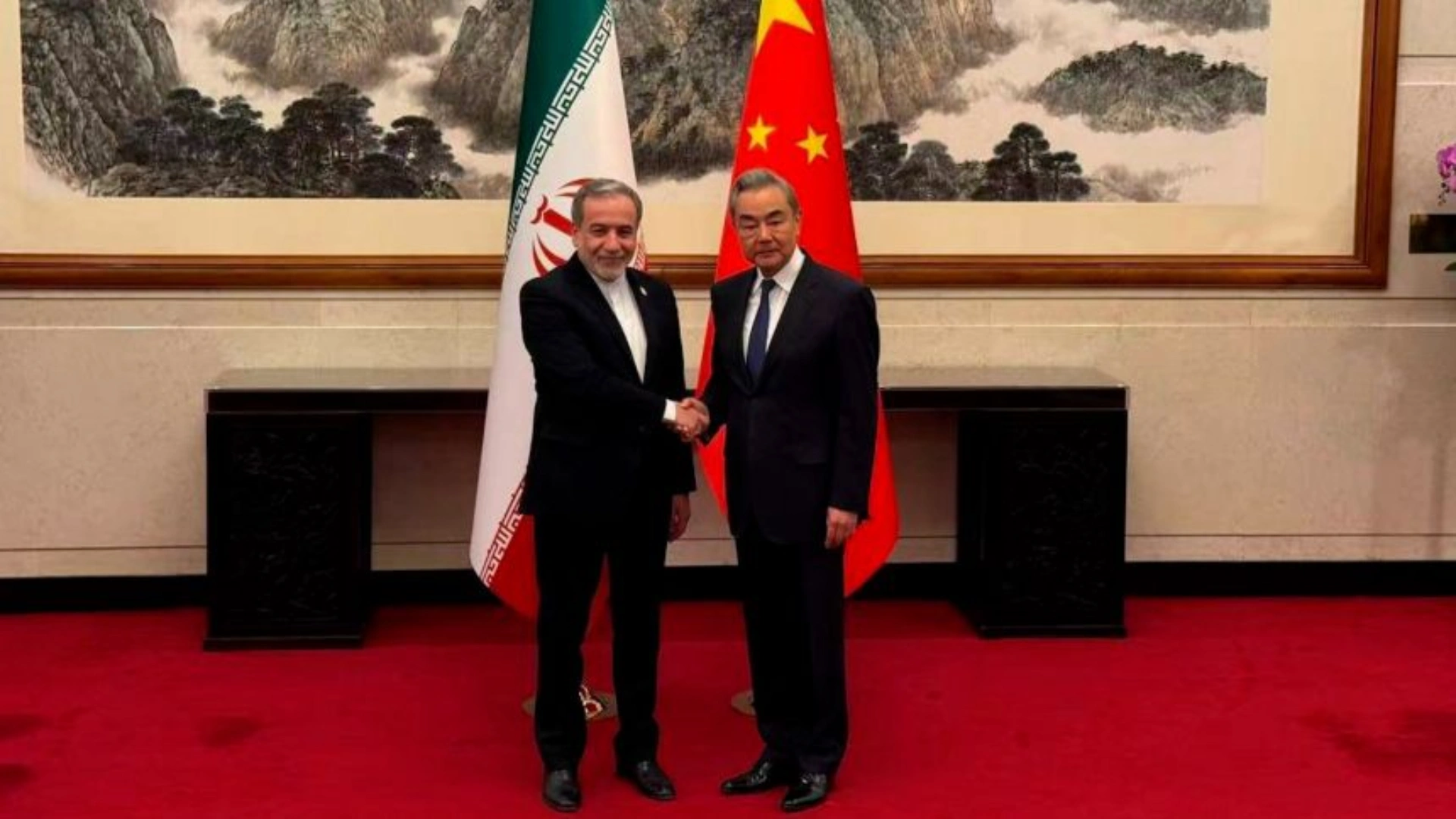

Iran China talks are moving to the centre of diplomatic efforts surrounding the six-month conflict as Iranian Foreign Minister Abbas Araghchi visits Beijing for discussions with Chinese Foreign Minister Wang Yi, with disruption in the Strait of Hormuz, rising U.S. military costs and pressure on global energy markets adding urgency to efforts to reduce the fighting.
China’s Foreign Ministry confirmed that Araghchi would visit China on September 16 and that Wang would hold talks with him. As of early Wednesday, Beijing had not released a detailed account of the discussions or announced a new diplomatic agreement.
The meeting comes at a sensitive moment. Shipping through the Strait of Hormuz remains far below normal levels, the United States has spent tens of billions of dollars on operations against Iran, and Washington is simultaneously pressing Beijing over China’s financial and commercial links with Tehran.
The Iran China talks therefore extend beyond relations between two longstanding partners. They are part of a wider diplomatic contest over whether military pressure can be converted into negotiations and whether China can use its unusual position in the region to help move the conflict towards a political settlement.
Beijing has substantial economic ties with Iran, but it also maintains important relationships with Saudi Arabia, the United Arab Emirates and other Gulf governments. It has repeatedly called for negotiations while trying to protect the energy routes on which its own economy depends.
That gives China influence, but it does not give Beijing control over the decisions of Iran, the United States, Israel or other governments involved in the wider confrontation.
Iran China Talks Come as Hormuz Remains Severely Disrupted
The Strait of Hormuz remains one of the most immediate reasons the Beijing discussions matter far beyond Iran and China.
Only four vessels were recorded crossing the waterway on Tuesday, according to preliminary shipping data reported by Reuters on September 16. That was down from seven a day earlier and far below the recent 10-day average of 18.
Two vessels entered the strait and two exited. None of those recorded crossings involved very large crude carriers or liquefied natural gas tankers. Some vessels may have travelled with their tracking equipment switched off and would therefore not appear in the figures.
Before the war, the Strait of Hormuz carried roughly one-fifth of the world’s oil and liquefied natural gas supply. The continuing disruption has forced traders, energy companies and governments to operate with unusual uncertainty over the volume of oil actually leaving the Gulf.
For China, that uncertainty carries direct economic consequences.
The country is the world’s largest crude importer and obtains a significant share of its energy from the Middle East. Higher prices and disrupted shipping therefore affect Chinese refiners, manufacturers and consumers even though Beijing is not a combatant in the war.
Chinese refiners have also been drawing heavily from domestic oil inventories. Reuters reported that refiners used an estimated 639,000 barrels a day from stocks in August as processing exceeded the combined supply available from imports and domestic production.
The situation gives Beijing a clear reason to favour restored navigation through Hormuz and a reduction in regional attacks.
U.S. War Costs Have Reached About $38 Billion
The diplomatic activity in Beijing comes immediately after the U.S. Congressional Budget Office released its most detailed assessment yet of the financial consequences of the conflict.
The CBO estimated that U.S. military operations against Iran had cost the Department of Defense about $38 billion as of August 1. The figure includes the cost of replacing weapons used during the fighting, equipment lost in battle, additional flying hours, military operations and higher fuel costs.
The future cost depends heavily on the intensity of the fighting.
If violence remained around the relatively lower levels seen in May and June, another month of operations could cost approximately $2 billion, the CBO said. A return to fighting at roughly the intensity recorded in July could increase that figure to about $3 billion a month. A larger escalation could cost still more.
The agency cautioned that its calculations carry significant uncertainty because the Defense Department did not provide information requested by the CBO, forcing analysts to rely on government databases and publicly available reports.
The cost is not limited to money.
The CBO said heavy use of missile-defence interceptors has reduced U.S. inventories and could leave stocks below previous levels for several years. That could become particularly important if the United States faced another conflict involving an opponent with large missile forces. The agency specifically identified a potential conflict involving China and Taiwan as an example.
The Pentagon has disputed suggestions that the United States lacks the weapons required to meet its military objectives. Reuters reported that administration officials maintain that U.S. forces retain sufficient munitions to carry out the president’s strategic goals.
The War Is Also Feeding Inflation
The wider economic effects help explain why governments outside the Middle East are increasingly focused on diplomacy.
The CBO concluded that reduced oil and natural gas shipments through Hormuz, combined with disruption in the Red Sea, have pushed global energy costs higher.
Those increases do not stop at petrol stations. Petroleum is used in aviation, trucking, shipping, manufacturing and agriculture, meaning higher fuel prices can eventually affect the cost of a much broader range of goods.
The CBO now estimates that U.S. inflation in the first quarter of 2027 will be about 0.5 percentage points higher than it projected in February because of the conflict and associated energy shock. Core inflation, which excludes food and energy, is projected to be about 0.3 percentage points higher.
Those pressures have helped turn what began as a regional military confrontation into an issue for central banks, investors and households much further away.
For China, which relies heavily on imported energy and remains deeply integrated into global manufacturing, continued instability in Gulf shipping carries its own risks.
Why the Iran China Talks Matter for Beijing
China and Iran have spent years developing a relationship that combines politics, energy and opposition to U.S.-led sanctions.
In 2021, the two countries signed a 25-year cooperation agreement covering areas including energy and infrastructure. Public details of the arrangement have remained limited, and Chinese investment in Iran has historically been smaller than Beijing’s economic commitments to several other Middle Eastern states.
Oil has been the strongest part of the relationship.
In 2025, China bought more than 80% of Iran’s shipped oil, averaging roughly 1.38 million barrels per day, according to Kpler data reported by Reuters. Those figures describe the period before the current war and should not be treated as a measure of present flows, which have been heavily disrupted.
China has also opposed unilateral sanctions that are not authorised by the United Nations Security Council. Washington, meanwhile, is increasing pressure on the financial and commercial networks that allow Tehran to continue trading.
U.S. Treasury Secretary Scott Bessent told lawmakers this week that Iran and China’s financial links would feature in upcoming discussions with Chinese officials. Bessent is expected to meet Chinese Vice Premier He Lifeng before an anticipated meeting between President Donald Trump and Chinese President Xi Jinping. Beijing had not formally confirmed that presidential meeting at the time of the latest reporting.
The United States has sanctioned some smaller Chinese entities and independent refiners over Iran-related business while so far avoiding broader action against China’s major financial institutions.
That puts Beijing in an increasingly difficult position.
China wants to maintain its strategic relationship with Iran, but it also has an interest in preventing the war from destabilising Gulf economies, damaging global trade and creating a larger confrontation with Washington.
Beijing Has Tried This Kind of Diplomacy Before
China’s claim to a diplomatic role in the Middle East did not begin with the current war.
Its most prominent success came in 2023, when Beijing mediated an agreement between Saudi Arabia and Iran that restored diplomatic relations after a seven-year rupture.
That agreement strengthened China’s argument that it could play a political role in a region where its influence had previously been associated mainly with trade and energy.
The current crisis is significantly more difficult.
Restoring relations between two governments that had already been engaged in quiet discussions is different from trying to end an active conflict involving several military powers, competing security demands, disrupted sea routes and disagreements over Iran’s nuclear and missile programmes.
Still, the Iran China talks are part of an established diplomatic relationship.
Wang and Araghchi have been in repeated contact throughout the conflict. During talks in May, the Chinese Foreign Ministry said Wang called for a complete end to hostilities, continued negotiations and the restoration of normal and safe navigation through Hormuz. Araghchi said Iran wanted a political settlement through diplomatic channels.
In June, after another round of Iran-U.S. diplomacy, Wang again said the Hormuz issue needed to be addressed and that China would continue supporting negotiations.
Wednesday’s meeting therefore represents another stage in a diplomatic process rather than a sudden Chinese entry into the crisis.
Can Iran China Talks Produce a Diplomatic Breakthrough?
China’s advantage is access.
It maintains close relations with Tehran, talks regularly with Washington and has built substantial economic ties with Saudi Arabia, the UAE and other Gulf governments. Few major powers have comparable channels across all sides of the regional divide.
Its limitation is leverage.
Beijing can encourage compromise, facilitate discussions and signal how continued fighting affects Iranian access to its most important economic partner. It can also make clear that prolonged disruption of Hormuz conflicts with Chinese interests.
But China cannot unilaterally resolve the security disputes driving the conflict.
Iran will make decisions based on its own assessment of national security and political survival. The United States and Israel have their own military objectives, while Gulf governments are balancing security concerns with their desire to avoid being pulled deeper into the fighting.
There is also a difference between having influence and being prepared to use it.
China benefits economically from its relationship with Iran, but its trade and investment across the wider Gulf are also extremely important. Beijing has little incentive to take steps that would jeopardise those relationships or expose major Chinese companies to wider financial sanctions.
Perspective: Why the Beijing Meeting Matters Beyond Iran
The significance of the Iran China talks may ultimately lie less in whether Wednesday produces an immediate agreement and more in what the meeting reveals about the changing diplomatic structure around the war.
Six months of military pressure have imposed heavy costs.
The United States has spent approximately $38 billion through August 1. Hormuz traffic remains sharply reduced. Missile stocks have come under pressure. Energy prices have contributed to higher inflation, and attacks around major Gulf shipping routes have widened the economic impact.
Iran, meanwhile, continues to face military and financial pressure but retains relationships with countries that reject Washington’s sanctions strategy.
China sits at the intersection of those pressures.
It wants stable energy supplies, continued trade with Iran, productive relations with Arab Gulf states and manageable ties with the United States. Those interests give Beijing strong reasons to promote diplomacy, even if they do not guarantee that China can produce an agreement.
For now, the Iran China talks show that the diplomatic search for an end to the conflict is increasingly extending beyond Washington and Tehran.
Whether that produces a genuine opening will depend not simply on China’s influence, but on whether the governments doing the fighting decide that further military pressure offers less than negotiation.
Don’t forget to follow us on Facebook | Instagram | Twitter | LinkedIn to get the latest updates from Cape Town Tribune