
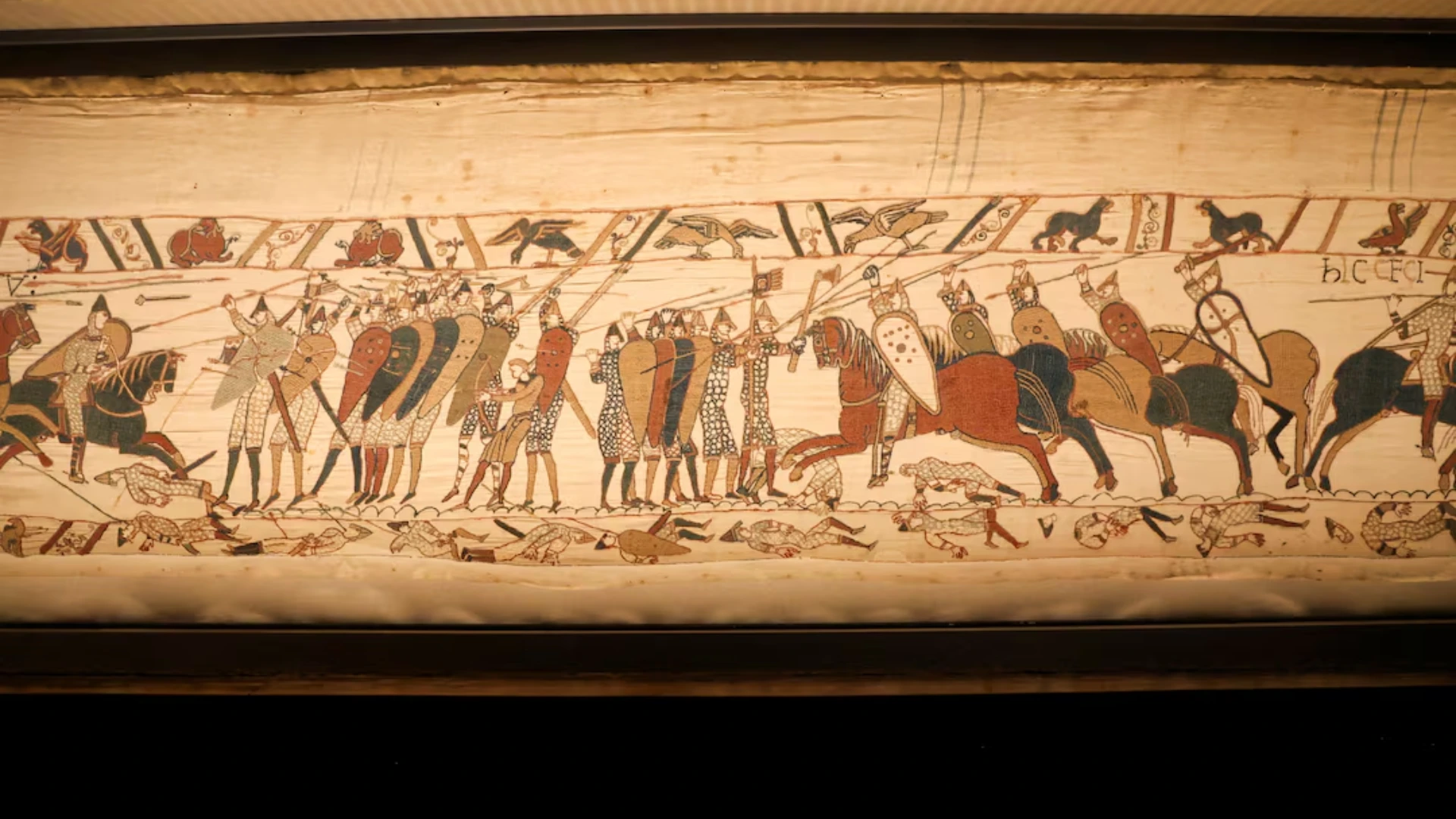

For almost a millennium, England’s most famous account of its own conquest has been kept on the other side of the Channel.
Now the Bayeux Tapestry has returned to England, bringing the extraordinary 11th-century embroidery back to the country where it is widely believed to have been made and where the events it depicts permanently changed the course of English history.
King Charles III and French President Emmanuel Macron viewed the work at the British Museum in London on September 2, ahead of an exhibition opening to the public on September 10. The loan marks what the British Museum and French authorities describe as the first time the tapestry has been on English soil since its creation nearly 1,000 years ago.
It is an exceptional journey for an object that has rarely left Normandy at all.
Stretching almost 70 metres, the Bayeux Tapestry recounts the struggle for the English throne that culminated in the Battle of Hastings in 1066, when William, Duke of Normandy, defeated the forces of the English king Harold Godwinson. The victory established William as William I of England and transformed the country’s political elite, language, architecture, and relationship with continental Europe. But the tapestry’s arrival in London is about more than revisiting 1066.
Its loan has become an elaborate act of cultural diplomacy between Britain and France, accompanied by reciprocal loans, presidential and royal ceremony, enormous public demand and an unusually intense debate about whether such a fragile object should have travelled at all.
For an artwork created in the aftermath of a conquest, its latest role is strikingly different: it is being asked to represent reconciliation.
Why the Bayeux Tapestry’s return to England is so significant
Despite its name, the Bayeux Tapestry is not technically a tapestry. It is an embroidery, made by stitching coloured wool onto linen.
UNESCO records its surviving length as 68.8 metres, with a height of roughly 50 centimetres. It was added to UNESCO’s Memory of the World Register in 2007 because of its exceptional historical and documentary importance.
Across that narrow strip of cloth unfolds one of medieval Europe’s most ambitious visual narratives.
The work contains 58 scenes, approximately 600 human figures, hundreds of animals and ships, buildings, weapons, clothing and scenes of everyday life, accompanied by short Latin inscriptions. The official Bayeux Museum counts around 1,500 individual designs and 380 Latin words.
Its story begins before the Norman invasion itself.
Edward the Confessor, king of England, dies without an heir. Harold Godwinson takes the throne. William of Normandy claims that the crown had been promised to him and prepares an invasion. Ships are built, troops cross the Channel, armies gather and finally collide at Hastings.
Harold is killed. William wins. The embroidery ends abruptly, and historians generally believe part of its conclusion has been lost.
The survival of so much of the work is remarkable enough. Its return to the country whose conquest it records gives the British Museum exhibition a historical resonance few travelling exhibitions can match.
Was the Bayeux Tapestry actually made in England?
One of the ironies of its return is that the work may be coming back to the place where it was created.
Although definitive proof of its workshop has never been found, the Bayeux Tapestry is widely believed to have been made in England, probably within a highly skilled Anglo-Saxon embroidery tradition.
The British Museum describes it as likely commissioned by a Norman patron but produced by English embroiderers using artistic models associated with Canterbury. The most frequently proposed patron is Odo of Bayeux, William the Conqueror’s half-brother, bishop and one of the most powerful men in Norman England.
That makes its cultural identity unusually complicated.
Its subject is a Norman conquest. Its likely patron was Norman. Its makers were probably English. It was preserved for centuries in France. And its images have become inseparable from the way Britain itself imagines 1066.
It does not fit comfortably into a single national category. That ambiguity is part of what makes the current loan so effective as diplomacy. Both Britain and France can plausibly regard the work as part of their history.
A medieval account of war, but not a simple history book
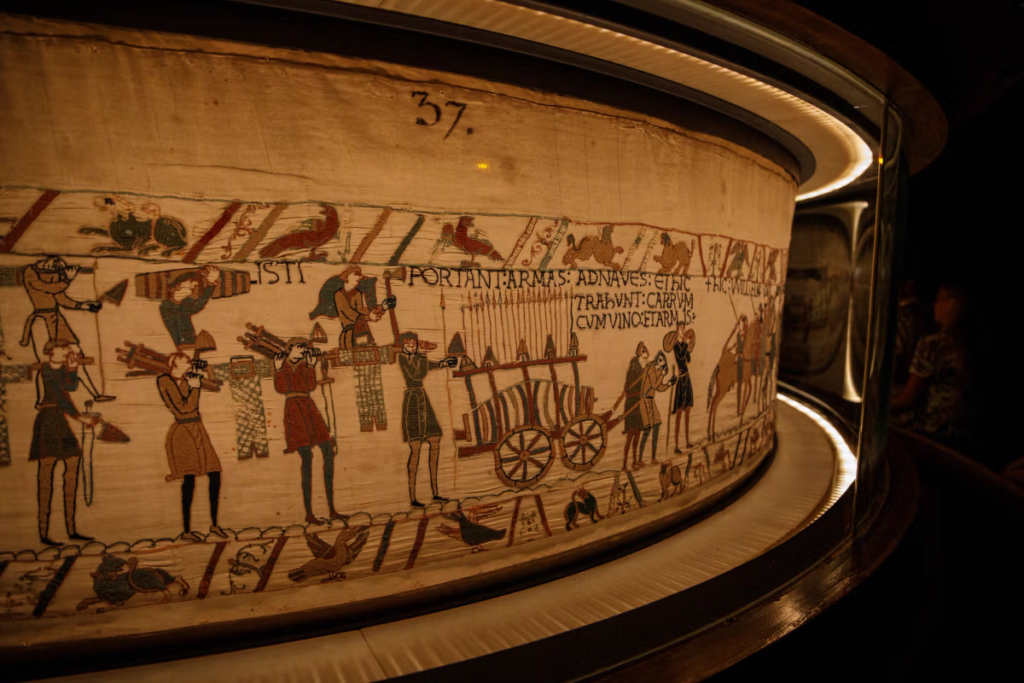
The Bayeux Tapestry is valuable partly because it preserves details of the 11th century that written chronicles cannot show in the same way.
Ships are loaded. Horses are transported across the Channel. Warriors carry shields and weapons. Men feast. Buildings rise in the background. Halley’s Comet appears overhead. Borders above and below the central narrative fill with animals, mythical creatures and occasionally violent or enigmatic scenes.
It provides historians with evidence about clothing, armour, naval technology, architecture and elite life.
But it should not be mistaken for neutral reportage. The work was created in a political world shaped by the Norman victory and has often been interpreted as presenting William’s claim to the English throne in a favourable light.
At the same time, its message is more complicated than straightforward triumphal propaganda. Harold is not depicted throughout as a caricatured villain, and generations of scholars have debated whether some scenes contain sympathy for the defeated English or deliberate ambiguity.
That uncertainty has helped keep the tapestry intellectually alive.
Nearly a thousand years after its creation, historians still disagree about exactly who commissioned it, who designed it, where every section was made, and how audiences in the 11th century would have interpreted its political message.
From Hastings to the British Museum
The tapestry has spent most of its known history in Bayeux in Normandy. Its documented existence stretches back centuries, and it survived periods in which its future was far from secure.
During the French Revolution, it reportedly came close to being used as practical material before being recognised and preserved.
Napoleon had it transferred to Paris in 1803, at a time when France was preparing for the possibility of invading Britain. The historic image of a successful cross-Channel invasion carried obvious contemporary relevance.
It moved again during the German occupation of France in the Second World War.
Those journeys were exceptional.
Le Monde reports that before the current British loan, the tapestry had left its Norman home only twice in more than a thousand years: under Napoleon and during the Nazi occupation.
That history helps explain why moving it to London generated such anxiety.
The loan triggered a serious conservation dispute
When Macron announced that France would lend the Bayeux Tapestry to Britain, the response from parts of the conservation world was not celebratory.
The object is extremely fragile.
A detailed assessment cited by Le Monde recorded 24,000 stains, more than 16,000 creases, close to 10,000 other alterations and around 30 tears. Earlier expert reports had warned against transporting it. A petition opposing the British loan attracted more than 78,000 signatures.
The central question was straightforward: was the symbolic importance of the loan worth taking even a small risk with an irreplaceable work approaching its thousandth year? French authorities commissioned further technical analysis.
The eventual transport plan was unusually elaborate. Specialists studied vibration, temperature, humidity and the physical stresses that could affect the embroidery. A climate-controlled protective system was developed, trial journeys were undertaken, and even problematic sections of road between Normandy and London were studied.
The transport container was engineered to limit vibration and maintain conditions of around 20C and 50% relative humidity. Specialists concluded that the journey could be made safely.
The tapestry arrived in London in July, where British and French conservators began another detailed condition assessment before installation.
The debate, however, remains part of the exhibition’s story.
Its presence in London demonstrates both how sophisticated modern conservation has become and how difficult museums still find the question of when an object is simply too important, or too vulnerable, to travel.
King Charles and Macron turn medieval history into modern diplomacy
The symbolism of Charles and Macron viewing the tapestry together is difficult to miss.
The object records a French-speaking Norman duke crossing the Channel, defeating an English king and taking his crown.
Almost 960 years later, the British monarch and French president walked its length together as representatives of two states trying to emphasise partnership rather than rivalry.
Charles described the loan as representing a renewed spirit of friendship between Britain and France, while Macron placed it within the two countries’ long and intertwined history. The September 2 preview was also attended by Queen Camilla, Brigitte Macron and British Prime Minister Andy Burnham.
The diplomatic context is important.
Relations between London and Paris went through years of strain after Brexit, particularly over migration, fishing rights, defence and Britain’s changing relationship with the European Union.
Cultural exchange offers a less confrontational language for rebuilding relations.
In this case, both sides have chosen objects carrying unusually powerful ideas of nationhood.
France gets Sutton Hoo in return
The Bayeux loan is not a one-way gesture. Britain will send major early medieval objects to France, including material from the Sutton Hoo treasure and the Lewis Chessmen. The exchange was formalised through an agreement between the two governments.
The choice of Sutton Hoo is particularly intelligent. Excavated in Suffolk in 1939, Sutton Hoo’s spectacular seventh-century ship burial transformed understanding of Anglo-Saxon England before the Norman Conquest.
Putting Sutton Hoo in dialogue with the Bayeux Tapestry effectively allows Britain and France to exchange two different visions of medieval England.
One represents the sophisticated Anglo-Saxon world that existed before 1066.
The other records the event that destroyed much of its ruling order.
Together, the loans turn a diplomatic agreement into a conversation about the period before and after one of Europe’s great political ruptures.
Demand for the British Museum exhibition has been exceptional
Public interest suggests the history still has extraordinary reach. The British Museum exhibition opens on September 10, 2026, and is scheduled to run until July 2027 in the Sainsbury Exhibitions Gallery.
Reuters reported before the opening that ticket sales had already generated about £2.5 million, making it the British Museum’s best-selling exhibition at that stage.
Le Monde reported that around 80,000 people entered the online queue when tickets became available, while the museum expects the exhibition could eventually draw around one million visitors. Part of the attraction is rarity.
The Bayeux Tapestry is familiar to generations who encountered fragments of it in textbooks, documentaries and history classrooms. But reproductions radically alter the experience of the object.
Its scale is fundamental to how it works. The viewer follows the narrative horizontally, almost as if moving through a sequence of frames.
Armies gather over metres rather than centimetres. Ships stretch across the cloth. The story accumulates through movement. Seeing individual scenes reproduced on a page gives little sense of that physical rhythm.
How the Norman Conquest Changed England Forever
The exhibition’s appeal also rests on the unusual hold that one year continues to have on British historical memory.
The Norman Conquest altered who controlled England’s land, government and church. Norman elites replaced much of the Anglo-Saxon aristocracy. French and Latin reshaped the language of administration and power. Castle building expanded dramatically. England became more closely entangled with political struggles across continental Europe. Its linguistic consequences remain visible in modern English.
Words derived from French entered law, government, aristocratic life, and cuisine, often existing alongside words inherited from Old English.
The conquest did not instantly produce the England that exists today, but it redirected the country’s development in ways that remained visible for centuries.
The Bayeux Tapestry makes that transformation tangible because it comes from close to the moment itself.
It is not a modern reconstruction of medieval history. It is one of the objects through which that history was first interpreted.
An object claimed by two histories
There is an appealing contradiction at the centre of the Bayeux Tapestry British Museum exhibition.
The work celebrates, or at least records, the defeat of Anglo-Saxon England. Yet it is likely the product of English craftsmanship.
France has protected it for centuries, yet the events it depicts are central to British national history. Its protagonists fought over sovereignty, but the object now travels under a diplomatic agreement intended to demonstrate cooperation.
That makes its return more interesting than the language of a conventional blockbuster exhibition suggests. It is not simply a famous medieval artwork visiting London.
It is an object whose identity has always depended on the Channel between England and France: crossed by Harold, crossed by William’s invasion fleet, and now crossed again under climate control and extraordinary security.
The first journey ended in conquest. Nearly a millennium later, the latest has been arranged as an exchange.
Don’t forget to follow us on Facebook | Instagram | Twitter | LinkedIn to get the latest updates from Cape Town Tribune