


Gen Z is spending more time offline, but not by abandoning technology altogether. Across social media and lifestyle platforms, young people are showing renewed interest in analog hobbies such as knitting, journaling, scrapbooking, film photography, pottery, flower pressing, and puzzles. Many of these activities have existed for generations, but they are now being rediscovered by people looking for a break from constant scrolling.
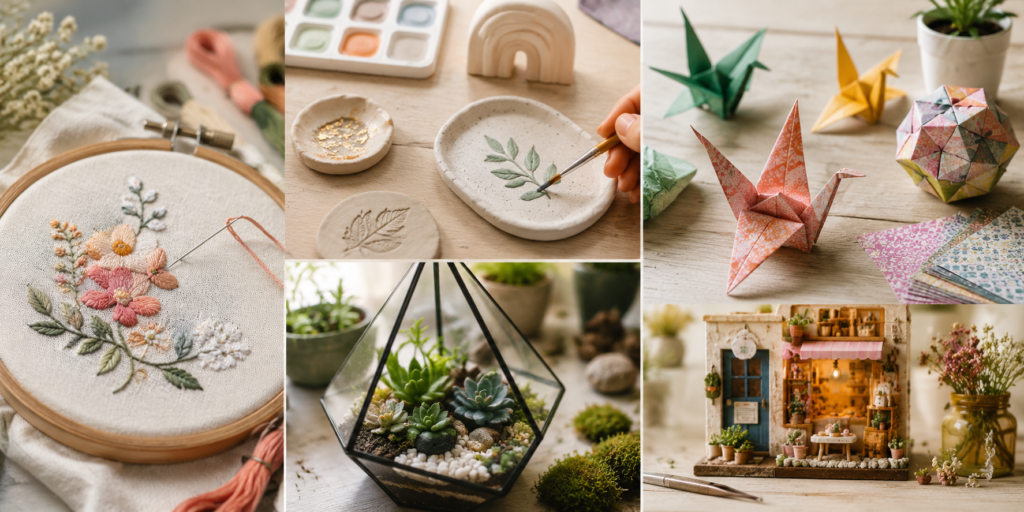
Pinterest’s 2026 Hobbies Trend Report points to growing interest in hands-on, screen-free activities. The platform says 51% of Gen Z respondents associate having a hobby with joy, while searches for activities including embroidery, clay crafts, miniatures, and other physical projects have increased significantly.
The trend is also visible beyond Pinterest.
Young people are joining craft groups, buying film cameras, carrying books instead of relying entirely on phones for entertainment, and attending in-person hobby clubs.
The shift does not mean Gen Z is rejecting digital life. It suggests that many young people are trying to create more balance between online and offline time.
Why analog hobbies are becoming popular again
The attraction is relatively simple. Many digital platforms are designed to keep users engaged for as long as possible.
Social feeds do not have a natural stopping point, and notifications can make it difficult to concentrate on one activity for long.
Analog hobbies work differently. A person can finish a crossword, complete a knitting project, develop a roll of film, or fill a page in a journal.
These activities require attention, but they also provide a clear sense of progress.
That sense of completion may be one reason these hobbies are becoming more appealing.
Pinterest’s latest data shows rising searches for activities including hand embroidery, air-dry clay crafts, origami, terrariums and miniatures.
The trend is broad, but the common theme is clear: people want activities that involve making, learning or doing something away from a screen.
The rise of the ‘analog bag’
One of the most visible parts of the trend is the so-called analog bag.
The idea is simple. Instead of relying on a phone during spare moments, people carry physical alternatives such as books, notebooks, crossword puzzles, sketchpads, knitting supplies or watercolours.
The goal is not to give up smartphones. It is to make it easier to choose something else.
Fast Company recently reported on the growing popularity of analog bags among Gen Z, describing them as a practical response to the habit of reaching for a phone whenever there are a few minutes of free time.
For many people, that might mean reading on a train instead of opening TikTok, or writing in a notebook while waiting for a friend instead of checking notifications.
The trend is also being discussed in countries including India and across the Middle East, where young people are experimenting with more screen-free activities.
Traditional hobbies are attracting younger audiences
Another part of the movement involves hobbies that were once associated more strongly with older generations.
Knitting, crochet, needlepoint, birdwatching, board games and mahjong are all attracting younger participants.
Associated Press reporting has highlighted young adults taking up activities including needlepoint, poetry, blacksmithing and mahjong, often describing them as a way to focus, socialise or spend time without constantly checking a phone.
These hobbies are sometimes described online as “grandma hobbies”, but that label is becoming less relevant as younger people make them part of contemporary lifestyle culture.
The appeal may have less to do with nostalgia and more to do with the structure these activities provide.
They are slow, practical, and often social. They also offer a clear contrast to passive digital entertainment.
Film photography is part of the same shift
The revival of film photography is one of the clearest examples of the broader analog lifestyle trend.
Smartphones allow people to take unlimited photographs instantly, yet younger consumers are increasingly experimenting with disposable cameras and traditional film.
That may appear counterintuitive.
Film is slower, more expensive, and less convenient. Users cannot immediately see whether a photograph has turned out well, and every roll contains a limited number of images.
But those limitations are part of the attraction. Some younger photographers say film encourages them to think more carefully before taking a picture and makes photography feel less connected to the pressure of immediately posting online.
Fujifilm has also noted renewed interest among younger consumers in disposable cameras.
For people who have grown up with digital photography, film can feel less like an outdated technology and more like a different experience.
This is not simply nostalgia
It would be easy to describe the entire trend as nostalgia, but that does not fully explain it.
Many Gen Z consumers are too young to remember film cameras, CDs, or pre-smartphone life as the norm.
For them, analog products may feel new. A paper journal, physical magazine or cassette player can offer a simpler experience because it performs one clear function.
That is different from a smartphone, which can act as a camera, television, workplace, newspaper, bank, shopping platform and social network at the same time.
This may help explain why older formats are becoming attractive to younger consumers.
YPulse has also identified growing interest in physical media, vintage technology and offline activities across North America and Western Europe.
The trend suggests that some young people are looking for experiences that feel less connected to algorithms and notifications.
Screen fatigue is helping drive the trend
The rise of screen-free hobbies is also closely linked to growing frustration with constant digital use.
Research continues to examine the relationship between heavy screen use and issues including sleep, stress, concentration and mental wellbeing.
At the same time, digital detoxes and screen-time limits have become common topics across lifestyle and wellness media.
However, most people participating in the analog trend are not trying to stop using technology completely.
Instead, they are looking for practical ways to reduce unnecessary screen time.
A hobby can make that easier. Someone who spends an hour painting, cooking, knitting, or reading is not simply avoiding a phone. They are replacing that time with another activity.
That can be more realistic than trying to rely on willpower alone.
Social media is also helping analog hobbies grow
There is an obvious contradiction in the trend.
Many people discover analog hobbies through social media.
TikTok videos introduce users to film cameras. Pinterest provides journaling ideas. Instagram helps people find local pottery classes or craft groups.
The same platforms that contribute to screen fatigue are also helping people discover activities that take them offline.
That does not necessarily weaken the trend. It shows that digital platforms are becoming tools for finding offline experiences.
For some users, the important change is not using less technology in every part of life. It is deciding when technology is useful and when it becomes unnecessary.
Offline hobbies can also help people socialise
The popularity of analog hobbies is also connected to growing interest in in-person social activities.
Book clubs, pottery classes, craft groups, photography walks and board-game nights give people structured ways to meet others.
That structure can make socialising easier.
Instead of meeting simply to talk, participants have a shared activity.
This overlaps with renewed interest in “third places”, or social spaces outside home and work where people can spend time with others without a formal purpose.
Hobby groups can fill that role. For younger people who are tired of socialising mainly through apps, these activities offer another option.
Brands are beginning to respond
The commercial opportunity is also becoming clear. Companies are selling more craft kits, journals, stationery, film cameras, vinyl records and other products associated with analog living.
Brands are also organising phone-free events and in-person experiences aimed at younger consumers.
YPulse has described Gen Z’s interest in analog experiences as a growing opportunity for companies working in physical media, workshops and offline events.
However, the trend does not have to involve expensive products.
Reading a library book, writing with pen and paper, cooking, walking, gardening or playing cards can all provide the same kind of screen-free experience.
That may be one reason the trend has broad appeal.
Gen Z is not rejecting technology
The rise of analog hobbies in 2026 should not be understood as a rejection of modern technology. Gen Z remains one of the most digitally connected generations.
The more important shift is that some young people appear to be setting clearer boundaries around how much time they want to spend online.
Analog hobbies provide a practical way to do that. They offer activities with a clear purpose, visible progress and a natural stopping point.
For a generation that has grown up with endless feeds and constant notifications, that simplicity may be enough to explain why older hobbies are becoming popular again.
The smartphone is still central to everyday life. But it no longer has to fill every spare minute.
Don’t forget to follow us on Facebook | Instagram | Twitter | LinkedIn to get the latest updates from Cape Town Tribune