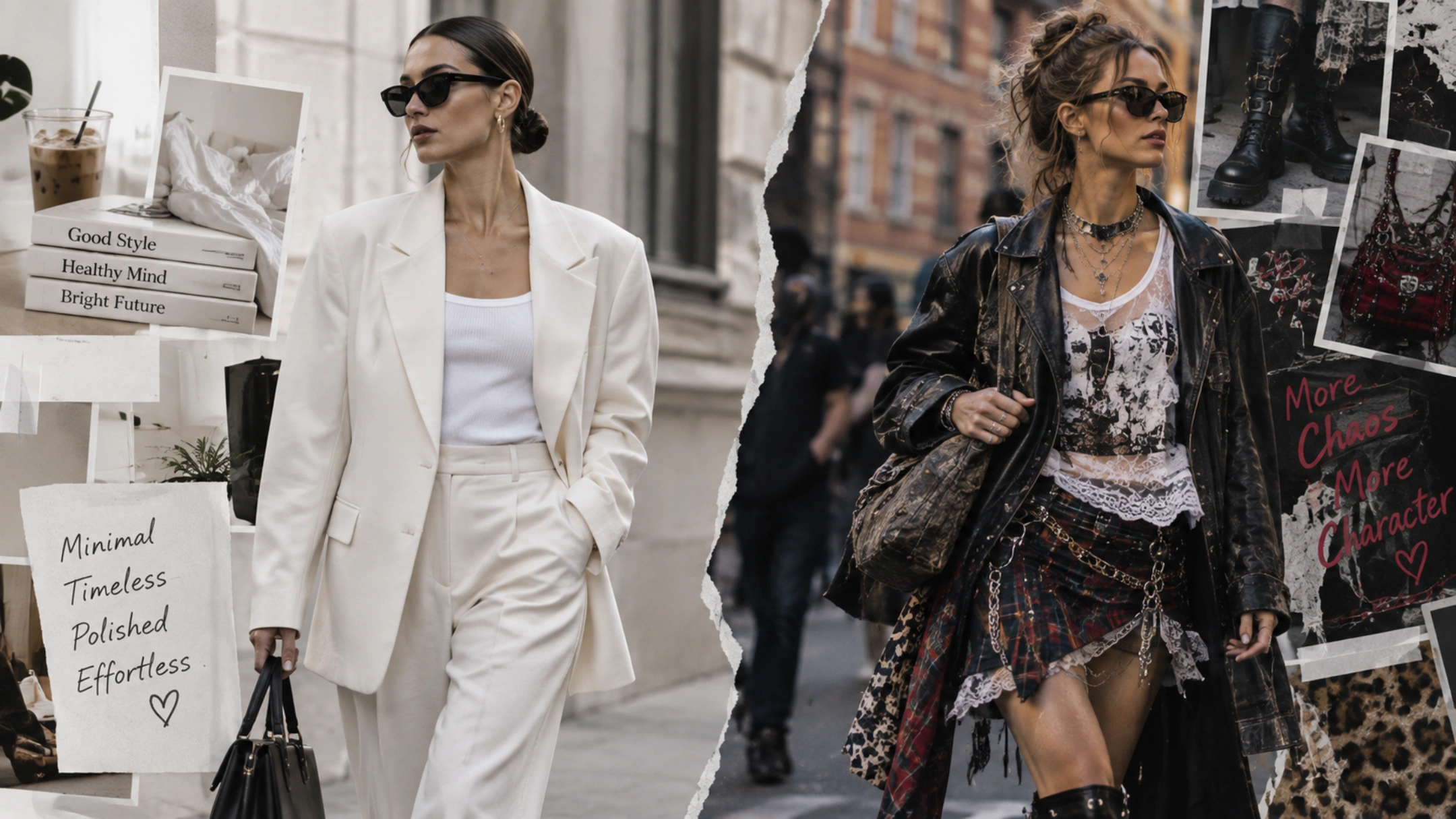
For several years, looking fashionable often meant looking as though very little effort had gone into the process. Hair was pulled into a precise bun. Skin appeared glossy but almost bare. Gold jewellery was delicate.
Clothes came in cream, black, grey and beige. Handbags were discreet, tailoring was restrained, and every part of the outfit seemed to understand the assignment: do not attract too much attention.
The clean girl aesthetic became one of the defining visual languages of the early 2020s. It moved from TikTok beauty videos into wardrobes, luxury fashion, celebrity dressing, and eventually the wider culture of “quiet luxury”.
Now, fashion appears to be growing restless. The signs are increasingly difficult to miss. Recent runway collections have introduced richer textures, unusual proportions and more visible decoration.
Fall 2026 accessories include brooches, charms, oversized jewellery, colourful shoes and fuzzy bags. New York Fashion Week street style has featured clashing prints, unexpected colour combinations and styling that looks deliberately less uniform.
Vogue’s early predictions for spring and summer 2027 go further, describing a turn toward what it calls “messy girl” dressing, where personality matters more than polish. The clean girl may not have disappeared. But fashion is beginning to look considerably less interested in behaving perfectly.
How the clean girl aesthetic became so powerful
The clean girl aesthetic was easy to recognise because its rules were unusually consistent.
Think slicked-back hair, natural-looking makeup, groomed brows, neutral clothes, simple jewellery, pristine trainers, structured coats and an overall impression of controlled effortlessness. Its success made sense.
During a period of intense online noise, the aesthetic offered visual calm. It translated easily across TikTok, Instagram and Pinterest because its ingredients were instantly identifiable. It also worked at different price points. A luxury cashmere coat and a basic white T-shirt could both belong to the same visual world.
The rise of quiet luxury strengthened that appeal. Logos became less important than fabric, cut, and restraint. Neutrals suggested sophistication. Fashion began celebrating wardrobes built around pieces designed to look timeless rather than obviously fashionable.
Beauty followed similar rules. Dewy skin, lip oils, subtle blush and carefully brushed brows promised the appearance of effort without visible excess. But an aesthetic can become successful enough to create the conditions for its own decline.
When millions of people begin using the same colour palette, hairstyle, beauty routine and wardrobe formula, something intended to look effortless can start to look highly standardised. In 2026, fashion’s response to that uniformity is becoming clearer.
Fashion is moving from perfection toward personality
Vogue’s fall 2026 trend report describes a season moving beyond years of understated dressing and toward a more expressive approach. Designers are combining relatively practical clothes with dramatic volume, unusual detail and richer surfaces. Retail buyers are noticing the same change.
In Vogue’s September survey of leading fashion retailers, buyers pointed toward layered styling, plum and chartreuse, animal prints, embellished footwear, dramatic outerwear, vintage-inspired pieces and highly visible accessories as some of the important purchases for fall. Moda Operandi, Bergdorf Goodman, Saks Fifth Avenue, Nordstrom and others all identified products with character rather than anonymous basics.
Business of Fashion has described a related shift from “quiet luxury” toward louder forms of luxury, with feathers, shearling, beading, lace, fringe and tactile materials returning to prominence. Shoppers who already own good basics are increasingly looking for something that adds visible interest.
Fashion is not necessarily throwing away the well-cut blazer, straight trousers or simple white shirt. Instead, it is changing what gets worn with them.
A plain outfit might now acquire a sculptural belt, enormous earrings, a leopard-print shoe or a brightly coloured bag. A traditional coat can be paired with a scarf worn in an unexpected way. A simple dress can become the base for layers of necklaces or a deliberately oversized brooch.
The foundation may remain clean. The personality is being added back.
Accessories are becoming fashion’s easiest rebellion
Perhaps nowhere is the shift clearer than in accessories. For fall 2026, Vogue identified Western belts, silk scarves, brooches, charms and other small details as important ways to personalise clothing.
Another Vogue accessories report highlighted fuzzy handbags, unusual pearls and brightly coloured shoes.
ELLE has similarly noted the growing appeal of expressive accessories, from novelty handbags to highly decorated shoes. Retailers told the publication that consumers who already own dependable wardrobe staples are showing greater interest in purchases with colour, texture or some distinctive point of interest.
Statement earrings have also returned in exaggerated forms. Saint Laurent’s fall 2026 collection, for example, looked back toward the scale and drama of jewellery from earlier decades, including large clip-ons and heavily embellished pieces.
This is an important change because accessories offer a relatively simple way to reject aesthetic uniformity.
Someone does not need to replace an entire wardrobe to move beyond clean-girl dressing. One unusual bag, dramatic necklace or pair of patterned shoes can interrupt an otherwise restrained outfit.
That may explain why maximalism is returning gradually rather than as a complete rejection of minimalism.
Prints and colour are becoming less polite
The return of print is another clue. Animal patterns have moved beyond being occasional accents. Current autumn styling includes mixed animal prints, vividly coloured versions and full statement pieces.
Polka dots have also returned after seasons in which minimalist shirts and uncomplicated separates dominated wardrobes. Street style is pushing the idea further.
Recent New York Fashion Week photographs show attendees combining geometric stripes with floral skirts, mixing bright colours and using accessories to make otherwise familiar clothes more personal. Minimal outfits are still present, but they now exist beside much more assertive combinations.
The point is not that every outfit is suddenly maximalist. What has changed is the tolerance for friction.
For much of the clean-girl period, coordination was part of the appeal. Everything was designed to belong together. The emerging mood allows pieces to disagree.
A floral skirt can meet a striped shirt. Brown can sit beside orange. A vintage brooch can appear on an ordinary jacket. An intentionally awkward shoe can finish an elegant dress.
The resulting outfit may be less immediately “perfect”, but it can reveal more about the person wearing it.
Beauty is becoming less controlled too
The same movement is visible above the neckline. Business of Fashion reported earlier this year that although clean-girl beauty continues to sell strongly, consumers, particularly younger shoppers, are becoming more interested in personalised and expressive makeup.
Precision products including lip liner and liquid shadow are gaining attention as people experiment with more individual looks.
Vogue has documented the return of blue eyeshadow, graphic eyeliner and softer, smudged eye makeup as alternatives to the barely-there beauty that dominated social media for years. Makeup artists have described the shift as a reaction to clean-girl beauty’s long period of influence.
Even when makeup remains subtle, perfection is becoming less important.
One of 2026’s emerging beauty directions has been blurred makeup: diffused lips, soft-focus blush, and finishes that look less sharply controlled.
Vogue has positioned the look as a contrast with clean-girl makeup, which often depended on precise application despite appearing effortless. The new beauty mood is not necessarily louder. It is simply more comfortable, looking human.
The algorithm may be part of the problem
The clean-girl aesthetic did not spread through fashion magazines alone. It flourished inside algorithmic culture.
Platforms reward recognisable visual codes. A user understands “clean girl”, “old money”, “coastal grandmother” or “mob wife” almost immediately because each aesthetic arrives with its own colours, products and references.
That efficiency is useful for algorithms and brands. It can be exhausting for people.
ELLE recently examined a growing interest in developing personal style away from recommendation feeds. Stylists and fashion writers interviewed by the publication argued that genuine style develops gradually through experience, culture, travel, relationships and experimentation rather than through copying a complete outfit formula online.
There are signs of wider digital fatigue as well. ELLE cited a 2025 Harris Poll in which 81% of respondents said they wished it were easier to disconnect from their devices, while 72% said print magazines felt more authentic.
Vogue has linked nostalgia for 2016 to a similar desire for something that feels less polished and less machine-generated. Its analysis of the revival described growing interest in messy styling, unedited content and the “aesthetic chaos” of an earlier social-media era.
Fashion’s turn toward imperfection may therefore be about more than clothes. It could also be a reaction to life inside feeds where everything increasingly looks optimised.
Why nostalgia is helping fashion become messier
Fashion rarely moves forward without looking backward. The latest rejection of minimalism borrows heavily from earlier decades. Large jewellery recalls the 1980s.
Smudged makeup and irreverent styling recall the 1990s and 2010s. Animal prints, capri trousers, vintage bags and highly decorated accessories have all returned in new combinations.
But nostalgia in 2026 is not necessarily about recreating a specific decade perfectly. It is often about recovering the freedom associated with less controlled dressing.
That is why Vogue’s spring 2027 forecast includes clashing colours and prints alongside romantic sheer clothing, peplums, strong orange and practical “gardening-core” references. These trends have little in common visually, which is precisely the point.
Fashion is moving away from one dominant uniform toward several competing ideas.
But the clean girl is not actually dead
Declaring the clean girl dead would make for a neat headline. It would also oversimplify what is happening. Minimalism remains commercially powerful.
Clean manicures are still appearing on red carpets. Neutral wardrobes remain useful. Quietly luxurious clothing continues to attract consumers.
Rihanna, one of fashion’s most committed maximalists, can still make a restrained blazer-and-jeans combination relevant precisely because clean dressing remains part of the contemporary vocabulary.
The more accurate description is that clean-girl dressing has lost its monopoly.
For several years, minimalism operated almost like a default setting. Dressing loudly could look deliberately countercultural. Now the balance is changing.
A minimalist can remain minimalist. But the pressure to make every wardrobe look similarly polished is weakening.
Personal style may be fashion’s real next trend
The most interesting development may be that fashion is becoming harder to reduce to a single aesthetic.
That could be healthy.
An industry built on constant trend cycles will always attempt to name whatever comes next. “Messy girl”, “whimsymaxxing” and other labels will inevitably appear. Some will disappear as quickly as they arrived.
Yet the strongest current signal is not one particular skirt, colour or shoe.
It is permission. Permission to mix inexpensive and expensive clothes. Permission to repeat old pieces. Permission to wear something unfashionable because it feels personal. Permission to combine styles that supposedly belong to different aesthetics. Permission, perhaps, to stop dressing like an algorithm has already decided what good taste looks like.
The clean girl aesthetic succeeded because it promised simplicity at a complicated moment. Its possible decline reflects a different desire.
After years of optimisation, restraint and visual perfection, fashion appears ready to become more emotional, tactile and individual again. The clean girl is unlikely to vanish. She may simply have to share the room with people who are louder, stranger and considerably less interested in matching.
Don’t forget to follow us on Facebook | Instagram | Twitter | LinkedIn to get the latest updates from Cape Town Tribune