Houthi attack on Saudi Aramco headquarters in Dhahran has damaged offices used by the company’s senior executives, marking a serious escalation in the renewed conflict between Saudi Arabia and Yemen’s Iran-aligned Houthi movement.
The attack struck the headquarters complex in eastern Saudi Arabia on Tuesday night, October 13. Saudi authorities confirmed that the strike caused a fire, while people familiar with the damage told Reuters that flames spread across several floors of an administrative building. Officials reported no casualties.
The Houthis subsequently threatened additional attacks on Saudi airports and oil infrastructure, raising concerns about the security of the kingdom’s energy industry and the potential consequences for international markets.
The strike comes amid renewed fighting in Yemen and wider regional tensions linked to the confrontation between Iran and the United States. Saudi Arabia has also faced a series of missile and drone attacks in recent days, including a deadly assault on Riyadh’s international airport.
Although Aramco has continued its operations, the attack has highlighted the vulnerability of facilities central to Saudi Arabia’s economy and its role in global energy markets.
Houthi Attack on Saudi Aramco Headquarters Causes Extensive Damage
Saudi Arabia’s Energy Ministry acknowledged the attack on the Dhahran complex but described the resulting fire as limited.
Reuters, however, cited three people with direct knowledge of the incident who described substantially greater damage.

According to those accounts, the fire began on the ninth floor of an office building’s southern wing and spread between the sixth and tenth floors. The flames damaged rooms used by senior executives, including areas near the office of Aramco chief executive Amin Nasser.
Sources also described collapsed sections of ceiling, shattered windows and damaged doors.
The Associated Press separately reported that the strike damaged the upper floors of a building housing executive offices.
Saudi authorities reported no deaths or injuries at the complex.
Despite the physical damage, Aramco continued its operations. Some employees began working remotely, while the company transferred certain functions to offices elsewhere.
The Dhahran headquarters houses an operations centre that helps oversee the company’s oilfields, refineries, pipelines and export facilities.
The available reporting does not establish that the attack disrupted crude oil production or exports. Nevertheless, its location has attracted particular attention because the headquarters plays an important role in coordinating Aramco’s extensive energy operations.
Houthis Threaten Further Strikes on Saudi Airports and Oil Facilities
Following the attack, the Houthi movement announced that it would continue targeting Saudi infrastructure.
The group identified airports and oil facilities as potential targets and urged civilians and foreign companies to avoid areas it considers militarily significant.
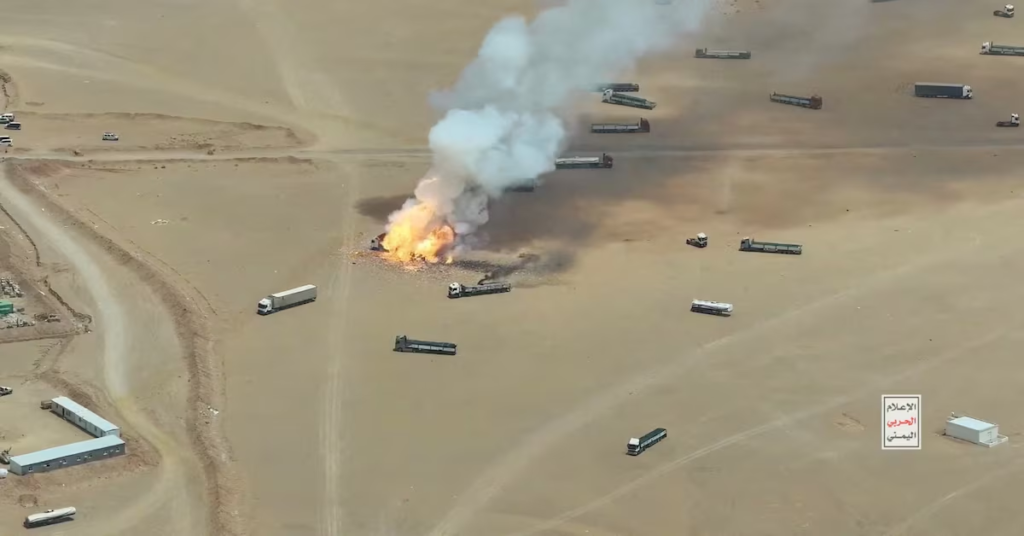
Houthi officials described the campaign as retaliation for Saudi military operations in Yemen.
Saudi Arabia has carried out strikes against Houthi-controlled facilities, including oil depots and other infrastructure that Riyadh considers important to the group’s military capabilities.
The exchange of attacks has intensified a conflict that had experienced a prolonged reduction in hostilities following a United Nations-brokered truce in 2022.
The latest confrontation has also demonstrated the Houthis’ ability to strike prominent Saudi targets using missiles and drones.
The group’s warnings have created additional concerns for civilian aviation and businesses operating in the kingdom.
International companies must now consider not only the possibility of physical damage but also the operational consequences of disrupted transport networks, emergency restrictions and heightened security measures.
Riyadh Airport Attack Adds to Saudi Arabia’s Security Concerns
The strike on Aramco’s headquarters followed a deadly attack on King Khalid International Airport in Riyadh.
The October 10 assault killed 13 people and injured hundreds, according to reporting from Reuters and the Associated Press.
The attack disrupted airport operations and forced airlines to cancel or divert flights, affecting international travel through one of Saudi Arabia’s principal aviation hubs.
Further missile and drone alerts have increased pressure on the kingdom’s air-defence systems.
Saudi forces have intercepted several incoming threats, although recent attacks demonstrate that defensive measures cannot eliminate every risk.
The disruption carries economic significance beyond the immediate security emergency.
Saudi Arabia has invested heavily in aviation, tourism and international business as part of Crown Prince Mohammed bin Salman’s Vision 2030 programme, which seeks to diversify the economy beyond oil.
Repeated attacks on airports and major commercial facilities could complicate those ambitions by increasing operating costs and weakening confidence in the security of critical infrastructure.
The extent of any long-term economic consequences will depend on the duration and intensity of the renewed fighting.
Why the Saudi Aramco Attack Matters to Global Oil Markets
Saudi Aramco occupies an important position in international energy markets as one of the world’s largest oil producers and exporters.
Its facilities support a vast network of oil production, refining, transportation and distribution operations.
A prolonged disruption to Saudi energy supplies could affect prices worldwide, particularly in countries that depend heavily on imported crude oil.
The latest attack has not produced confirmed evidence of a significant interruption to Aramco’s production.
However, oil markets respond not only to actual supply losses but also to the possibility of future disruptions.
Traders must assess whether attacks could extend from administrative buildings to production facilities, export terminals or pipelines.
The risks have increased as military activity continues around the Strait of Hormuz, a strategically important waterway connecting the Persian Gulf with international shipping routes.
Before the current regional conflict, approximately one-fifth of global petroleum liquids consumption passed through the strait.
Continued attacks on commercial vessels and uncertainty surrounding Gulf shipping have increased concerns about freight costs, insurance premiums and the reliability of energy deliveries.
Oil prices have consequently remained sensitive to military and diplomatic developments.
A sustained increase in crude prices could raise transport and manufacturing costs and contribute to inflation in energy-importing economies.
For Saudi Arabia, the immediate challenge involves protecting its infrastructure while preventing further escalation from undermining regional energy security.
Renewed Saudi-Houthi Fighting Threatens Yemen’s Fragile Stability
The conflict between Saudi Arabia and the Houthis forms part of Yemen’s prolonged civil war, which has devastated the country’s economy and humanitarian infrastructure.
The Houthis control the capital, Sanaa, and substantial territory in northern Yemen. Saudi Arabia supports Yemen’s internationally recognised government and has conducted military operations against the movement.
The 2022 truce substantially reduced fighting, although it did not produce a comprehensive political settlement.
Recent military operations have reversed some of those improvements.
Fighting has intensified around several contested areas, including Marib and Taiz, while airstrikes and missile attacks have increased the danger to civilians.
Humanitarian organisations report growing pressure on hospitals and difficulties delivering essential supplies.
The World Food Programme has warned that renewed hostilities have interrupted assistance to more than 600,000 people in parts of Taiz.
Communities already struggling with economic hardship now face additional difficulties obtaining food, fuel and medical treatment.
The fighting has also affected schools and local transport, creating further disruption for families who have endured years of instability.
The consequences inside Yemen remain central to understanding the wider conflict. Military escalation across the Saudi border does not occur separately from the humanitarian emergency affecting Yemen’s population.
Regional Diplomacy Faces Another Test
The renewed confrontation has complicated diplomatic efforts to secure a lasting agreement between Saudi Arabia and the Houthi movement.
Regional and international mediators have continued encouraging both sides to reduce hostilities.
Oman has played an important diplomatic role in previous negotiations, while other governments have supported efforts to prevent the fighting from expanding.
Houthi representatives have indicated that they remain open to ceasefire discussions, even as the movement threatens further attacks.
The conflicting signals leave considerable uncertainty about whether negotiations can produce an immediate reduction in violence.
Saudi Arabia must also consider its wider strategic interests, including relations with the United States, Iran and neighbouring Gulf states.
The kingdom has sought to strengthen its economic position and attract international investment while managing security threats along its southern border.
The latest attacks have placed those priorities under renewed pressure.
For international governments, the concern extends beyond the Saudi-Houthi confrontation. Further escalation could complicate efforts to reduce regional tensions and protect commercial shipping.
Saudi Arabia Faces Growing Pressure to Prevent Further Escalation
The immediate consequences of the Aramco headquarters attack remain limited by the absence of reported casualties and the company’s ability to maintain operations.
Nevertheless, the damage demonstrates that the Houthis retain the capability to strike prominent targets deep inside Saudi territory.
Their threats against additional airports and energy facilities have increased the pressure on Riyadh to strengthen defensive measures while assessing its military and diplomatic options.
The risk of further attacks remains significant as both sides continue exchanging warnings and military strikes.
For global energy markets, the central question is whether the confrontation will remain focused on selected facilities or expand into attacks that materially disrupt oil production and exports.
For Yemen’s civilian population, the immediate concern is more direct: renewed warfare threatens to deepen an already severe humanitarian crisis.
The destruction at Aramco’s headquarters has not halted Saudi oil operations. It has, however, exposed the security challenges facing the kingdom as the conflict with the Houthis intensifies.
Whether the latest escalation develops into a broader regional confrontation will depend on the decisions taken by Riyadh, the Houthi leadership and the governments seeking to influence events across the Gulf.
Don’t forget to follow us on Facebook | Instagram | Twitter | LinkedIn to get the latest updates from Cape Town Tribune