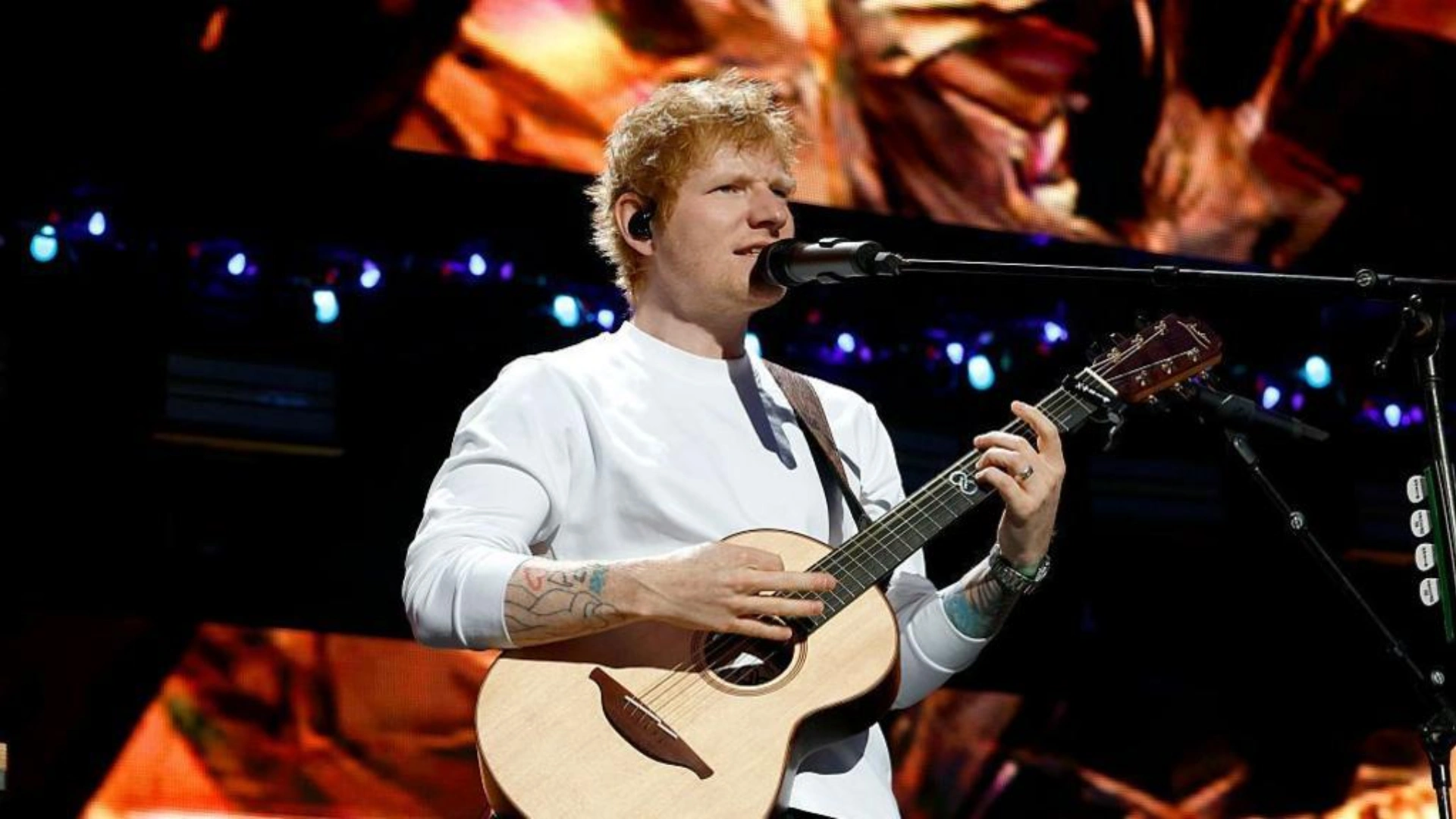

What began as a political statement during an opening set at an Ed Sheeran concert has developed into one of the most complicated live-music disputes of the year.
Four supporting acts, including Finneas, Lukas Graham, Aaron Rowe and Irish folk group Beoga, have withdrawn from upcoming dates on Sheeran’s Loop Tour following the removal of rapper Macklemore from the U.S. lineup. Macklemore had been scheduled to support Sheeran at eight of the 10 remaining American shows.
The exits have transformed what might have remained a dispute between one performer, a promoter and several venues into a broader argument about artistic expression, commercial pressure and who ultimately controls the stage at a modern stadium concert.
Sheeran has insisted the decision to remove Macklemore was not his. In a statement released Tuesday, the British singer said upcoming venues had objected to Macklemore remaining on the bill following his pro-Palestinian statements during Sheeran’s September concerts at MetLife Stadium in New Jersey.
Sheeran said he held discussions with venue owners, promoters and activists in an unsuccessful attempt to reach a compromise. “Macklemore coming off tour was the promoter’s decision, it was not mine,” Sheeran said.
The controversy is exposing something that audiences rarely have reason to consider: the biggest artist on a concert poster is not necessarily the only person with the power to decide who appears onstage.
How Macklemore’s MetLife performance started the dispute
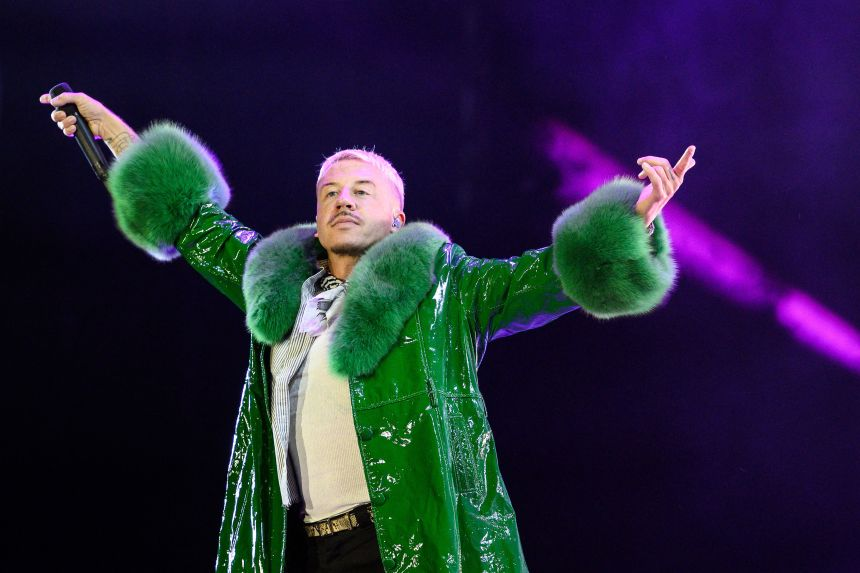
The controversy began during Macklemore’s opening performances at MetLife Stadium on September 4 and 5.
The Seattle rapper, who has publicly supported Palestinian causes for several years, addressed the audience before performing “Hind’s Hall,” his protest song supporting pro-Palestinian demonstrators.
During the set, Macklemore repeatedly called for a “Free Palestine” and said he wanted Palestinians in Gaza and the West Bank to know they had not been forgotten. He also told Jewish audience members that his criticism of Israel was not intended as criticism of Jewish people.
The response was sharply divided. Some fans and activists praised Macklemore for using a stadium platform to speak about Palestinian suffering. Others objected to political advocacy at a concert and accused the rapper of crossing a line between entertainment and activism.
The Israeli American Council subsequently launched a petition seeking his removal from the tour, arguing that audiences attending Sheeran’s concerts had not signed up for a political event.
Macklemore’s remarks also reopened criticism surrounding earlier controversies in his career. Opponents have pointed in particular to a 2014 costume that was widely criticised as invoking an antisemitic stereotype. Macklemore apologised at the time and said he had not intended the costume to represent Jewish people.
Macklemore has rejected accusations that his current advocacy is antisemitic, arguing that criticism of the Israeli government should be distinguished from hostility toward Jewish people. Robert Kraft and other critics have disputed that framing in relation to some of the rapper’s rhetoric and imagery.
Those competing interpretations soon moved beyond social media and into the business of Sheeran’s tour.
The venues become the decisive players
Messina Touring Group, promoter of the U.S. leg of the Loop Tour, said it was informed by upcoming venues that they would not permit concerts to proceed with Macklemore on the lineup.
The promoter said the objections threatened the continuation of shows affecting hundreds of thousands of ticket holders and that, following discussions with stakeholders, Macklemore would no longer perform on the remaining dates.
That account complicates the idea that the controversy is simply a disagreement between Sheeran and Macklemore.
Macklemore said New England Patriots owner Robert Kraft, whose Kraft Group owns Gillette Stadium in Massachusetts, played a central role in the opposition.
Kraft confirmed that he had decided Macklemore would not perform at Gillette Stadium. He said the decision was based on Macklemore’s recent stage material as well as what Kraft described as a broader record of rhetoric and imagery offensive to members of the Jewish community.
Macklemore has alleged that Kraft encouraged other stadium owners to take similar positions. Kraft confirmed his own decision regarding Gillette Stadium, but the extent of his role in decisions at other venues has not been independently established in the same detail.
Sheeran said he personally spoke with Kraft as part of his attempt to find a solution but was unable to change the outcome.
Then the opening acts began leaving
The situation escalated further when Sheeran’s other supporting performers began withdrawing. Finneas, Lukas Graham, Aaron Rowe and Beoga each announced that they would no longer take part in scheduled shows.
Their statements differed in wording but shared a central objection to Macklemore’s removal and expressed support for Palestinian rights or for artists being able to voice political positions. Grammy-winning songwriter and producer Finneas said artists should not be silenced for speaking on behalf of people they believe are being oppressed.
Danish band Lukas Graham framed its withdrawal partly around the influence of wealth and institutional power over public expression. Beoga’s departure is particularly notable because the Northern Irish group has a longstanding musical relationship with Sheeran, appearing on his recordings and performing with him previously.
The withdrawals leave Sheeran confronting a problem that is no longer primarily about Macklemore. The argument now concerns the conditions under which musicians are willing to participate in the tour itself.
Ed Sheeran’s position is more complicated than the headline suggests
Sheeran has attempted to draw a clear boundary between his own political approach and Macklemore’s. He said he was deeply troubled by suffering in the Israel-Palestine conflict but explained that he deliberately avoids turning his concerts into political forums.
His shows, Sheeran said, are intended to provide “unity, joy, escapism” for audiences that include children and people from different political and cultural backgrounds. He also said choosing not to make political statements publicly should not be interpreted as indifference.
At the same time, Sheeran said he respects Macklemore’s determination to advocate publicly for his beliefs. That leaves the singer in an unusually difficult position.
One group of critics is questioning why Macklemore was removed from a tour bearing Sheeran’s name. Another group objected to Macklemore’s political material appearing during those concerts in the first place.
Sheeran’s argument is that neither interpretation accurately reflects the contractual reality: Macklemore’s agreement was with the promoter, and venues had enough leverage to threaten the concerts themselves.
Whether audiences accept that distinction is another question.
Celebrity culture tends to place responsibility for a tour almost entirely on its headline performer. The actual mechanics of stadium touring are much more distributed.
Promoters negotiate the events. Stadium operators control their properties. Artists and support acts work under contracts. Security, insurers, sponsors, local authorities and production companies can all have interests in whether an event proceeds.
The Macklemore dispute has brought that usually invisible structure into public view.
Who really controls a stadium stage?
That may ultimately be the most important entertainment-business question emerging from the controversy.
Modern stadium tours operate at enormous financial scale. Tens of thousands of tickets can be sold for a single evening, while hundreds of crew members, contractors and venue workers can depend on the show going ahead.
A disagreement involving one support act can therefore become a decision involving millions of dollars, contractual obligations and the livelihoods of people who had no role in the original controversy.
Sheeran explicitly pointed to that responsibility in explaining why he would not cancel the broader tour, saying he had obligations to fans, crew members, musicians and other workers.
For Macklemore and the artists who subsequently withdrew, however, the issue is about what happens when those commercial structures determine which political messages are considered acceptable onstage.
The disagreement therefore cannot easily be reduced to one side supporting free expression and another opposing it.
Private venues generally have substantial discretion over speakers and performers on their property. The First Amendment in the United States ordinarily restricts government action rather than requiring private businesses or property owners to provide a platform for speech.
That means the debate here is primarily cultural, contractual and commercial, rather than a straightforward constitutional free-speech case.
The more difficult question for the entertainment industry is what standards venues and promoters should apply when politically outspoken artists are booked for major events.
Political music is hardly new
Musicians using stages to address war, inequality, civil rights and government policy is not a modern invention.
Protest music has been embedded in popular culture for generations. Artists have used concerts to campaign against apartheid, wars, racism and authoritarian governments. Others have deliberately avoided political statements and argued that entertainment should remain a space apart from political conflict.
What has changed is the speed and scale at which individual moments now become global controversies.
A statement delivered to a stadium audience can be recorded, clipped, posted and debated worldwide within minutes. Sponsors, advocacy organisations, venue owners, artists and fans can respond publicly before the tour has moved to its next city.
The stage is therefore no longer confined to the people inside the stadium.
That reality increases pressure on everyone involved. For politically outspoken artists, a concert can offer access to an audience far larger than most traditional activist platforms.
For headliners, that same stage can create reputational consequences for statements they did not make.
For venues and promoters, the issue becomes both commercial and operational: whether keeping an artist on a lineup risks protests, audience backlash, security concerns or cancellation pressure.
And for fans, the fundamental disagreement remains unresolved. Some believe musicians have a responsibility to address major events. Others attend concerts precisely because they want an escape from them.
Neutrality is becoming harder to maintain
Sheeran’s position illustrates another challenge facing globally famous performers.
His stated approach is to keep his concerts politically neutral and welcoming to audiences with different views.
But the current dispute demonstrates how difficult that position becomes once another performer on the same stage decides to speak politically.
Removing that performer can be interpreted as taking a position. Keeping the performer can also be interpreted as taking a position. Saying the decision belongs to promoters or venues may accurately describe the contractual arrangement, but the headline artist remains the public face of the event.
That does not mean Sheeran secretly holds a particular political position. There is no basis for drawing such a conclusion from the tour dispute.
It does show how neutrality can become increasingly difficult to communicate when artists, venues, advocacy groups and audiences expect public responses.
What happens to the Loop Tour now?
Sheeran’s U.S. stadium run is scheduled to resume on September 19 in Philadelphia.
Before Macklemore was removed, the rapper had been due to appear at eight of the final 10 U.S. dates, including shows in Philadelphia, Massachusetts, Georgia, Indiana, North Carolina, Texas and Florida.
The departure of Finneas, Lukas Graham, Aaron Rowe and Beoga has now created additional disruption around the support lineup.
The main Loop Tour is continuing. Yet whatever happens next, the dispute has already moved beyond one rapper being removed from one concert series.
It has exposed the competing layers of power behind major live entertainment.
The artist whose face is on the poster may command the audience. The promoter may hold the contracts. The venue owns the building. Support acts have the option to walk away. Fans hold tickets and expectations. Advocacy groups can exert public pressure. Every participant has some influence, but none necessarily has complete control.
For decades, political expression and popular music have existed side by side.
What the Ed Sheeran and Macklemore controversy reveals is how much more complicated that relationship becomes when a political statement collides with the enormous commercial machinery of a modern stadium tour.
The result is no longer simply a debate over what an artist said onstage. It is a debate over who gets to decide what can be said there at all.
Don’t forget to follow us on Facebook | Instagram | Twitter | LinkedIn to get the latest updates from Cape Town Tribune