
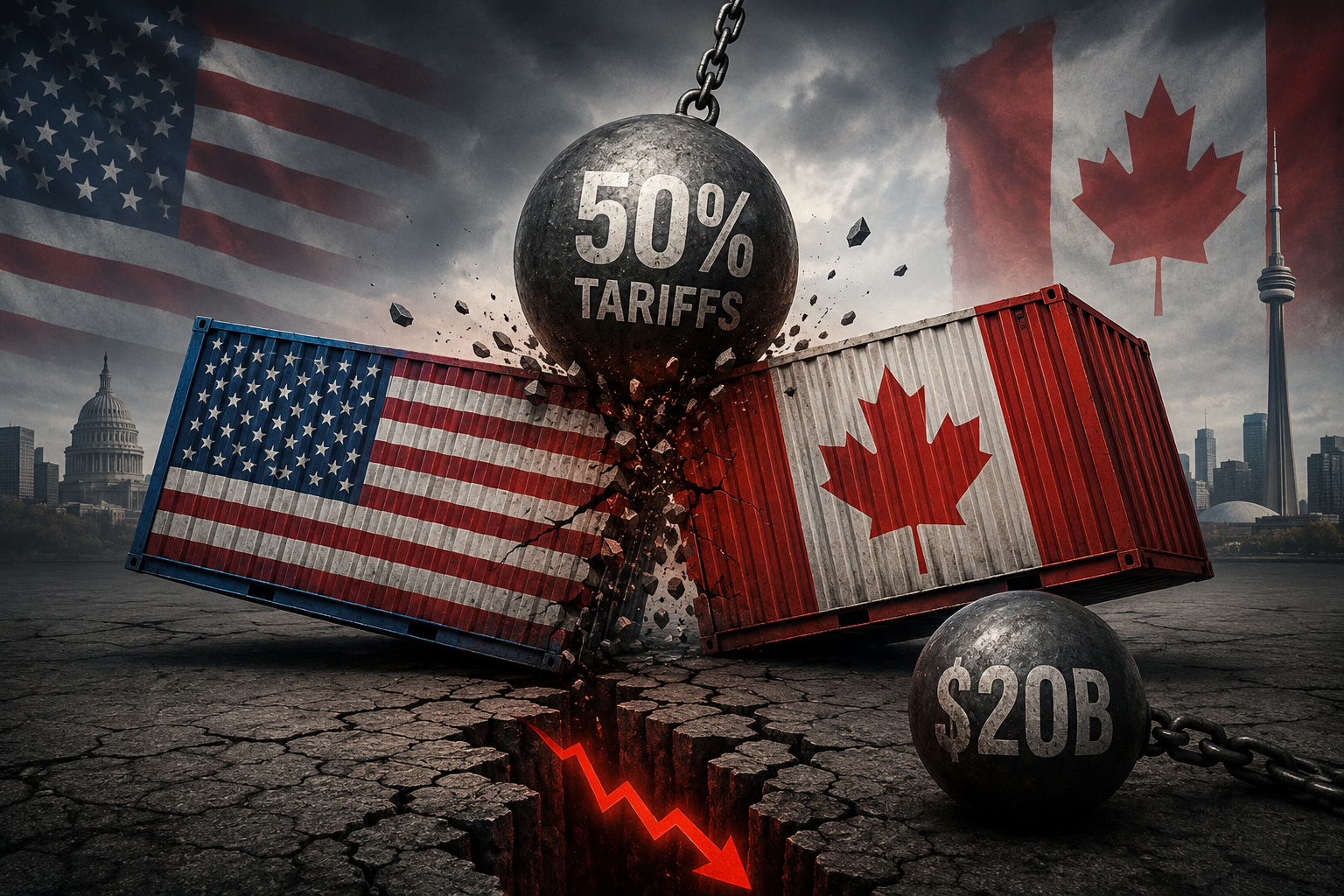

Canada is approaching one of the most consequential trade deadlines of the year as US tariffs on Canada are scheduled to rise sharply on a wide range of Canadian goods from Wednesday, August 19.
The Trump administration’s new 50% tariffs on Canadian goods would cover nearly US$20 billion in imports, including products such as wine, furniture, dairy products, cement, clothing, fishing equipment and hockey gear.
For Canadian businesses, the clock is running out. Prime Minister Mark Carney’s government is still negotiating with Washington, but the two sides remained far apart heading into the final days before the deadline. Carney described the discussions as intense and delicate and said he expected to speak with U.S. President Donald Trump before the tariffs take effect.
The immediate question is whether Canada and the United States can reach a last-minute agreement.
The more serious question here is: Could the latest US tariffs on Canada permanently change the way businesses think about one of the world’s most deeply integrated trading relationships?
US Tariffs on Canada Set to Begin August 19
The new tariffs are scheduled to take effect on August 19, 2026, following a July decision by President Donald Trump to use Section 338 of the Tariff Act of 1930 against Canadian imports.
The Office of the United States Trade Representative says Trump imposed an additional 50% tariff on nearly $20 billion in imports from Canada, arguing that Canadian policies discriminate against American exports.
According to Reuters, the targeted products represent roughly 5.2% of the approximately $383 billion in goods the United States imported from Canada in 2025.
That means the new duties are not a blanket 50% tariff on all Canadian exports.
However, they are large enough to create serious problems for specific industries and businesses that depend heavily on U.S. customers.
For some Canadian companies, a 50% tariff could radically alter the economics of selling into their largest export market.
Why Is Trump Imposing 50% US Tariffs on Canada?
The Trump administration says the new US tariffs on Canada are a response to what Washington considers discriminatory treatment of American products.
U.S. Trade Representative Jamieson Greer has specifically pointed to three major areas of concern Canada’s treatment of U.S. alcoholic beverages, Canada’s dairy market and import policies, and Restrictions affecting U.S. motor vehicle exports
The USTR says Canada removed American alcohol from shelves in several provinces, provided preferential dairy access in ways Washington considers unfair, and restricted vehicle access for U.S. manufacturers.
Canada disputes Washington’s broader characterization of the dispute and has argued that some of its measures were responses to earlier U.S. tariffs.
Canadian officials are now trying to negotiate relief from existing tariffs while preventing the new Section 338 duties from taking effect. On August 14, Canada’s government specifically listed avoiding implementation of the Section 338 tariffs among its priorities in talks with Washington.
Which Canadian Products Face the 50% Tariff?
The latest 50% US tariffs on Canada cover a surprisingly diverse group of products.
The targeted Canadian imports include:
- Wine
- Furniture
- Dairy products
- Cement
- Clothing
- Hockey equipment
- Fishing rods
- Swimming pools
- Seeds
- Wigs
- Other selected products
For consumers, that list may appear unusually broad. However, for the businesses it is concerning.
A company selling a Canadian product into the United States may suddenly need to decide whether to absorb additional tariff costs, increase prices, renegotiate contracts, reduce shipments, or rethink its U.S. strategy altogether.
A 50% tariff leaves little room for easy solutions.
Nearly $20 Billion in Canadian Goods Are at Risk
The headline number surrounding the US tariffs on Canada is nearly US$20 billion.
That is the approximate value of imports covered by the new tariff action, according to the USTR.
In the context of the entire Canada-U.S. trading relationship, the amount is limited. The targeted goods represent about 5.2% of U.S. goods imports from Canada in 2025.
But looking only at the national percentage can obscure the real business impact.
Tariffs rarely hurt every company equally.
A large diversified corporation may be able to redirect production, negotiate lower input prices or absorb some additional costs.
A small furniture manufacturer, winery, supplier or specialty producer may have far fewer options.
Reuters reported warnings from Canadian businesses that the new tariffs could result in job losses in industries already facing economic pressure.
For those companies, the problem is not theoretical.It could determine whether selling to American customers remains commercially viable.
Small Canadian Businesses Could Be Hit Hardest
Small and medium-sized enterprises may be among the most vulnerable to the latest US tariffs on Canada.
Many smaller Canadian manufacturers have spent years building relationships with U.S. distributors and customers.
They may not have alternative export markets capable of replacing American demand quickly.
They may also lack the financial resources to absorb a 50% tariff while waiting for governments to resolve the dispute.
The Canadian Federation of Independent Business warned that implementation could cause substantial disruption for small Canadian businesses dependent on U.S. clients and for American buyers dependent on Canadian suppliers.
This is one reason the tariff story goes beyond government negotiations.
For businesses operating on narrow margins, even temporary tariffs can have lasting consequences like orders can disappear, contracts can move to competitors, investment can be postponed, and
Workers can lose hours or jobs. Once a customer has changed suppliers, winning that business back may be difficult even if tariffs are eventually removed.
Canada and US Trade Deal Remains Elusive
Canada and the United States are still negotiating, but a Canada US trade deal capable of preventing Wednesday’s tariffs had not been announced as of August 18.
Canadian Trade Minister Dominic LeBlanc and Chief Trade Negotiator Janice Charette have intensified negotiations with U.S. Trade Representative Jamieson Greer.
Reuters reported that LeBlanc and Greer had met repeatedly in the weeks leading up to the deadline, while technical discussions between officials continued.
Despite that activity, substantial differences remain. The negotiations involve far more than the newest tariff package.
Issues include automobiles, dairy, alcohol, Canadian retaliatory duties and the broader future of the United States-Mexico-Canada Agreement, or USMCA.
That creates a difficult negotiating environment. A deal that resolves one tariff issue may not resolve the wider trade dispute.
Auto Tariffs Have Become a Major Sticking Point
Automobiles are emerging as one of the biggest obstacles in the negotiations over US tariffs on Canada.
Canadian-built vehicles currently face a 25% U.S. Section 232 tariff.
Reuters reported that U.S. and Canadian negotiators have discussed potentially reducing that rate to 15%, subject to deductions based on the value of qualifying content in the vehicle.
But the two countries disagree over how those deductions should work.
Washington wants deductions to focus on U.S.-specific content.
Canada wants the calculation to recognize broader North American content, including Canadian and Mexican components.
It may sound like a technical accounting dispute.
It is not.
North America’s automotive industry has spent decades developing cross-border supply chains in which parts and components can move between Canada, the United States and Mexico during production.
How tariff calculations treat those parts could have a major effect on the final cost of Canadian-built vehicles entering the U.S.
USMCA Protection May Not Shield Targeted Canadian Goods
One of the most significant elements of the latest Trump tariffs on Canada is their relationship with USMCA.
Many Canadian exports have remained protected from previous tariff actions when they satisfied the trade agreement’s requirements.
The new Section 338 tariffs are different.
Reuters reports that the new duties would apply even to targeted products that otherwise qualify for preferential treatment under USMCA.
That distinction could have consequences beyond the goods immediately affected.
Businesses rely on trade agreements partly because they provide predictability.
Companies choose factory locations, suppliers and distribution networks based on assumptions about how goods will be treated when they cross borders.
If businesses conclude that qualifying for USMCA treatment no longer guarantees protection from major new tariffs, some may rethink investment decisions.
That uncertainty can become an economic cost of its own.
Are All Canadian Exports Facing 50% Tariffs?
No, despite the scale of the headlines surrounding US tariffs on Canada, the new 50% duties do not apply to every product Canada exports to the United States.
Several strategically important Canadian exports were exempted from the new measures. The exemptions reportedly include Energy, Potash, Fish, critical minerals, and Products already subject to certain Section 232 tariffs
This distinction must be noted and saying that the United States is imposing a 50% tariff on all Canadian goods would be inaccurate.
The duties apply to a specified group of products representing nearly $20 billion in imports.
What Is Section 338 of the Tariff Act of 1930?
The legal mechanism behind the latest US tariffs on Canada is receiving almost as much attention as the tariffs themselves.
Section 338 of the Tariff Act of 1930 allows a U.S. president to impose additional duties of up to 50% on imports from a country that is found to discriminate against American commerce.
Trump’s use of the provision is historically significant the July action marked the first known use of Section 338 in nearly a century.
The provision comes from a period associated with aggressive protectionist trade policies and the economic turmoil surrounding the Great Depression.
Its revival therefore raises a broader question for global businesses.
If Section 338 becomes a more frequently used trade tool, could other U.S. trading partners face similar actions in future disputes?
For investors and multinational companies, that possibility is worth watching.
Could US Consumers Pay More Because of the Tariffs?
Tariffs are charged on imported goods, but their final economic cost can be distributed across several participants.
An American importer may choose to absorb some of the tariff. A Canadian exporter may reduce its price. A retailer may raise prices. A buyer may switch to a competing supplier.
The final outcome depends on the product, competition, supply availability and bargaining power.
That means US tariffs on Canada can also create costs for American companies and consumers, particularly where U.S. businesses depend on Canadian suppliers.
The interconnected nature of the two economies makes it difficult to ensure that tariff pressure remains confined to one side of the border.
Why the August 19 Deadline Matters
The immediate deadline is Wednesday, August 19, 2026.
Unless Washington modifies, postpones or withdraws the action, the new 50% duties are scheduled to take effect. There are several possible outcomes:
1. The tariffs take effect
Canadian businesses covered by the measures begin facing the new duties and may immediately need to adjust pricing, shipments and production.
2. Washington delays implementation
A temporary delay could give negotiators additional time without solving the underlying disputes.
3. Canada and the US reach a deal
A last-minute agreement could prevent or modify the new tariffs while potentially addressing other areas of trade friction.
At the time of publication, no final agreement preventing the tariffs had been publicly announced.
What Businesses and Investors Should Watch Next
The next phase of the Canada tariff news cycle could move quickly.
Businesses and investors should watch several developments closely.
First, any direct conversation or agreement between Donald Trump and Mark Carney before the August 19 deadline could change the tariff outlook.
Second, watch for an official announcement from the White House or USTR confirming whether the Section 338 tariffs will take effect as scheduled.
Third, progress on Canadian automotive tariffs could provide an indication of whether a broader compromise is possible.
Fourth, businesses should watch developments surrounding USMCA because the current dispute could affect confidence in North America’s long-term trading framework.
Finally, Canadian companies exposed to the targeted sectors will need to assess whether they can absorb tariff costs or whether they need alternative markets and supply-chain strategies.
The Bigger Business Risk Is Uncertainty
The most important consequence of the latest US tariffs on Canada may eventually prove to be something that does not appear directly on a customs invoice.
Uncertainty.
Canada and the United States have built one of the world’s most integrated economic relationships.
Factories, warehouses and supply chains have been designed around relatively predictable cross-border trade.
A manufacturer deciding whether to invest millions of dollars in a Canadian facility needs to know what access to the U.S. market will look like in five or ten years.
A U.S. company choosing Canadian suppliers needs similar confidence. Repeated tariff disputes make those calculations harder.
Businesses can adapt to known costs. They struggle much more with costs that could change abruptly because of political negotiations.
What the 50% US Tariffs on Canada Mean for North American Trade
The latest tariff confrontation is about more than US$20 billion of goods.
It is another test of whether Canada and the United States can maintain a stable economic relationship while simultaneously renegotiating major areas of trade policy.
The two economies remain deeply connected.
That means a prolonged tariff battle can affect Canadian exporters, American importers, workers, consumers and investment decisions across the continent.
The relatively limited share of trade covered by the latest tariffs may prevent them from becoming a major macroeconomic shock on their own.
For businesses directly targeted, however, the consequences could be severe.
And if the dispute spreads into broader USMCA negotiations, the economic stakes could increase significantly.
Bottom Line
The US tariffs on Canada are now hours away from a critical implementation deadline.
President Trump’s new 50% duties are scheduled to hit nearly US$20 billion in Canadian imports on August 19, targeting products ranging from wine and furniture to dairy, cement and hockey equipment.
Ottawa and Washington continue to negotiate, but significant differences remain over automobiles, dairy, alcohol and the broader trade relationship.
For Canada, a last-minute agreement could prevent significant disruption for affected exporters.
Failure to reach one would mark another escalation in North American trade tensions.
The immediate economic impact may be concentrated in specific industries.
The longer-term risk is broader: companies on both sides of the border may begin questioning whether the stability that once defined Canada-U.S. trade can still be taken for granted.
Frequently Asked Questions
When do the US tariffs on Canada take effect?
The new 50% tariffs are scheduled to take effect on August 19, 2026, unless the Trump administration delays, modifies or withdraws the measures.
How much Canadian trade is affected by the tariffs?
The new tariffs cover nearly US$20 billion worth of Canadian imports, according to the Office of the U.S. Trade Representative.
What products are affected by the 50% US tariffs on Canada?
Affected products include wine, furniture, dairy products, cement, clothing, hockey equipment, fishing rods, swimming pools, seeds and other selected Canadian goods.
Do the 50% tariffs apply to all Canadian goods?
No. They apply to selected products. Energy, potash, fish, critical minerals and products already covered by certain Section 232 tariffs are among the exemptions reported when the measures were announced.
Why did Trump impose tariffs on Canada?
The Trump administration says the tariffs respond to Canadian policies affecting U.S. vehicles, alcoholic beverages and dairy exports. Canada says it is negotiating with Washington to address outstanding trade issues and prevent the new Section 338 tariffs from taking effect.
What is Section 338?
Section 338 of the Tariff Act of 1930 gives the U.S. president authority to impose additional duties of up to 50% when another country is deemed to discriminate against U.S. commerce.
Don’t forget to follow us on Facebook | Instagram | Twitter | LinkedIn to get the latest updates from Cape Town Tribune