
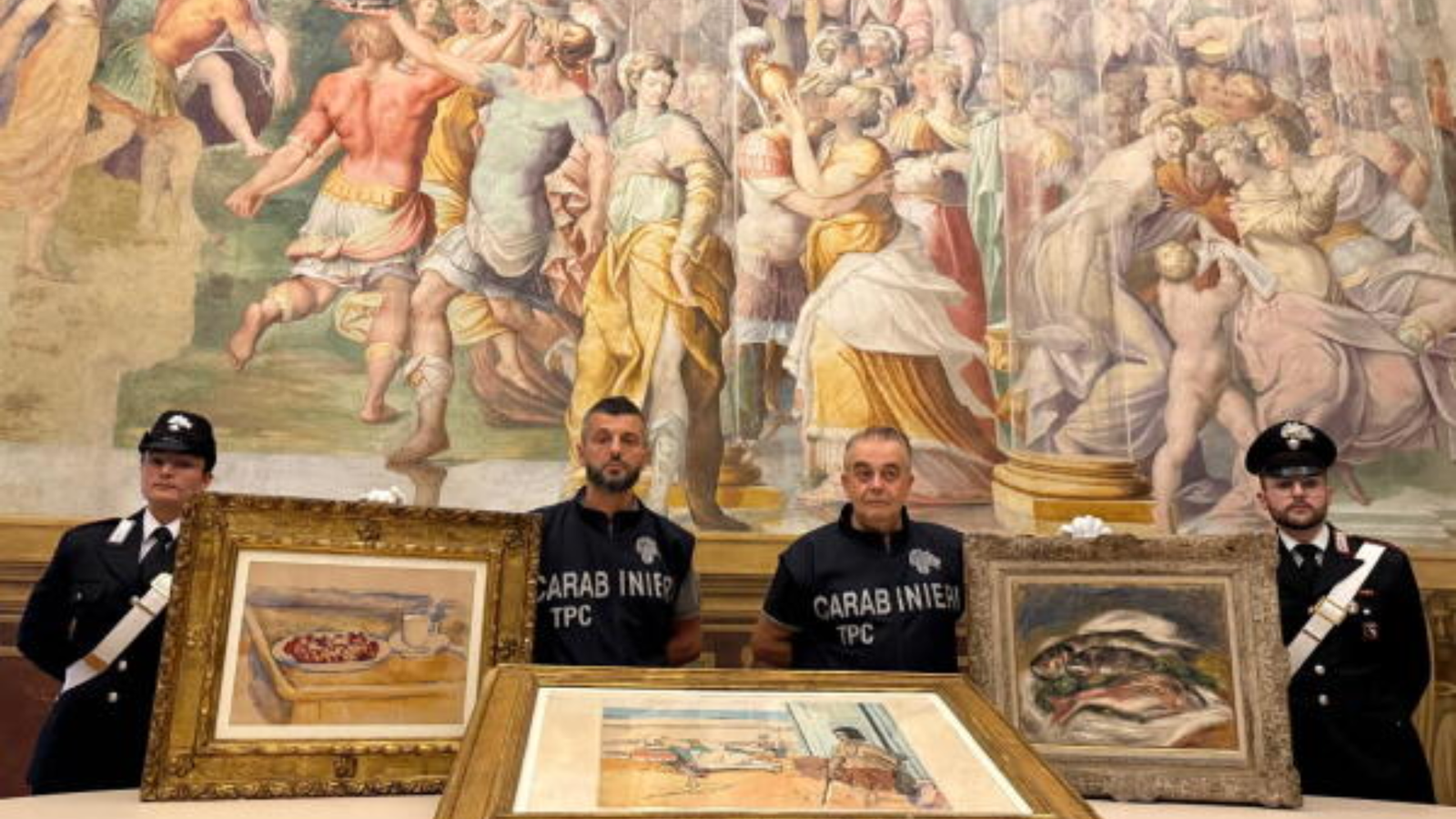

Three major works by Paul Cézanne, Pierre-Auguste Renoir, and Henri Matisse have been recovered nearly five months after they were stolen from the Fondazione Magnani Rocca near Parma. The stolen art recovered in Italy is collectively valued at more than €9 million and was found after an investigation involving the Carabinieri’s specialist cultural heritage officers.
The recovery closes a tense chapter for one of northern Italy’s most distinctive private collections. It also offers a rare positive ending in a field where stolen masterpieces can disappear for years. The stolen art recovered in Italy includes works removed from the museum during a robbery that lasted less than three minutes, a detail that made the case unusually striking from the moment it became public.
For the Fondazione Magnani Rocca, however, the story is about more than recovering property worth millions. These works belonged to a collection shaped by the taste of Luigi Magnani, the Italian critic and collector whose holdings brought together some of the most celebrated names in European art. Their return restores a part of that cultural vision.
Stolen Art Recovered in Italy After a Three-Minute Heist
The stolen art recovered in Italy consists of Cézanne’s Tasse et Plat de Cerises, Renoir’s Les Poissons and Matisse’s Odalisque sur la Terrasse. Italian authorities placed their combined estimated value at more than €9 million, or about $10.4 million, when the recovery was reported.
The theft took place at the Fondazione Magnani Rocca in Mamiano di Traversetolo, near Parma, in March 2026. Surveillance footage showed two masked burglars entering the museum, removing the works, and escaping in less than three minutes.
That speed remains one of the most unsettling details of the case. These were artworks that had spent years inside a carefully assembled collection, yet only minutes were needed to remove them from public view.
The stolen art recovered in Italy therefore represents more than a successful police operation. The case is also a reminder of how quickly museums can lose objects that have taken generations to preserve, research, and place within cultural history.
Which Cézanne, Renoir, and Matisse Works Were Recovered?
The Cézanne work is Tasse et Plat de Cerises, translated as Cup and Plate of Cherries. Renoir’s recovered work is Les Poissons, while the Matisse piece is Odalisque sur la Terrasse. All three belonged to the Magnani Rocca Foundation collection before their theft.
The artists occupy distinct places in modern European art. Cézanne helped reshape the possibilities of painting through his approach to form and structure. Renoir became one of the defining figures of Impressionism, while Matisse helped transform twentieth-century art through his distinctive use of colour, line and composition.
Their presence within a single collection says something about Luigi Magnani’s eye as a collector.
The stolen art recovered in Italy restores the relationship between individual artworks and the broader museum around them. Private collections often possess a character that cannot be reproduced simply by replacing one missing work with another of similar financial value.
Magnani selected works because they spoke to his own understanding of European culture. When several disappeared at once, a part of that conversation disappeared with them.
How Italian Police Traced the Missing Works
The investigation involved the Carabinieri Cultural Heritage Protection unit, a specialised branch of Italy’s police dedicated to crimes involving art, archaeological objects, and other forms of cultural property. Reuters reported that nine Moldovan nationals were under investigation in connection with the robbery when the recovery was announced.
The stolen art recovered in Italy was eventually found in Parma rather than thousands of kilometres away or hidden outside the country. That detail is significant because high-profile museum thefts often inspire speculation about international traffickers or secret collectors.
Instead, the missing Cézanne, Renoir, and Matisse remained surprisingly close to the institution from which they had been taken.
The recovery followed months of investigative work. Other reporting on the case said police examined physical evidence and surveillance material while tracing people believed to have links to the robbery. The works were ultimately found concealed in a Parma property.
The contrast is almost absurd. Works worth millions, associated with three towering figures of modern art, were hidden far from the glamorous image that fictional art thefts tend to create.
Why Famous Stolen Art Can Be So Difficult to Sell
The case exposes one of the central contradictions of art crime. A masterpiece is valuable partly because experts know exactly what it is, but that recognition becomes a major disadvantage once the work has been stolen.
Important works by Cézanne, Renoir, and Matisse are extensively documented. Museums maintain records, scholars study their provenance, auction houses examine ownership histories, and law-enforcement agencies circulate information about stolen cultural property.
The stolen art recovered in Italy would therefore have been extremely difficult to introduce into the legitimate art market without attracting attention.
A buyer willing to pay millions for an important Cézanne would normally expect evidence showing where the work came from, who owned it, and whether the seller had the legal right to transfer it. A stolen artwork cannot easily survive that level of scrutiny.
This is where reality differs sharply from the romantic image of the sophisticated art thief. Removing a masterpiece from a museum may be possible. Turning that masterpiece into usable money is another matter entirely.
The more famous the stolen object becomes, the more dangerous it can become for anyone attempting to sell it.
Why €9 Million Does Not Tell the Whole Story
The headline value of more than €9 million naturally attracts attention, but the stolen art recovered in Italy matters for reasons that cannot be measured by an insurance valuation.
The Fondazione Magnani Rocca preserves the private collection assembled by Luigi Magnani. Reuters notes that the museum’s holdings include works by artists such as Titian, Goya, Monet, Rubens, and Giorgio Morandi, alongside the recovered works by Cézanne, Renoir, and Matisse.
That breadth gives the museum its identity.
A collection is not simply an accumulation of expensive objects. Its meaning comes partly from how those objects sit beside one another, how scholars interpret them, and how visitors encounter them over time.
When a significant work disappears, an institution loses more than its market value. It loses part of the visual and intellectual structure around which the collection was built.
The recovery therefore restores something money alone could not replace.
Stolen Art Recovered in Italy Restores Magnani’s Collection
The stolen art recovered in Italy has particular significance because the Magnani Rocca Foundation grew from one individual’s sustained engagement with art, music, and European culture.
Collections created by a single person often retain a strong personality. They reflect choices about what deserves attention and which artists or periods should be viewed together.
That personal dimension separates them from larger encyclopaedic museums, where galleries may be arranged primarily by chronology, geography, or artistic movement.
At Magnani Rocca, the recovered pieces belong to a broader cultural story. Their absence disrupted that story, while their return allows visitors to experience the collection in something closer to its intended form.
This is one reason the case has resonated beyond Parma. A museum theft removes an object from the public, but it also interrupts the relationships that give that object meaning.
Italy’s Art Police Remain Central to Cultural Protection
Italy faces an unusually demanding challenge when it comes to protecting cultural heritage. Museums, archaeological sites, churches, villas, historic buildings, and private collections are spread across the country, many containing objects of international importance.
The Carabinieri’s cultural heritage specialists have developed expertise specifically around these crimes.
The stolen art recovered in Italy adds another high-profile recovery to that work and has placed renewed attention on the role of specialist policing in protecting cultural property.
The timing is particularly striking. Soon after the Parma recovery, another major art theft emerged in Sicily involving works by Renaissance master Antonello da Messina. Italian cultural heritage police are also involved in that investigation.
The contrast could hardly be sharper. One museum is celebrating the recovery of missing masterpieces while another is facing the uncertainty and anxiety that follow their disappearance.
The Heist Raises Difficult Questions About Museum Security
The positive outcome does not erase the troubling details of the original robbery.
Two masked thieves were able to remove major works from the Fondazione Magnani Rocca in less than three minutes.
The stolen art recovered in Italy will therefore remain relevant to discussions about museum security even after the works return to display.
Historic cultural institutions face a particularly difficult balance. Many occupy villas, palaces, churches, and buildings that existed long before modern alarms, cameras, and motion sensors were imagined.
They must protect valuable objects without turning galleries into spaces that feel inaccessible to the public.
The Parma theft demonstrates how quickly criminals can exploit weaknesses. Its successful resolution should not prevent museums from asking how similar incidents can be stopped before artworks leave the building.
Recovery is a success, but prevention remains the better outcome.
Why the Recovery Matters Beyond Italy
The stolen art recovered in Italy has attracted international interest because art theft ultimately affects more people than the legal owner of an object.
A museum may own a painting, but scholars study it, students learn from it, and visitors build memories around seeing it in person.
When such a work disappears, public access disappears with it.
The return of the Cézanne, Renoir, and Matisse works restores that access and prevents three important objects from joining the long list of stolen artworks that remain missing.
For the Fondazione Magnani Rocca, their return is especially meaningful because the museum’s identity depends so strongly on the coherence of Luigi Magnani’s collection.
What was disrupted in March can now begin to be restored.
A Three-Minute Crime Took Months to Reverse
Perhaps the most telling detail in the entire case is the difference between the time required to steal the artworks and the time required to bring them back.
The thieves needed less than three minutes. Investigators needed almost five months.
The stolen art recovered in Italy illustrates a fundamental truth about cultural heritage. Removing an object can be frighteningly quick, while preserving, documenting, locating, and recovering it demands patience and expertise.
Art acquires cultural meaning slowly. It passes through studios, collections, scholarship, and public memory. A thief can interrupt that history in moments, but repairing the damage is rarely simple.
That is what makes this recovery worth celebrating without romanticising the crime that preceded it.
A Rare Positive Ending for an Art Theft
The stolen art recovered in Italy offers something that many museum theft stories never receive: a clear and hopeful ending.
Cézanne’s Tasse et Plat de Cerises, Renoir’s Les Poissons, and Matisse’s Odalisque sur la Terrasse are no longer missing. Their return means a collection built through years of careful judgement can again be viewed more completely.
The case will understandably be remembered for its famous artists, €9 million valuation, and remarkably fast robbery.
Its cultural significance is quieter but more important. Artworks that disappeared from public view have been found, preserved, and returned to the world that gives them meaning.
For a museum, there are few outcomes more valuable than that.
Frequently Asked Questions
What stolen art was recovered in Italy?
The stolen art recovered in Italy includes Paul Cézanne’s Tasse et Plat de Cerises, Pierre-Auguste Renoir’s Les Poissons, and Henri Matisse’s Odalisque sur la Terrasse. The three works were stolen from the Fondazione Magnani Rocca near Parma in March 2026.
How much are the recovered artworks worth?
The Cézanne, Renoir, and Matisse works have a combined estimated value of more than €9 million, according to reporting on the recovery.
How long did the museum robbery take?
Police surveillance footage showed two masked burglars completing the theft in less than three minutes.
Where were the artworks recovered?
The works were recovered in Parma, northern Italy, after an investigation involving the Carabinieri’s Cultural Heritage Protection unit.
Why is the recovery culturally important?
The stolen art recovered in Italy forms part of Luigi Magnani’s carefully assembled collection. Returning the works restores public access and repairs an important gap in the Fondazione Magnani Rocca’s cultural identity.ni.
Don’t forget to follow us on Facebook | Instagram | Twitter | LinkedIn to get the latest updates from Cape Town Tribune