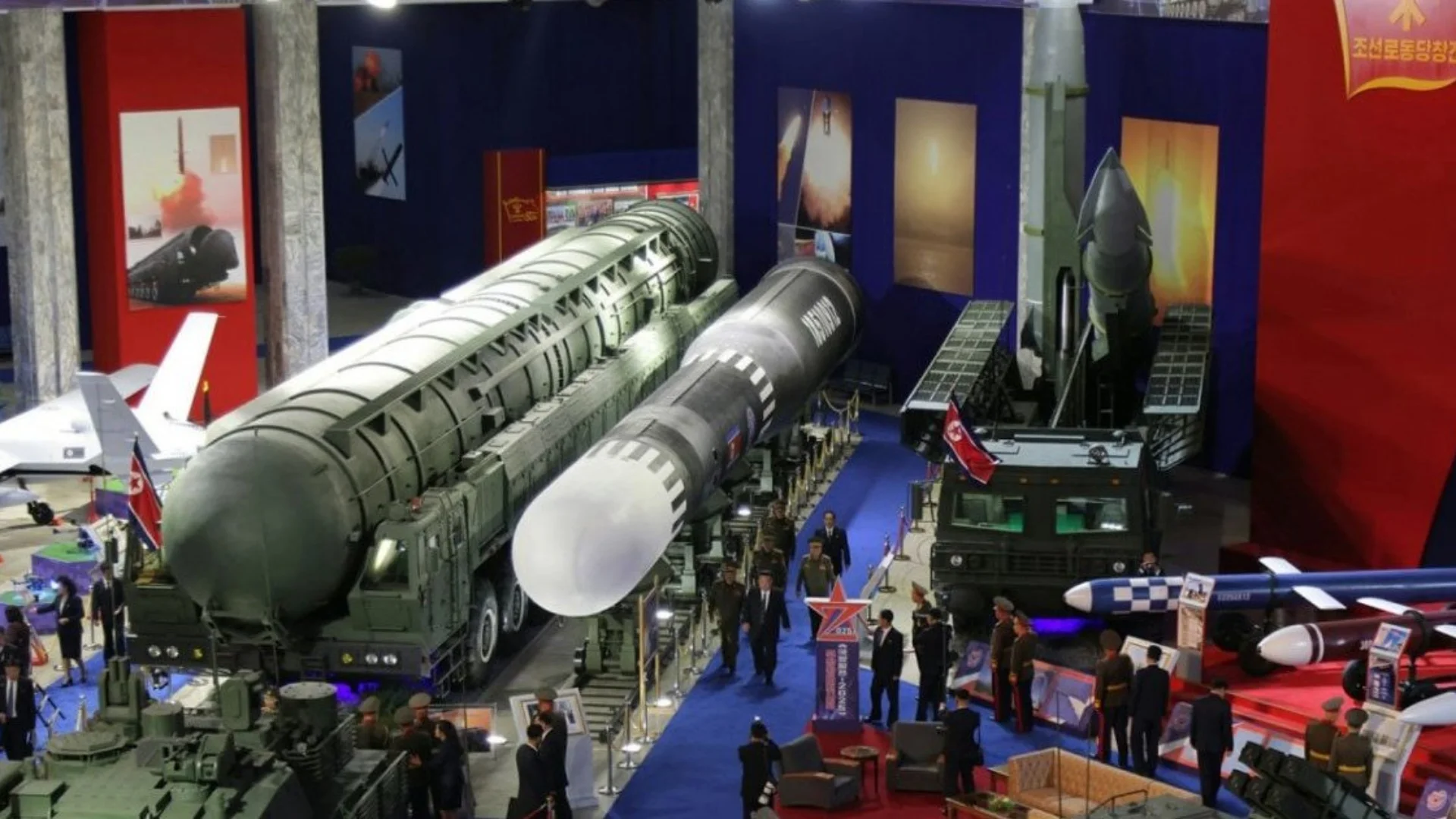

Kim Jong Un has overseen a new weapons test that appears to involve an upgraded short-range missile with hypersonic technology, adding pressure to an already difficult diplomatic standoff with Washington.
The Hwasong-11Ma missile has become the latest focus of concern over North Korea’s expanding weapons programme after state media released images of Kim Jong Un overseeing tests of what Pyongyang described as a new combat system of major military significance.
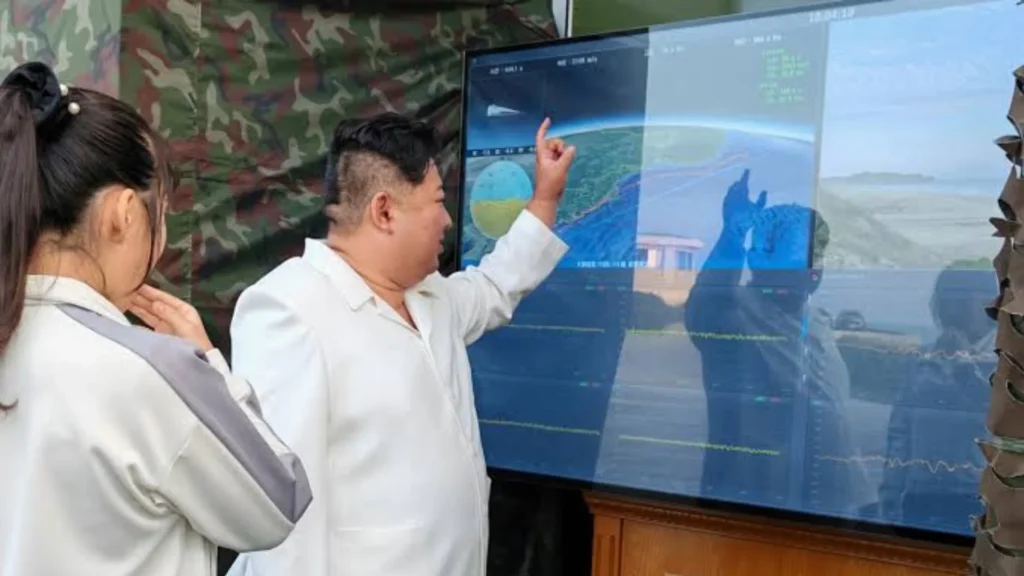
North Korea said on Tuesday that its missile bureau had successfully tested the weapon two days earlier in the presence of Kim and his daughter, Kim Ju Ae. State media did not formally identify the missile in its written announcement, but a display visible in photographs released by Pyongyang carried the words “Hwasongpho-11Ma-1 flight trajectory.” That has led South Korean officials and analysts to assess that the test involved a new or upgraded version of the Hwasong-11 family.
The images appear to show a system equipped with a manoeuvrable glide vehicle, technology associated with North Korea’s work on so-called hypersonic weapons. Pyongyang has previously described similar systems in those terms, although the actual capabilities of the latest missile have not been independently established.
North Korea wants its adversaries to believe that its newest weapons can travel quickly, alter course during flight and challenge existing missile defences. Whether the Hwasong-11Ma can reliably do all of those things remains an open technical question.
What is not in doubt is the direction of North Korea’s military programme. Kim continues to broaden the country’s missile arsenal even as nuclear diplomacy with the United States remains largely frozen.
What is known about the Hwasong-11Ma missile test
South Korea’s Joint Chiefs of Staff detected two short-range ballistic missiles launched from the Wonsan area on North Korea’s east coast on Sunday.
The first missile travelled approximately 450 kilometres, according to the South Korean military. A second missile, launched nearly three hours later, flew more than 600 kilometres. Japan also detected the launches and said the projectiles fell outside its exclusive economic zone.
North Korea subsequently presented a different set of figures. A screen shown in photographs released by the Korean Central News Agency appeared to indicate a flight distance of 908.2 kilometres.
Yonhap reported that South Korean experts were examining the discrepancy and raised the possibility that the North Korean figure might not represent the same measurement used by Seoul.
The difference illustrates one of the enduring difficulties in assessing North Korean weapons tests.
Pyongyang controls almost all information released about its missile programme. Outside governments rely heavily on radar, satellite observations and other monitoring systems, while analysts examine photographs and state-media footage for clues about design and performance. The latest test is no exception.
North Korean media described the launch as evidence of advanced defence technology and progress in modernising the country’s armed forces. Kim said the system would have significant implications for the country’s military readiness.
Why the Hwasong-11Ma missile is attracting attention
The Hwasong-11 family consists of solid-fuel short-range ballistic missiles that are particularly relevant to the security of South Korea and nearby U.S. military installations.
The apparent Hwasong-11Ma configuration is drawing additional scrutiny because of its warhead design.
Photographs released after the test suggest the missile may carry a hypersonic glide vehicle. Such vehicles are designed to separate from or travel with a rocket booster before manoeuvring through the atmosphere towards a target.mThe word “hypersonic” can sometimes obscure more than it explains.
Many ballistic missiles already travel faster than five times the speed of sound, the commonly used threshold for hypersonic speed. The military significance of a hypersonic glide vehicle lies less in raw speed than in its ability to manoeuvre and follow a less predictable flight path.
That can complicate the work of missile-defence systems.
Traditional ballistic missiles generally follow trajectories that can be tracked and projected once their speed and direction are established. A weapon capable of changing course may reduce the time defenders have to determine where it is heading and how best to intercept it. That does not make the system unstoppable.
Experts have previously questioned whether North Korea’s hypersonic weapons have demonstrated all of the manoeuvrability and consistent high-speed performance claimed by Pyongyang. The latest test does not resolve those doubts.
Still, repeated testing matters. Even systems that initially fall short of their advertised capabilities can become more effective through continued engineering, testing and refinement.
Kim Jong Un is building a broader missile force
The Hwasong-11Ma missile sits inside a weapons programme that has expanded considerably over the past decade.
North Korea now operates or is developing several classes of missiles intended for different military purposes.
Its shorter-range systems are designed primarily to threaten South Korea and nearby military installations. Intermediate-range weapons can potentially reach Japan and U.S. bases elsewhere in the Pacific. Intercontinental ballistic missiles are being developed with the stated aim of being able to strike the U.S. mainland.
Kim has also emphasised solid-fuel technology, which can allow missiles to be prepared and launched more quickly than older liquid-fuel systems.
This is not simply an effort to accumulate more missiles. Pyongyang is trying to create an arsenal with different ranges, launch methods and flight characteristics. For South Korea, Japan and the United States, that variety makes military planning more complicated.
A missile-defence network that must simultaneously prepare for ballistic missiles, cruise missiles, manoeuvrable weapons and potentially nuclear-armed systems faces a more difficult task than one confronting a single class of threat.
North Korea has made clear that it intends to continue that expansion.
The launch arrived at a sensitive diplomatic moment
The timing of the latest test was notable. The launches came shortly before world leaders gathered in New York for the United Nations General Assembly and only days before a planned meeting between U.S. President Donald Trump and Chinese President Xi Jinping.
North Korea has also been sharply criticising military activity involving the United States, South Korea and Japan.
Pyongyang argues that U.S.-led exercises represent preparation for conflict and justify further expansion of its nuclear and missile forces. Washington, Seoul and Tokyo say their exercises are defensive and necessary because of North Korea’s weapons programme.
Senior diplomats from South Korea, the United States and Japan met in New York following the missile launches and reiterated their commitment to the complete denuclearisation of North Korea while saying that the path to dialogue remained open.
Pyongyang has so far shown little sign that it is prepared to return to negotiations on those terms.
Nuclear diplomacy has been stalled for years
The current deadlock can be traced in large part to the collapse of talks between Kim and Trump in 2019.
The two leaders held an unprecedented series of meetings during Trump’s first presidency, beginning in Singapore in 2018. The process generated considerable international attention but produced few irreversible limits on North Korea’s weapons programme.
Their February 2019 summit in Hanoi ended without an agreement. The central dispute involved how much sanctions relief Washington was willing to offer in exchange for North Korean steps towards dismantling its nuclear programme.
Negotiations never fully recovered. Since then, North Korea has continued developing missiles and nuclear capabilities while arguing that the United States must abandon what Pyongyang calls its hostile policy before meaningful talks can resume.
Trump has continued to express an interest in meeting Kim again, but no sustained negotiating framework has emerged.
The military balance has also changed since Hanoi. North Korea today possesses a larger and more varied arsenal than it did seven years ago. That means any renewed negotiation would begin under different conditions.
South Korea wants a more gradual approach
South Korean President Lee Jae Myung has argued that expecting immediate and complete North Korean denuclearisation may no longer be a practical opening position. Lee has instead advocated a phased process.
The first step, in his view, could be persuading Pyongyang to freeze further expansion of its nuclear and missile programmes. Later agreements could then seek reductions in exchange for political or economic incentives.
Lee told AP that stopping additional development could serve as the beginning of a longer process rather than insisting that North Korea surrender its entire arsenal at once.
Reuters also reported that Lee has urged Washington to consider easing some sanctions if North Korea agrees to freeze its nuclear weapons development.
That approach reflects concern that the existing stalemate is allowing Pyongyang to improve its military capabilities while diplomacy remains inactive.
It is not clear whether Washington will ultimately embrace the proposal. North Korea has given even less indication that it is prepared to accept a freeze.
For Kim, the growing arsenal provides both military security and negotiating leverage. The government increasingly presents nuclear weapons as a permanent part of the country’s defence rather than a temporary bargaining tool.
Relations with Russia and China have changed the calculation
North Korea’s strategic position has also shifted because of its relationships with Moscow and Beijing.
China remains North Korea’s most important economic and diplomatic partner, although Beijing has sometimes supported international sanctions against Pyongyang.
Russia’s relationship with North Korea has deepened significantly in recent years.
That has weakened the level of international consensus that once existed over how aggressively to pressure North Korea through the United Nations Security Council.
For Pyongyang, greater support from major powers reduces the risk of complete diplomatic isolation.
For Washington and its allies, it makes coordinated pressure more difficult.
This broader geopolitical shift is one reason Kim may feel less urgency to return to negotiations than he did during the earlier Trump administration.
The existence of another new missile system reinforces that calculation.
Tensions are also rising along the Korean border
The missile test has come amid separate concerns along the Demilitarized Zone dividing North and South Korea.
Three South Korean military officers were injured on Monday when a suspected land mine exploded during a route-clearance operation south of the Military Demarcation Line. One officer lost an ankle, according to South Korea’s military.
South Korean authorities are investigating the origin of the device.
Officials have said North Korea has been strengthening barriers, installing mines and carrying out other fortification work along the border since 2024. South Korea’s defence minister called on Pyongyang to stop measures that could increase risks inside the heavily militarised area.
There is no evidence that the land-mine incident and the Hwasong-11Ma test were directly connected.
They do, however, form part of the same deteriorating security environment. Political communication between the two Koreas is minimal. Military activity continues. Each side views the other’s actions through an increasingly adversarial lens.
That raises the possibility of miscalculation even in the absence of a deliberate decision to escalate.
What the Hwasong-11Ma missile test actually changes
North Korea’s latest announcement should be neither dismissed nor accepted uncritically. There is not yet enough independent evidence to conclude that the Hwasong-11Ma represents the kind of fully mature hypersonic system Pyongyang wants its adversaries to believe it possesses.
The disputed flight-distance figures alone warrant caution.
But focusing exclusively on whether every North Korean technical claim is accurate risks missing the larger development.
Pyongyang continues to test weapons. Its engineers continue to experiment with manoeuvrable missile technology. Its nuclear programme remains active. And its diplomatic position appears increasingly resistant to the demands that shaped earlier negotiations.
The Hwasong-11Ma missile is therefore significant not because it has already been proven to transform the military balance, but because it shows where North Korea is directing its resources while diplomacy remains stalled.
That creates a difficult problem for Washington and Seoul.
Waiting for better negotiating conditions may allow North Korea more time to improve its arsenal. Returning to talks, however, increasingly means negotiating with a state whose military capabilities and political expectations have changed substantially since 2019.
Kim’s latest missile display does not answer that dilemma. It makes it harder to ignore.
Don’t forget to follow us on Facebook | Instagram | Twitter | LinkedIn to get the latest updates from Cape Town Tribune