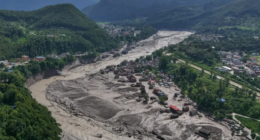

Hunger stones hidden beneath some of Central Europe’s great rivers are emerging again as severe drought pushes water levels to exceptionally low levels, exposing centuries of warnings left by communities that knew what disappearing water could mean.
Across stretches of Germany and Czechia, receding rivers are revealing an unusual archive of European history, one carved directly into stone.
Known as hunger stones, the rocks were marked during previous periods of extreme low water, often with dates, water lines, initials, and occasionally ominous messages meant for future generations.
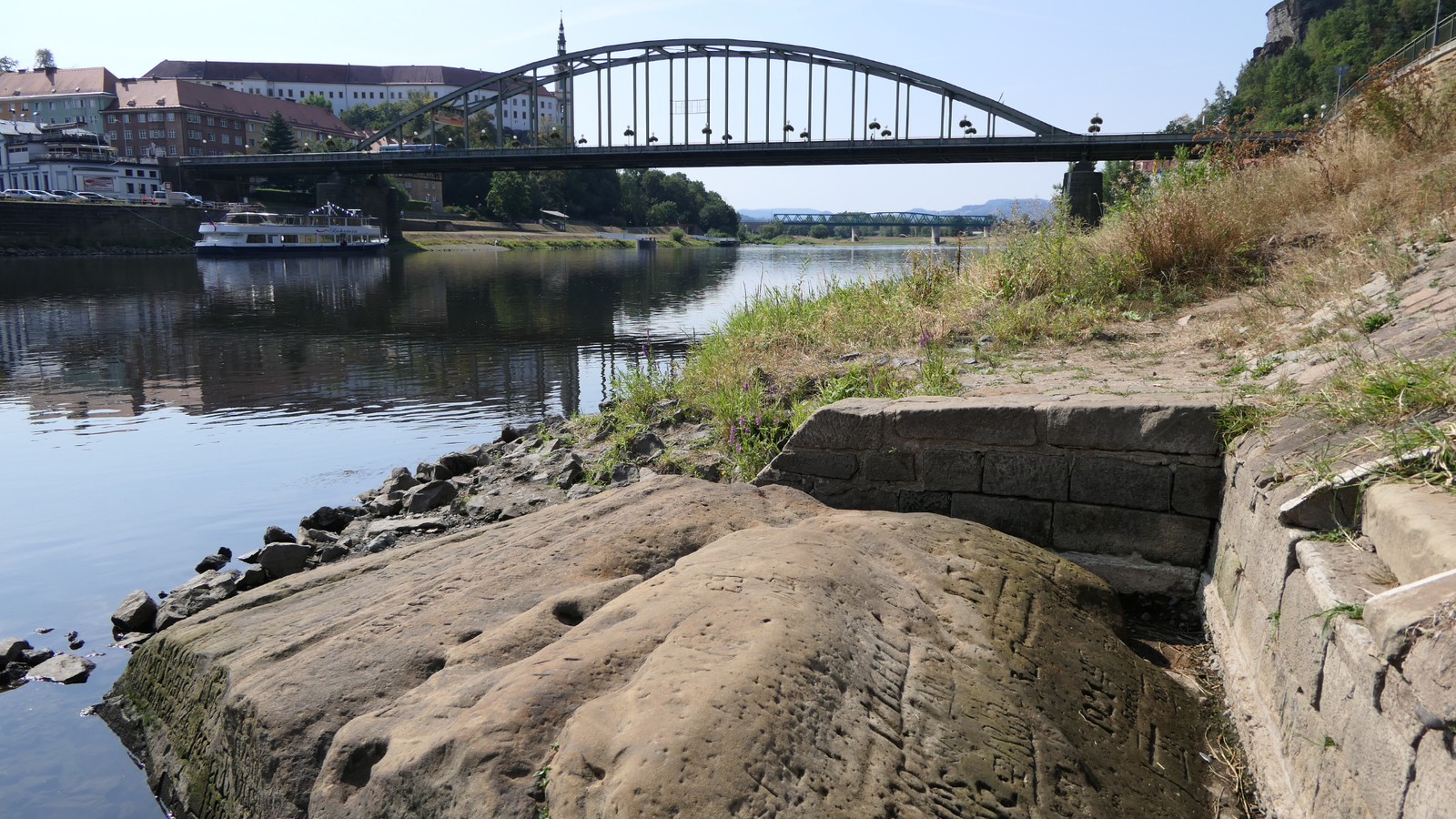
One of the most prominent examples to reappear during Europe’s 2026 drought is a large stone in the Oberposta district of Pirna, Germany, on the Elbe River near the Czech border. Its carvings record earlier low-water years stretching back to 1707. Other hunger stones have become visible near Leverkusen on the Rhine and around Dolní Žleb in Czechia.
Their return is more than an archaeological curiosity.
The stones emerged in societies where prolonged drought could cripple river transport, damage harvests, push up food prices and deprive labourers of work. What looks today like an eerie message from the past once represented a very practical warning about economic survival.
And as Europe endures another exceptionally dry summer, those warnings have acquired an uncomfortable new relevance.
Hunger stones emerge as Europe’s rivers shrink
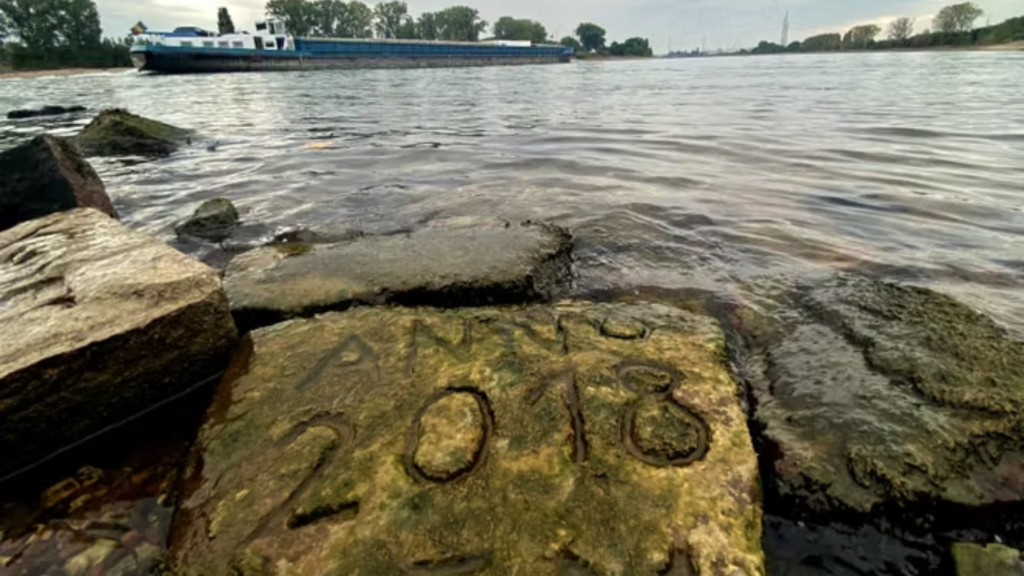
The appearance of the stones comes during a period of widespread drought across Europe.
The European Drought Observatory said drought conditions remained critical across much of the continent in early August, with drought-watch areas expanding in Germany and the Iberian Peninsula. Europe also experienced widespread above-average temperatures.
Copernicus reported that July 2026 was the joint-second warmest July globally, while western Europe experienced its hottest June-July period on record.
Much of western, central and eastern Europe was also drier than average, and river flows across many affected areas were described as much below normal or extremely low.
The Rhine, Danube and Seine have all experienced severe low-water conditions, affecting shipping, agriculture, irrigation and energy production.
On the Elbe, the falling water has exposed parts of the riverbed that ordinarily remain submerged. That is where the hunger stones wait.
What exactly is a hunger stone?
A hunger stone is essentially an early hydrological record.
During extreme droughts, when a river fell far enough to expose particular rocks, residents carved the year and sometimes the lowest water level into the stone.
When future generations saw the same rock exposed again, they could immediately understand that conditions had reached a level associated with previous hardship.
Unlike flood markers, which show how high water once rose, hunger stones documented the opposite extreme.
Researchers studying stones along the Elbe have found markings associated with droughts extending over several centuries. Scientific analysis published in Climate of the Past concluded that many of these markings correspond closely with independently documented episodes of very low water.
That makes them more than folklore. They are physical records of how European communities observed and remembered environmental extremes long before modern river gauges and weather stations existed.
Why were they called ‘hunger stones’?
The name reflects the consequences of drought in pre-industrial Europe.
Rivers such as the Elbe were major commercial arteries. Barges transported grain, timber and other goods, while large numbers of people earned their livelihoods loading vessels, towing boats and working along the river.
When water levels dropped too far, shipping became difficult or impossible. At the same time, drought could reduce crop yields.
The result could be a combination of lost income, food shortages and rising prices — conditions that hit poorer families particularly hard.
Vlastimil Pažourek of the Děčín Regional Museum has explained that recording dry years had a practical purpose because it reminded communities of the risks associated with severe low water. The term “hunger stone” also reflected the loss of work faced by labourers connected to river shipping.
In other words, the stones did not predict famine through superstition.
They recorded the conditions that people already knew could lead to hunger.
The real story behind ‘If you see me, weep’
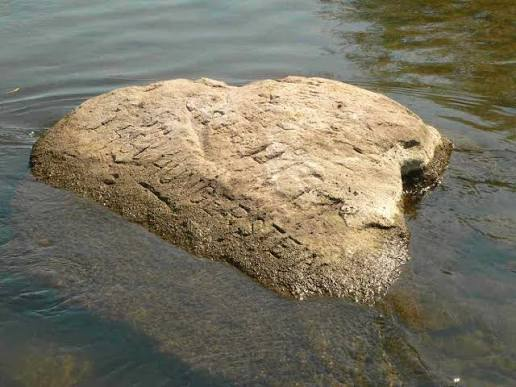
The most famous hunger stone lies on the Elbe at Děčín in Czechia, close to the German border.
It has become internationally known for a German inscription usually translated as:
“If you see me, weep.”
The phrase makes the stone sound like an ancient prophecy. The history is more complicated.
The Děčín stone does contain remarkably old drought markings. Researchers have documented a 1616 low-water mark, alongside later records from years including 1746, 1790, 1842 and 1868.
But the famous warning itself appears to be much younger.
Historical research connects the inscription to Franz Mayer, a local boatman and innkeeper, during the drought of 1904. The phrase was apparently carved again more deeply when the stone re-emerged during the 1911 drought.
Mayer also appears to have understood its attraction.
Contemporary newspaper reports describe crowds visiting the exposed stone, and postcards helped turn it into a local celebrity more than a century before social media rediscovered it.
So the viral phrase is not a medieval warning etched hundreds of years ago.
But the stone beneath it really does preserve evidence of droughts stretching back centuries. That arguably makes the story more remarkable, not less.
Scientists have tested the hunger stones
Modern researchers have attempted to establish whether the carvings genuinely correspond to historical low-water events.
A 2020 study led by researchers including experts from the Czech Hydrometeorological Institute examined hunger stones along the Elbe and compared their markings with instrumental measurements and documentary records.
The researchers found that several inscriptions represented surprisingly accurate records.
At Děčín, measurements engraved between the 19th and 20th centuries closely aligned with recorded river levels, in some cases differing by only a few centimetres.
Older markings are harder to verify because direct measurements do not exist for much of the period before the 18th century.
But historical records of drought broadly support several of the dates preserved on the stones.
They therefore occupy an unusual space between cultural heritage and climate science: monuments created by ordinary people that also preserve useful environmental information.
The drought is exposing more than stones
Europe’s shrinking rivers have revealed other objects normally concealed beneath the water.
The 2026 drought has exposed wartime wreckage, ammunition, archaeological remains and even prehistoric animal bones in different parts of the continent.
Along the Danube, low water has revealed wartime objects and stranded vessels. Elsewhere, retreating water has exposed remains believed to belong to a woolly mammoth.
These discoveries make compelling photographs, but the underlying reason for their appearance is much less romantic.
Copernicus says exceptionally hot and dry conditions have affected large parts of Europe, with extremely low river flows already disrupting transport, water supplies, irrigation and power generation.
On the Rhine, extremely shallow water has forced cargo vessels to reduce their loads.
At Kaub, one of the key navigation points on the German Rhine, DW reported water falling to just 19 centimetres on August 5, briefly touching 18 centimetres.
The economic implications echo the problems earlier Europeans faced — even if modern economies are far better equipped to absorb them.
Are hunger stones evidence of climate change?
The stones demonstrate something important: Europe experienced severe drought long before modern climate change.
That is precisely why researchers value them.
Historical drought records allow scientists to compare modern extremes with conditions that occurred centuries ago.
But their existence does not contradict current climate science.
Human-caused climate change does not mean drought never occurred in the past. Rather, rising temperatures can intensify evaporation, dry soils more quickly and increase the likelihood or severity of certain hot and dry conditions.
Copernicus says western Europe’s June-July 2026 period was the hottest on record, while dry conditions and extremely low river flows affected broad areas of the continent.
Climate researchers therefore use historical markers such as hunger stones as part of a much larger archive that includes written records, tree rings, sediment, weather observations and modern satellite data.
The stones tell scientists what happened before. Modern climate science helps explain why risks are changing now.
Ancient warnings find a new audience
There is something unusually powerful about the reappearance of hunger stones because they collapse centuries of history into a single object.
A date carved by someone who watched the Elbe shrink hundreds of years ago can suddenly become visible to someone standing beside the same river in 2026.
The circumstances surrounding those two droughts are not identical.
Europe today has modern agriculture, international food markets, reservoirs, engineered waterways and sophisticated forecasting systems. Low river levels no longer automatically translate into famine.
Yet the fundamental dependence on water has not disappeared.
Rivers still move goods. They still supply cities and industry. Farmers still depend on rainfall and irrigation. Electricity systems still depend on reliable water flows.
That is why the resurfacing hunger stones resonate far beyond their archaeological value.
They are not supernatural prophecies. They are something arguably more unsettling: records left by people who had already learned how to experience what could happen when the rivers ran dry. And in the drought-stricken summer of 2026, Europe can read those warnings once again.
Don’t forget to follow us on Facebook | Instagram | Twitter | LinkedIn to get the latest updates from Cape Town Tribune