
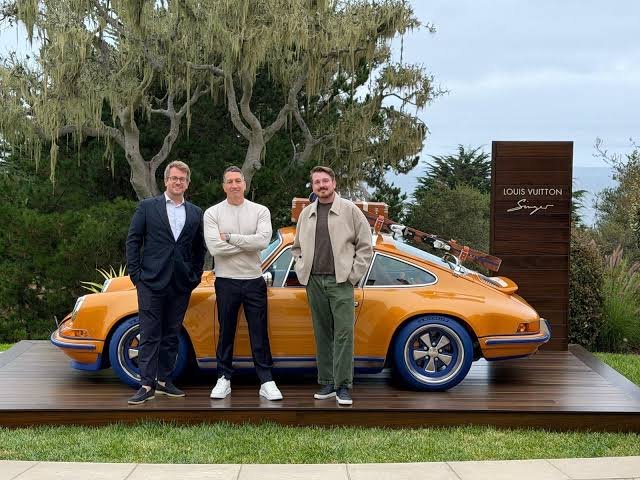
A luxury car collaboration usually begins with a special colour, a logo on the headrest or a limited-edition accessory. Louis Vuitton and Singer have taken a far more ambitious route.
The French luxury house and California-based Singer, known for its highly personalised restorations of classic Porsche 911s, have created two one-off cars that extend well beyond automotive design. Bespoke luggage, driving clothes, watches, skis and even a surfboard have been developed around them, turning each car into part of a much larger vision of luxury travel.
Unveiled in California during Monterey Car Week in August 2026, the Louis Vuitton Singer Porsche 911 project brings together two companies whose reputations are built around craftsmanship, personalisation and obsessive attention to detail. Singer describes the collaboration as an extension of Louis Vuitton’s long-standing “Art of Travel” philosophy into the automotive world.
What began as a dashboard clock eventually became something closer to a complete travelling collection.
A Dashboard Clock Started the Entire Project
The collaboration did not originally begin with plans to redesign two cars.
Singer approached Louis Vuitton’s watchmaking operation in Switzerland to develop a mechanical clock for the dashboard of one of its Porsche 911 restorations. The resulting timepiece drew on Louis Vuitton’s Tambour watch and was designed to be removable, allowing it to leave the car and function as a desk clock.
That relatively small commission expanded as both teams explored how Louis Vuitton’s watchmaking and leatherworking expertise could be applied elsewhere in the vehicle.
The instruments were reconsidered, including the speedometer, tachometer and gauges, while conventional plastic switches, vents and other fittings were replaced with hand-finished metal components. According to Travel + Leisure, the gauges themselves required around a year of development.
The project gradually moved from designing an accessory for a Singer Porsche to reconsidering much of the environment surrounding the driver.
The First Porsche 911 Turns Louis Vuitton Colours Into a Car
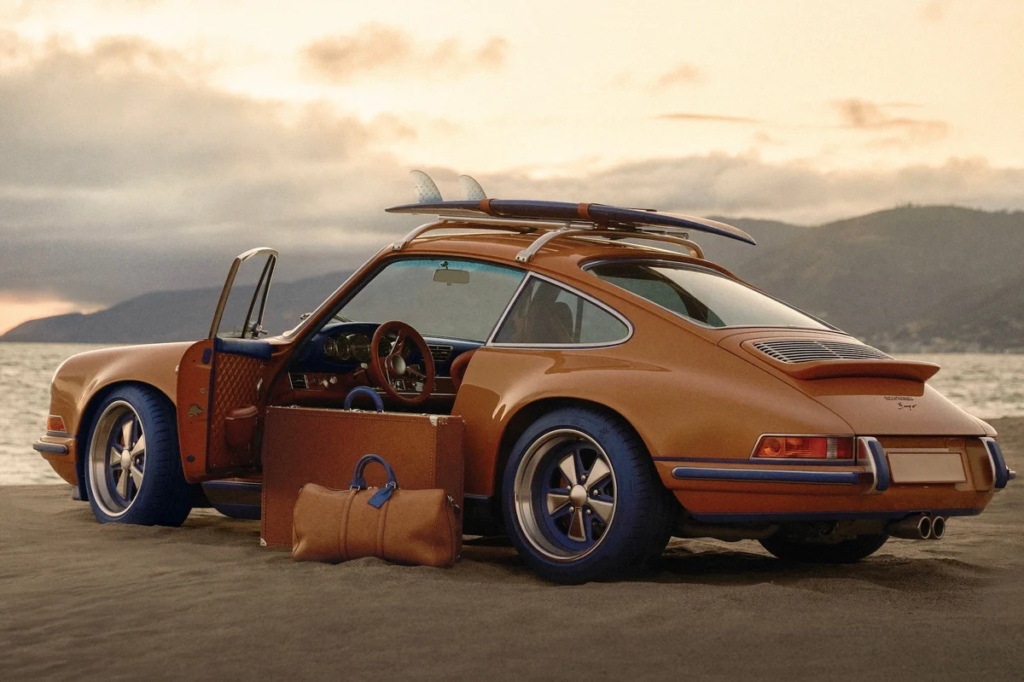
The first vehicle, officially called the Porsche 911 Reimagined by Singer – Classic, uses a striking combination of saffron, cobalt blue and yellow.
The colour choices are more deliberate than they initially appear. Singer says the saffron references a shade that has existed in Louis Vuitton’s archives for more than 150 years and has appeared extensively across the house’s packaging. It also connects with Bahama Yellow, a colour associated with some of Singer’s early commissions.
Inside, natural leather covers much of the cabin, while diamond-pattern embossing references the quilted interiors of Louis Vuitton trunks. Monogram flower motifs have also been incorporated into the seats as ventilation details rather than simply applied as decorative branding.
The result avoids looking like a conventional fashion logo pasted onto an existing vehicle. Louis Vuitton’s design language has instead been incorporated into surfaces, materials and functional components.
That distinction gives the project much of its credibility.
The Roof Rack May Be the Most Revealing Detail
The most interesting element may not be inside the car at all.
Singer designed a roof rack capable of carrying a fitted Louis Vuitton trunk, a pair of skis or a bespoke surfboard. Louis Vuitton then developed the objects themselves, including a surfboard made using blond oak and walnut marquetry and skis constructed from materials including wood, titanium and steel.
There is also a complete travel wardrobe around the Classic, including a leather racing jacket, driving shoes, gloves, a helmet and luggage designed specifically for the available storage spaces.
That turns the car into something more than a collector’s Porsche with fashion-house detailing. The luggage, clothing and sporting equipment have been designed around the journey the car is supposed to enable.
For Louis Vuitton, whose identity was built around trunks and travel long before handbags became its most recognisable products, the connection is particularly fitting.
The Second Porsche Takes a Completely Different Direction
The second car demonstrates how far the collaboration could stretch without simply repeating the same visual formula.
The Porsche 911 Reimagined by Singer – Classic Turbo is a cabriolet conceived with Nicolas Ghesquière, Louis Vuitton’s artistic director of women’s collections.
Instead of the bright saffron and cobalt palette of the Classic, the Turbo is finished in Calcaire Lutétien white with natural leather, gold-toned details and extensive woodwork. Its design takes inspiration from classic motorboats, extending to a rear luggage compartment that opens to reveal a deck-like wooden treatment.
The nautical references give the second car an entirely different character while preserving the same principle: the vehicle is being treated as a complete design environment rather than simply a machine receiving luxury trim.
Ghesquière’s involvement also pushes the project further into the territory where fashion, industrial design and automotive culture increasingly overlap.
Why the Louis Vuitton Singer Porsche 911 Collaboration Stands Out
Fashion and automotive collaborations are hardly new. Luxury brands regularly work with carmakers on special editions, luggage collections and limited accessories.
The Louis Vuitton and Singer project feels different because of its depth.
The cars are only one part of the proposition. Watchmaking, luggage design, leathercraft, fashion, sporting equipment and automotive engineering all sit within the same project.
Forbes described the collaboration as considerably more extensive than the badge-and-colour approach common to luxury automotive partnerships, noting how the original dashboard-clock concept eventually expanded across two highly individualised Porsche 911s.
That matters because wealthy consumers increasingly have access to almost every conventional symbol of luxury. Rarity alone is no longer enough at the highest end of the market. Personalisation, provenance, craftsmanship and the ability to create something that cannot easily be replicated become more significant.
A Porsche 911 restored by Singer is already a highly specialised object. Adding Louis Vuitton does not simply make it more expensive or more recognisable. It creates another layer of storytelling and customisation around how the car is used.
Luxury Is Moving Beyond Products Into Complete Experiences
The collaboration also reflects a broader direction within luxury.
Fashion houses increasingly operate far beyond clothing and handbags. Their identities now extend into restaurants, hotels, furniture, watches, travel experiences and highly specialised collaborations.
The appeal is not difficult to understand. A customer buying at the highest end of the luxury market may not want another isolated product. They may want a coherent environment built around their tastes.
The Singer collaboration follows that logic particularly well.
A customer is not simply offered a car. The luggage fits the storage space. The driving clothes match the project. The clock belongs to the dashboard but can also sit on a desk. The skis and surfboard turn potential journeys into part of the design story.
In that sense, the product is not just the Porsche.
The product is the world created around it.
Singer Brings a Different Kind of Luxury
Louis Vuitton’s involvement may attract much of the mainstream attention, but Singer is equally important to why the collaboration works.
The California company has built its reputation by reimagining air-cooled Porsche 911s with extraordinary levels of customisation rather than producing cars at conventional manufacturing scale.
Each project sits somewhere between restoration, engineering and commissioned design. Singer’s approach makes it unusually compatible with a luxury house that places similar emphasis on materials and craft.
Car and Driver notes that the two vehicles are based around the 964 generation of the Porsche 911, with the Classic using a naturally aspirated 4.0-litre flat-six and six-speed manual transmission, while the Classic Turbo uses a twin-turbocharged 3.8-litre flat-six.
These are therefore not static fashion objects. Beneath the luggage, leather and watchmaking details remain serious performance cars.
A Collaboration Designed for Collectors
Neither Louis Vuitton nor Singer has publicly disclosed pricing for the two cars, although reports indicate the vehicles and their associated collections are being offered for sale.
For prospective owners at this level, however, conventional price comparisons are unlikely to be the central consideration.
The appeal lies in having a project that combines two highly recognisable names but is not designed for mass replication. Each car brings together Singer’s interpretation of Porsche engineering with Louis Vuitton’s history in travel, leatherwork and watchmaking.
That combination makes the cars as relevant to collectors of design and luxury objects as they are to automotive enthusiasts.
The Porsche 911 Becomes Part of the Journey
The most successful luxury collaborations tend to make sense even after the surprise of the partnership wears off.
Louis Vuitton and Singer have a natural connection in that both businesses place considerable value on craftsmanship, personalisation and objects designed to be kept rather than quickly replaced.
The Porsche 911 provides an unusually effective canvas for bringing those ideas together.
More importantly, Louis Vuitton has not treated the car simply as another surface on which to place its monogram. From the removable Tambour-inspired clock to luggage shaped for individual storage compartments and equipment designed for trips by road, sea or mountain, the collaboration considers what might happen around the car as much as what happens inside it.
That is what makes the project interesting beyond its rarity.
Louis Vuitton and Singer have not simply created two luxury Porsche 911s. They have turned the automobile into the centrepiece of an entire approach to travel, where the car, luggage, wardrobe and destination are designed to belong to the same experience.
Frequently Asked Questions
What is the Louis Vuitton Singer Porsche 911 collaboration?
Louis Vuitton and Singer collaborated on two highly customised Porsche 911s unveiled in August 2026. The project combines Singer’s automotive work with Louis Vuitton’s leathercraft, luggage, watchmaking and fashion expertise.
How many Louis Vuitton Singer Porsche 911s were created?
The collaboration features two distinct cars: a Porsche 911 Reimagined by Singer – Classic and a Porsche 911 Reimagined by Singer – Classic Turbo cabriolet.
What accessories come with the Louis Vuitton Porsche 911?
The project includes made-to-measure luggage, driving clothing, helmets and other accessories. Depending on the car, Louis Vuitton also designed items including skis and a surfboard that can be carried using a specially designed roof rack.
How did the Louis Vuitton and Singer collaboration begin?
It began with Singer asking Louis Vuitton to develop a mechanical dashboard clock. The Tambour-inspired removable clock eventually led the two companies to expand the collaboration across the instruments, interiors and ultimately two complete vehicles.
How much does the Louis Vuitton Singer Porsche 911 cost?
An official price has not been publicly disclosed. The project consists of highly bespoke vehicles and associated accessories rather than a conventional production model.
Don’t forget to follow us on Facebook | Instagram | Twitter | LinkedIn to get the latest updates from Cape Town Tribune