
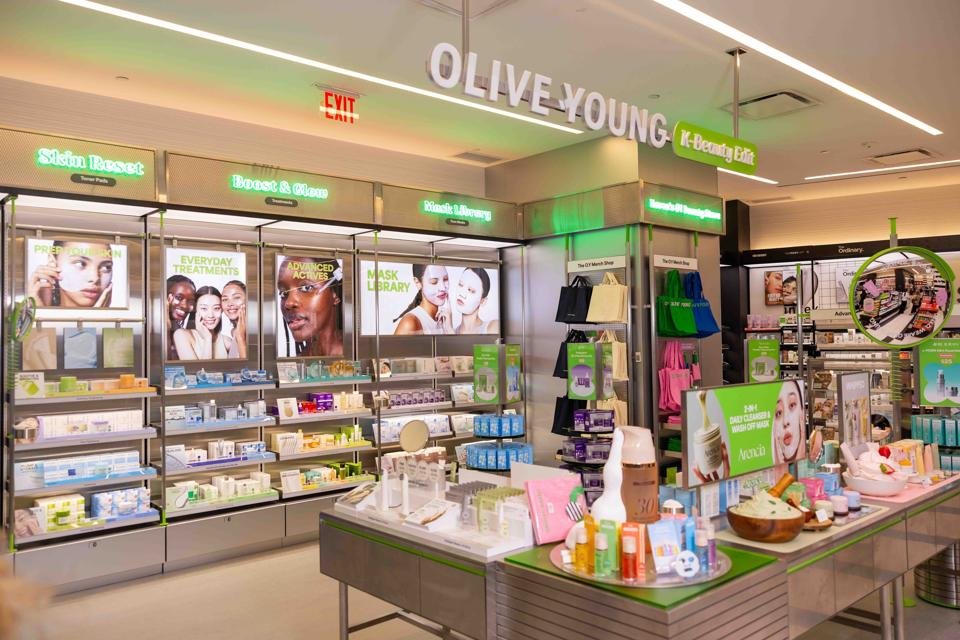

Olive Young Sephora is moving K-beauty deeper into the American mainstream, with 19 Korean beauty brands now rolling out across more than 500 Sephora stores in the United States and on Sephora.com.
The US launch, which began on August 20, 2026, is the first activation under a broader global partnership between Sephora and CJ Olive Young, South Korea’s dominant health and beauty retailer. The collaboration gives American shoppers easier access to Korean skincare and beauty labels selected for their performance, popularity, and trend leadership in Korea.
But the significance goes beyond adding another shelf of Korean serums and sheet masks.
K-beauty is entering a different stage of its international growth. What initially spread through beauty blogs, YouTube, TikTok, online marketplaces and specialist importers is increasingly becoming part of established Western retail. The Olive Young Sephora partnership puts one of Korea’s most influential beauty curators inside one of the world’s most powerful prestige beauty networks.
And it is happening just as Korean cosmetics exports and US consumer demand are reaching new highs.
What Is the Olive Young Sephora Partnership?
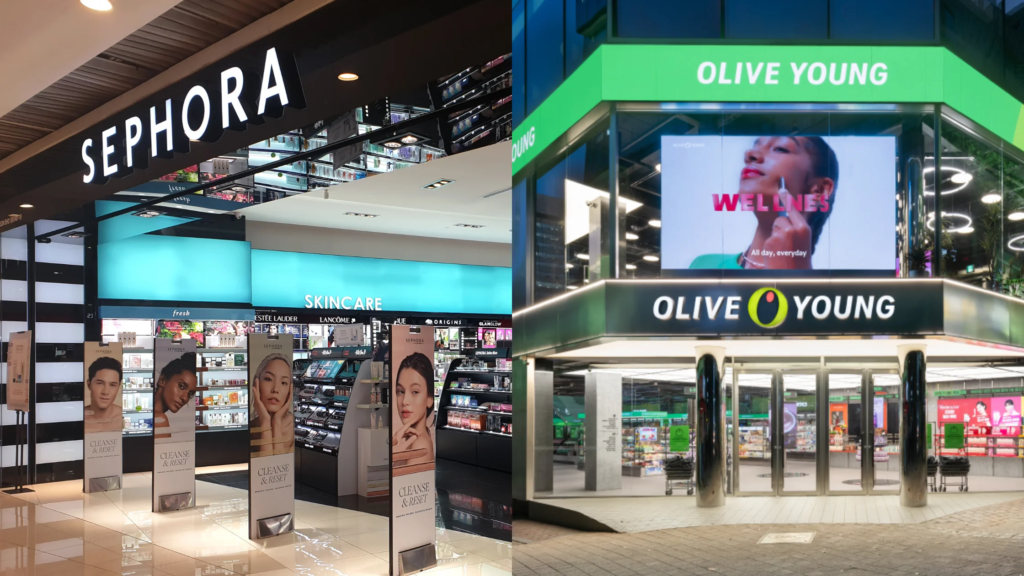
Under the partnership, Sephora has introduced an “OLIVE YOUNG K-Beauty Edit” featuring 19 Korean brands selected jointly with Olive Young.
The collection is available in more than 500 Sephora locations across the US, as well as online. Sephora’s Times Square flagship in New York has also received a dedicated Olive Young K-beauty space.
According to Sephora, the products were selected based on their performance, consumer popularity and ability to lead beauty trends in South Korea.
Carolyn Bojanowski, Sephora’s executive vice president of merchandising, said the partnership expands American consumers’ access to some of Korea’s most sought-after beauty products.
“Access to Korean Beauty has redefined the global beauty landscape.”
The deal effectively combines two different strengths.
Sephora brings international retail scale, brand recognition and an established prestige-beauty customer base. Olive Young brings something harder to replicate: a close view of what Korean consumers are actually buying before many products become international trends.
Which 19 K-Beauty Brands Are Coming to Sephora?
The initial Olive Young Sephora assortment includes:
- Abib
- Arencia
- BANILA CO
- beplain
- BIOHEAL BOH
- Cell Fusion C
- FATION
- FULLY
- HEVEBLUE
- MENOKIN
- REJURAN Cosmetics
- S.NATURE
- SUNGBOON EDITOR
- THOME
- Torriden
- WELLAGE
- WHIPPED
The selection spans cleansers, sunscreens, masks, serums, moisturisers and treatment-led skincare, reflecting one of the biggest forces behind K-beauty’s latest growth cycle: results-focused skincare rather than novelty alone.
Several of the names are already familiar to dedicated K-beauty shoppers. Others have had much less exposure through mainstream US prestige retail.
That discovery element is important.
Olive Young’s value to Sephora is not simply its ability to supply Korean products. It acts as a filter in an increasingly crowded beauty market.
Why the Olive Young Sephora Deal Matters Now
Korean beauty has been influential in the US for well over a decade. BB creams, cushion foundations, sheet masks, double cleansing, essences and “glass skin” routines have all moved from Korean beauty culture into international beauty conversations.
What is changing is the scale of distribution.
Circana reported that K-beauty brands in US prestige retail recorded 23% growth in dollar sales and 24% growth in units during the first quarter of 2026.
That is significantly faster than the overall US prestige beauty market, which grew 6% to $8.1 billion during the same period.
K-beauty still represents only about 3% of US prestige beauty retail, according to Circana, suggesting considerable room for further expansion.
In mass retail, its share is somewhat larger at around 6%. Korean skincare within that market was growing particularly quickly, with dollar sales up approximately 35%.
That combination of high growth and relatively low market share is one reason the Olive Young Sephora expansion matters.
There is already demand, but there is still substantial space for Korean brands to become more widely distributed.
K-Beauty Is Becoming a Major Korean Export Industry
The retail expansion is also part of a much larger economic story.
South Korean cosmetics exports reached a record $11.4 billion in 2025, increasing roughly 12% from the previous year, according to South Korea’s Ministry of Food and Drug Safety.
The United States became the largest overseas market for Korean cosmetics, receiving approximately $2.2 billion of exports, ahead of China and Japan.
South Korea also rose to become the world’s second-largest cosmetics exporter in 2025, according to the ministry’s analysis.
That is a significant shift.
China was historically the dominant overseas market for many Korean beauty companies. Greater US demand, together with expansion across Europe, Southeast Asia and the Middle East, is making the industry’s export base more diversified.
The share of Korean cosmetics exports going to markets outside the country’s five largest destinations climbed from 19.5% in 2021 to 43.4% in 2025, according to South Korea’s Ministry of Health and Welfare.
K-beauty is increasingly becoming a global consumer export industry rather than a regional success story.
Olive Young Is Expanding in America on Its Own, Too
The Sephora partnership is only one part of Olive Young’s US strategy.
The company opened its first American store in Pasadena, California, on May 29, 2026. The 8,647-square-foot location was accompanied by the launch of a dedicated US online store.
Olive Young followed that with a second location at Westfield Century City in Los Angeles on June 13.
The Pasadena opening also provided an early indication of demand. CJ said shoppers began lining up before sunrise, with some customers arriving during the night ahead of opening day.
Olive Young has said it intends to establish additional California locations before expanding into other major US markets. Five California stores are planned by early 2027 as part of its broader omnichannel strategy.
That creates an interesting retail strategy.
Rather than choosing between building its own stores and partnering with an established retailer, Olive Young is doing both.
Its standalone locations can introduce American consumers to the full Korean-style Olive Young shopping experience. Sephora, meanwhile, gives selected brands immediate national reach.
Why Sephora Wants a Bigger Piece of K-Beauty
There is also a clear commercial logic for Sephora.
The US beauty market remains remarkably resilient despite pressure on household budgets.
Circana estimated that US prestige beauty sales reached $36 billion in 2025, up 4%, while mass-market beauty sales increased 5% to $72.7 billion. Prestige skincare alone grew 3% during the year.
Consumers are also becoming more demanding about value.
Only 14% of US beauty buyers surveyed by Circana in 2025 believed that a higher price necessarily indicated better quality.
That environment suits many Korean beauty brands.
K-beauty has built much of its international reputation around combining relatively accessible prices with ingredient innovation, distinctive textures, sophisticated sunscreens and treatment-driven skincare.
For Sephora, the Olive Young Sephora deal provides a pipeline of products that can appeal to shoppers looking for innovation without automatically moving into ultra-luxury price points.
K-Beauty’s Image Is Changing
The newest phase of Korean beauty also looks different from the first wave that swept through Western markets.
The earlier K-beauty boom was frequently associated with unusual packaging, multi-step routines and viral products.
Circana says the 2026 market is showing a more clinical and treatment-focused identity, with greater attention to skin-barrier health, biotechnology, dermatological positioning and performance-led ingredients.
Products using peptides, hyaluronic acid, collagen-focused formulations, advanced sunscreens and ingredients associated with Korean dermatology have become increasingly visible.
That shift may broaden K-beauty’s audience.
Consumers who once saw Korean skincare as an internet trend are increasingly encountering it alongside established European, American and Japanese beauty labels.
The Partnership Is Going Global
The US is only the first stage of the Olive Young Sephora partnership.
Sephora says the collaboration is expected to expand into Hong Kong, Singapore, Malaysia and Thailand later in 2026.
Further launches are planned for the Middle East, United Kingdom and Australia in 2027.
That global roadmap could be especially important for smaller Korean beauty companies.
International expansion is expensive. Brands need distribution, marketing, regulatory expertise, logistics and credibility with local consumers.
Being selected by Olive Young and placed inside Sephora potentially provides several of those advantages at once.
For emerging brands, the partnership could therefore function as more than a retail agreement. It could become a route from success in Korea to international scale.
K-Beauty Is Moving From Trend to Retail Infrastructure
The most important part of the Olive Young Sephora partnership may be what it says about K-beauty’s evolution.
Korean skincare no longer depends primarily on consumers discovering a product through a viral TikTok, ordering it from overseas and waiting for international delivery.
That discovery culture remains important, but a parallel retail infrastructure is being built around it.
Olive Young now has its own American stores. Sephora is giving its curation national distribution. South Korean cosmetics exports have passed $11 billion. And US demand for Korean prestige beauty is growing at a double-digit pace.
None of this guarantees that every Korean brand will succeed internationally. Beauty trends move quickly, and the US market is intensely competitive.
But the direction is becoming difficult to ignore.
K-beauty spent years teaching international consumers new products, ingredients and routines through the internet. The Olive Young Sephora rollout of 19 brands across more than 500 US stores suggests the next phase will be fought on physical shelves as much as on social feeds.
And that could prove far more consequential than the latest viral skincare trend.
Don’t forget to follow us on Facebook | Instagram | Twitter | LinkedIn to get the latest updates from Cape Town Tribune