
For much of the past six years, the question surrounding Céline Dion was no longer when she would release another album or announce another tour. It was whether one of the most recognizable voices in popular music would ever be able to perform a full concert again.
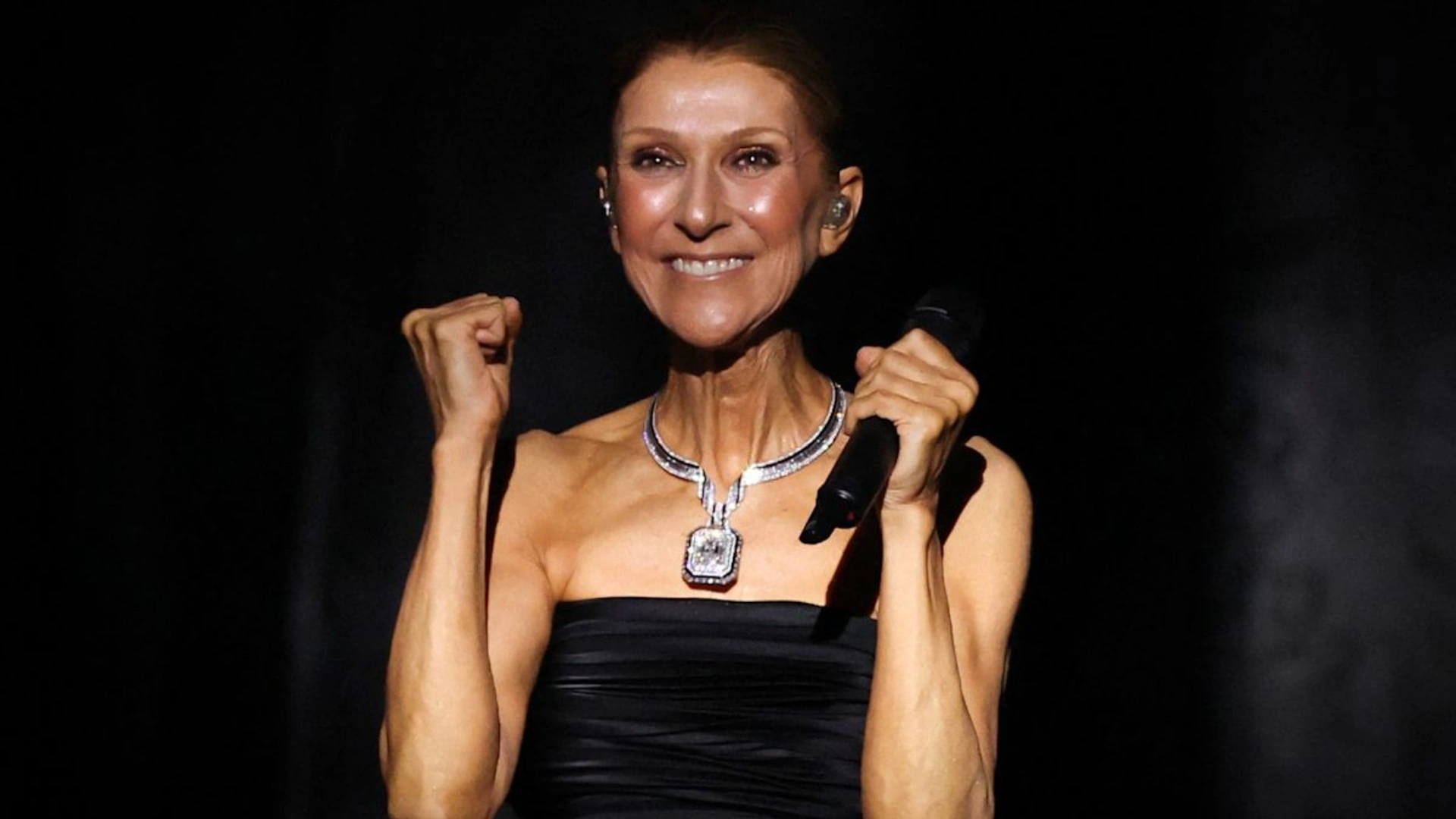
On Saturday night in Paris, Dion offered her answer.
The 58-year-old Canadian singer returned for her first full-length concert in more than six years, opening her Céline Dion Paris 2026-2027 engagement at Plénitude Arena in Nanterre, just outside the French capital. Her team said the opening night drew a sold-out audience of 35,000 people.
For Dion, it was more than the beginning of another series of shows. It marked the most demanding stage of a comeback that once appeared uncertain after she revealed in 2022 that she had been diagnosed with stiff-person syndrome, a rare neurological disorder that can cause severe muscle stiffness and painful spasms.
Standing before the crowd, Dion acknowledged the long road back.
“I made a promise to come back and to be back on stage,” she told the audience. “So here I am.”
The words carried unusual weight. Dion has spent much of her career performing songs built around longing, survival, heartbreak and devotion. This time, however, the emotion in the arena came as much from what had happened away from the stage as from the songs themselves.
A full concert changes the meaning of Dion’s comeback
Dion had already given the world a glimpse of her return. At the opening ceremony of the Paris Olympics in July 2024, she appeared on the Eiffel Tower and performed Édith Piaf’s “Hymne à l’amour.” It was her first live performance since March 2020 and became one of the ceremony’s defining moments.
But a single song, however significant, is different from carrying an entire concert.
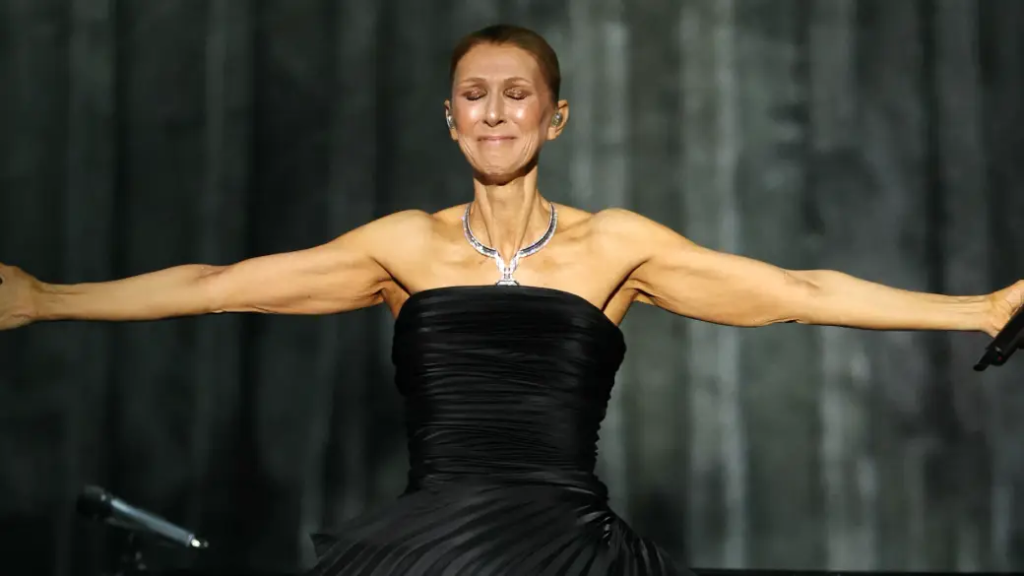
Saturday’s performance asked much more of her physically and vocally. The Associated Press reported that Dion performed 25 songs during a show lasting more than two hours. The set included material from both her French and English catalogues, bringing together songs that have followed her from Quebec to some of the world’s largest stages.
Her official website said the concert opened with the French-language song “On ne change pas” before moving through tracks including “Because You Loved Me,” “Courage” and “It’s All Coming Back to Me Now.”
That duration matters because Dion’s return is not simply about proving that she can still produce a spectacular vocal moment. The larger question has been whether her health would allow her to return to the rhythms and demands of live performance. Paris provided the strongest answer yet.
It was not a declaration that her illness had disappeared. Nor was it an attempt to erase what had happened. Instead, the concert presented a performer learning how to work within circumstances that have fundamentally changed.
Reviews noted that some songs had been adjusted to accommodate her current voice and condition. That did little to diminish the emotional force of the evening. In some ways, the adjustments made the performance more revealing. This was not Dion attempting to recreate herself exactly as she had been before her illness. It was a singer finding a way to continue.
What stiff-person syndrome meant for Céline Dion
Dion publicly disclosed her diagnosis in December 2022 after health problems had already forced interruptions to her touring schedule.
Stiff-person syndrome is a rare neurological condition associated with muscle stiffness and spasms. According to the U.S. National Institute of Neurological Disorders and Stroke, symptoms can affect the torso, arms and legs, while factors including sound, touch and emotional stress can trigger spasms in some patients. The condition can vary significantly in severity and is considered progressive.
For any performer, such symptoms can be difficult. For an artist whose career has depended on precise control of her body, breathing and voice during lengthy concerts, they posed an especially serious challenge.
Dion’s struggle became more visible with the release of the 2024 documentary I Am: Céline Dion, which showed the singer dealing with the physical reality of her condition rather than presenting a polished version of celebrity recovery.
That openness changed the nature of her relationship with many fans. For decades, Dion had been associated with extraordinary control. Her voice could move from delicate passages to huge sustained notes with a technical certainty that became central to her reputation.
The documentary introduced another image: a performer facing the possibility that her body might no longer reliably allow her to do what had defined much of her life.
That is why Saturday’s concert carried an emotional charge beyond nostalgia.
Audiences were not simply watching a famous singer perform familiar songs. They were watching someone return to an activity she had publicly acknowledged she might lose.
Why Paris was the natural place to return
There is also a reason this chapter is unfolding in Paris.
Dion’s international career is often remembered through English-language hits such as “The Power of Love,” “Because You Loved Me,” and the Titanic theme “My Heart Will Go On.” But her connection to the French-speaking world predates her emergence as an English-language superstar.
Born in Charlemagne, Quebec, Dion began recording in French as a teenager. Long before Hollywood soundtracks and Las Vegas residencies turned her into a global pop figure, French-speaking audiences had already embraced her.
France remained an important part of her career even after international success followed.
That relationship was visible across Paris in the days surrounding her return. Fans gathered outside her hotel, while the city hosted events tied to the comeback, including a mass karaoke celebration. Reuters reported that Dion has described France as her “second home.”
The choice of Paris therefore gives the residency a circular quality.
It was in Paris that Dion made her dramatic Olympic comeback in 2024. It is in Paris that she is now attempting something far harder: returning not for one song, but for a run of full concerts.
The current schedule stretches well beyond opening night. Dion’s official concert site lists 16 performances between September and October 2026, followed by another 10 dates in May 2027.
The scale of that commitment is perhaps the most important detail of all.
A comeback can be built around one carefully controlled appearance. A residency requires repetition. It requires recovery between performances, consistency, and the ability to return to the stage night after night.
How Dion manages that schedule will be watched closely.
This is not simply a story about resilience
Celebrity comeback stories are often reduced to simple narratives of adversity and triumph. Dion’s situation is more complicated.
Stiff-person syndrome has no simple cure that guarantees a return to a previous level of function. Treatment can help manage symptoms, and therapies may improve stiffness, mobility, and other complications, but experiences vary from patient to patient.
Dion’s successful return to concert performance therefore should not be read as evidence that the illness is behind her. Instead, the significance lies in adaptation.
Pop music has traditionally asked its biggest stars to project permanence. Singers are expected to reproduce the hits audiences remember, deliver the notes people have heard for decades, and appear largely unchanged by time.
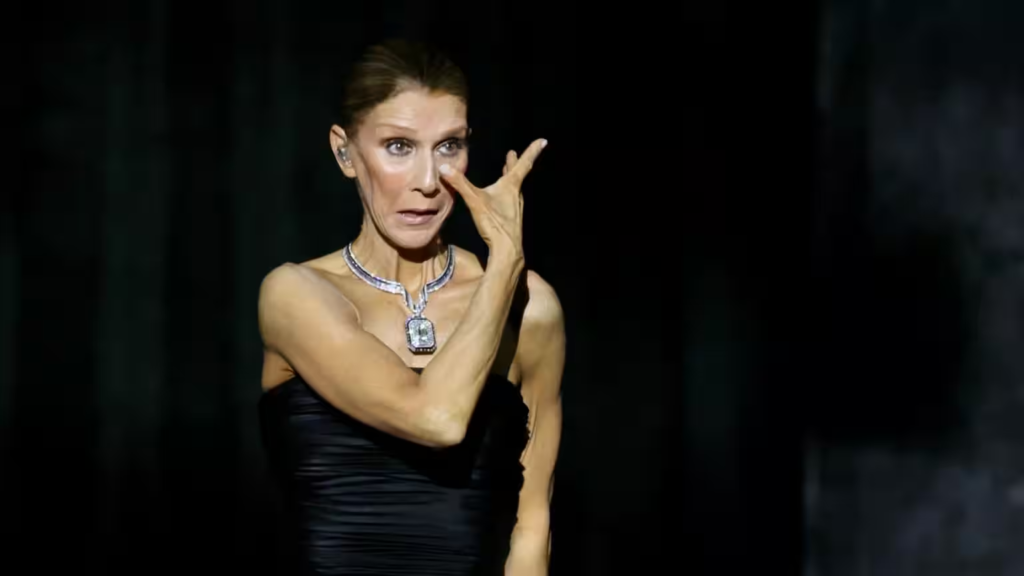
Dion’s return challenges that expectation. The audience in Paris knew what she had been through. Many had seen the documentary, followed the cancellations and watched the Olympic performance. They were not gathering simply to compare every note with recordings made decades earlier.
The vulnerability had become part of the performance. That may explain why her return has generated attention beyond her established fan base. It is not merely another veteran singer launching another residency. It is a public test of what a performing career can look like after serious illness.
A career built for the big stage
Few singers have a catalogue better suited to a moment this emotionally charged.
Dion’s career has been built around scale. She represented Switzerland and won the Eurovision Song Contest in 1988 before breaking into the English-language market and becoming one of the defining pop vocalists of the 1990s.
By the middle of that decade, she had moved comfortably between French-language success and international pop stardom. Then came “My Heart Will Go On,” the theme from James Cameron’s Titanic, which attached Dion’s voice to one of the most successful films in cinema history.
Her career later helped transform the modern Las Vegas residency into a destination for major contemporary artists rather than a final stop for performers past their commercial peak.
The Paris concerts now represent a very different type of residency. This time, the spectacle matters less than the fact that Dion is there at all.
The promise was never just about returning
In March, when Dion announced her Paris concerts on her 58th birthday, the news carried a sense of uncertainty that is difficult to separate from Saturday’s performance.
Fans knew that she wanted to return. The 2024 Olympics proved she could still produce a remarkable performance under extraordinary circumstances. What remained unknown was whether that moment could become something sustainable.
The opening concert does not answer every question. With months of performances still ahead, the focus will be on how Dion manages the demands of the schedule while continuing to prioritise her health.
But Saturday night changed the conversation. For years, Céline Dion’s story was about absence: cancelled performances, medical treatment, uncertainty and the possibility that a career built around one of popular music’s most famous voices had reached an ending she had not chosen.
Paris offered a different image. There was Dion, standing in front of tens of thousands of people again, singing songs that audiences have carried with them for decades.
She had promised that she would try to return. Six years after her last full concert, she finally did.
Don’t forget to follow us on Facebook | Instagram | Twitter | LinkedIn to get the latest updates from Cape Town Tribune