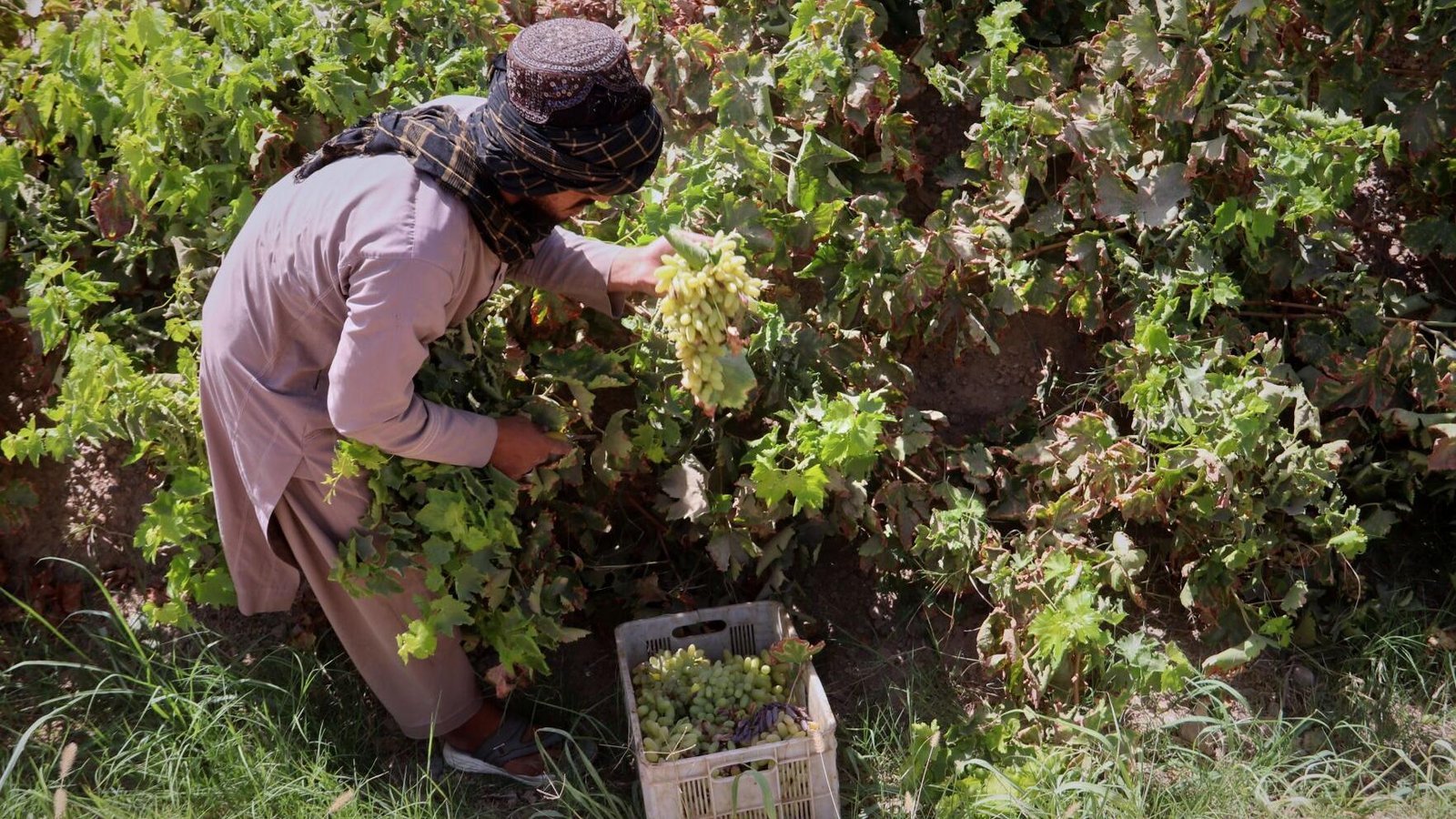

Afghanistan’s southern province of Kandahar is in the middle of a strong grape harvest, but for many Afghan grape farmers, abundance has become a problem rather than a reward.
The prolonged closure of key trade routes with Pakistan has cut growers off from their most important foreign market. Fresh grapes that would normally move quickly across the border are instead piling into domestic markets, pushing prices down and leaving orchard owners with few profitable options. Many Afghan grape farmers are responding by drying part of the harvest and turning it into raisins, which last longer but currently sell for far less than growers once expected.
The shift looks simple from a distance, yet it reflects a much larger disruption in everyday rural life. Grapes support orchard owners, seasonal pickers, transport workers, traders and families across southern Afghanistan. When those grapes cannot cross the border, the losses spread well beyond the vineyard.
Why Afghan Grape Farmers Are Turning Grapes Into Raisins
Fresh grapes are highly perishable. Once picked, growers have a limited window to sell or transport them before quality declines. Raisins offer one practical advantage: drying extends the life of the fruit and gives producers more time to find buyers.
That is why Afghan grape farmers in Kandahar’s Zhari district are hanging bunches of green grapes inside drying facilities rather than sending them straight to Pakistan. In the hot summer air, the fruit can be preserved instead of being sold immediately into an overcrowded local market.
The economics, however, are difficult. One orchard owner told AP that seven kilograms of raisins previously fetched about 1,000 to 1,200 afghanis. The same amount is now selling for roughly 400 to 450 afghanis. Turning grapes into raisins can reduce waste, but it does not restore the income lost when export channels disappear.
For Afghan grape farmers, preservation is therefore a defensive move. It buys time, but it does not solve the deeper problem of market access.
Pakistan Was the Market That Made the Harvest Work
The scale of Afghanistan’s dependence on Pakistan becomes clear in the export data. In 2025, five southern provinces that form the country’s main grape-producing region exported 44,225 tonnes of grapes worth about $13.8 million. Around 43,000 tonnes went to Pakistan, while much smaller quantities were sold to Bangladesh, Iraq and India.
So far in 2026, only 256 tonnes have been exported, worth about $100,000.
That collapse has left Afghan grape farmers facing a market that suddenly became much smaller than the harvest itself. Kandahar has no shortage of fruit this season. Local estimates published earlier in August placed grape production in the province above 225,000 tonnes, but export routes remained restricted.
When an agricultural economy is built around fast access to a neighbouring market, replacing that market is not as easy as finding another name on a map. Fresh fruit needs predictable customs procedures, affordable transport, storage and buyers able to take large volumes at short notice. Alternative routes can be significantly more expensive and complicated, particularly for perishable produce.
A Good Harvest Can Still Become a Bad Year
Agriculture often depends on a straightforward expectation: a bigger harvest should mean more income. This season in Kandahar shows why that assumption can fail.
A plentiful crop has increased the amount of fruit available just as access to the main export market has narrowed. Domestic buyers now have more grapes to choose from, which weakens growers’ bargaining power and drives prices lower. AP reported that the oversupply has sharply depressed both fresh-grape and raisin prices.
Afghan grape farmers are therefore confronting one of the harsher contradictions of food production. Their vines have performed well, yet that success can deepen their losses when the market cannot absorb what they have grown.
The situation is especially difficult for small producers who need cash from the harvest to cover household expenses, maintain orchards and prepare for the next growing season. Unlike durable goods, fresh fruit cannot simply sit in storage while farmers wait for politics to improve.
Raisin production helps stretch that timetable, but the steep fall in raisin prices means even this traditional method of preservation offers only partial protection.
Border Closures Are Reaching Deep Into Rural Livelihoods
The Afghanistan-Pakistan border has faced prolonged trade disruption following repeated clashes and political tensions between the two countries. Pakistan accuses Afghanistan’s Taliban authorities of allowing militants to operate from Afghan territory, an accusation Kabul denies. The extended closure dates back to fighting that intensified in October 2025.
For traders, the geopolitical argument is experienced in much more ordinary terms. A closed crossing means trucks stop moving, workers lose shifts and agricultural products stay inside the country.
The impact on Afghan grape farmers is particularly visible because grapes are both seasonal and perishable. Missing the export window can wipe out much of the value of an entire year’s crop.
The damage also reaches people who do not own land. Seasonal workers depend on grape picking, packing and loading for income. AP reported that one orchard employing about 1,500 workers last year was employing only around 15 this season.
That kind of contraction changes village life quickly. A farmer loses a buyer, a worker loses wages, a transporter loses a shipment and a household loses income it may have expected to use for food, fuel or other basic expenses.
Why Raisins Matter to Afghan Grape Farmers
Drying grapes is not a new response invented for this crisis. Raisins are part of Afghanistan’s agricultural economy and a familiar way of preserving fruit in a country where producers have long dealt with difficult transport and market conditions. Dried fruit also gives farmers more time to sell than a fresh crop allows.
What is different in 2026 is the pressure forcing Afghan grape farmers to rely more heavily on that option.
Inside drying houses, bunches are arranged so air can circulate around them as moisture gradually leaves the fruit. AP documented the process in Kandahar’s Zhari district, where fans move hot summer air around rows of hanging grapes.
In normal conditions, that flexibility can be an advantage. During a market collapse, however, many producers making the same decision at once can create another oversupply. Raisin prices then fall too.
This is why the current shift should not be read as a story about farmers simply discovering a better use for grapes. Afghan grape farmers are trying to protect what value remains in a harvest whose normal commercial route has been disrupted.
The Crisis Is Bigger Than Grapes
Kandahar’s fruit economy includes pomegranates as well as grapes, and business representatives say border restrictions are affecting both. The wider Afghanistan-Pakistan trade relationship has also been disrupted for months, hurting traders and workers on both sides of the frontier.
Before the extended closure, bilateral commerce supported large networks of transporters, wholesalers, customs agents and market workers. RFE/RL reported in June that Afghanistan and Pakistan had previously traded about $200 million worth of goods each month, citing a representative of the Pakistan-Afghanistan Joint Chamber of Commerce and Industry.
For Afghan grape farmers, those national trade figures become personal at harvest time. A border crossing determines whether fruit can reach a buyer quickly enough, whether a trader offers a workable price and whether seasonal workers are hired.
The story also shows how vulnerable agricultural communities can become when a large share of their exports depends on a single neighbouring country. Diversifying markets may sound straightforward in policy discussions, but perishable crops require roads, storage, processing facilities, financing and reliable trade corridors.
How the Border Dispute Hits Afghan Grape Farmers at Home
From an international perspective, Afghanistan-Pakistan tensions are usually covered through security, diplomacy and border clashes. In Kandahar, the same confrontation looks different.
It looks like grapes hanging in drying rooms because trucks cannot take them to Pakistan. It looks like lower wages, fewer seasonal jobs and farmers accepting prices they would once have rejected.
That is what makes the situation facing Afghan grape farmers relevant beyond agricultural trade. It shows how international disputes move into household budgets and decisions about whether a family can manage the months between one harvest and the next.
Afghanistan continues to face widespread poverty and food insecurity, which means severe income losses in farming communities can carry broader humanitarian consequences. AP noted that such losses are especially serious in a country where poverty and malnutrition remain widespread.
When farm income falls, spending in nearby markets can fall with it. Seasonal employment shrinks, transport work disappears and businesses that depend on agricultural communities lose customers.
Why New Markets Are Difficult for Afghan Grape Farmers
The obvious long-term answer is for Afghanistan to sell more fruit to countries other than Pakistan. In practice, that transition is difficult.
Pakistan is geographically close, familiar to Afghan traders and historically able to absorb large quantities of fresh produce. Last year’s figures show just how dominant the Pakistani market was: around 43,000 of 44,225 exported tonnes from the five southern provinces went there.
Reaching more distant destinations adds transport time and cost. Grapes also require careful handling, which makes weak storage and transport infrastructure a serious constraint. Alternative routes through Iran and Central Asia have proven more expensive for Afghan traders during the prolonged border disruption.
Afghan grape farmers would benefit from more drying capacity, packaging facilities, storage and reliable transport corridors. Those investments could allow producers to sell more fruit in processed form while also giving fresh grapes a better chance of reaching distant markets in good condition.
But infrastructure cannot fully replace stable trade relations. For the current harvest, farmers need routes that function now rather than processing capacity that may take years to build.
That is why growers and business representatives have repeatedly called on Kabul and Islamabad to restore commercial movement across the border.
What Reopening the Border Could Change for Afghan Grape Farmers
If major crossings reopen to commercial traffic, the most immediate benefit for Afghan grape farmers would be renewed access to the market that bought nearly all of the region’s exported grapes last year.
A reopening would not automatically restore previous prices. Traders would still have to work through the surplus that has accumulated inside Afghanistan, and commercial relationships disrupted by months of closure could take time to normalise.
Even so, restored trade would give growers something they currently lack: another major source of demand.
When farmers have only a crowded domestic market, buyers can offer very low prices because sellers have few alternatives. An export route introduces competition for the harvest and can strengthen producers’ bargaining position.
For seasonal workers, reopened trade could also revive jobs in harvesting, sorting, packing, transport and wholesale markets. The scale of employment losses reported in individual orchards shows how directly export activity can affect rural work.
The longer the disruption lasts, however, the greater the chance that this season’s losses become lasting financial damage for some households.
Afghan Grape Farmers Are Preserving More Than Fruit
The image of grapes slowly becoming raisins in Kandahar captures the practical intelligence of farming communities under pressure. Producers are using a familiar preservation method to keep part of their crop from losing all value.
But adaptation should not obscure the scale of the loss.
Afghan grape farmers had a strong harvest and a well-established customer base across the Pakistani border. What they lack is reliable access between the two.
The result is a season in which abundance has become a liability. Raisins can keep longer than fresh grapes, but they cannot replace thousands of lost export shipments, vanished seasonal jobs or the income families expected from a successful harvest.
For now, Kandahar’s drying houses are buying farmers time. Whether that time leads to recovery will depend far less on the quality of the grapes than on whether trade routes reopen.
Frequently Asked Questions
Why are Afghan grape farmers making more raisins?
Afghan grape farmers are drying more fresh grapes because prolonged border closures with Pakistan have sharply reduced access to their main export market. Raisins can be stored considerably longer than fresh grapes, giving growers more time to find buyers.
How badly have Afghan grape exports fallen in 2026?
Five southern Afghan provinces exported 44,225 tonnes of grapes in 2025, with around 43,000 tonnes going to Pakistan. So far in 2026, exports have fallen to only 256 tonnes, according to figures reported by AP.
Why is Pakistan important for Afghanistan’s grape industry?
Pakistan has historically purchased the overwhelming majority of grape exports from Afghanistan’s principal southern producing region. Its proximity also makes it particularly important for fresh fruit that needs to reach markets quickly.
Are raisin prices helping farmers recover their losses?
Not fully. Raisin prices have also fallen sharply. One Kandahar orchard owner told AP that seven kilograms previously sold for about 1,000 to 1,200 afghanis but now fetch around 400 to 450 afghanis.
Could Afghanistan simply export grapes to other countries?
Afghanistan already exports smaller quantities to other markets, but replacing Pakistan would require reliable transport routes, storage facilities and buyers capable of handling substantial volumes of perishable fruit. In 2025, Pakistan accounted for nearly all the grape exports from the five main southern producing provinces.
Don’t forget to follow us on Facebook | Instagram | Twitter | LinkedIn to get the latest updates from Cape Town Tribune