
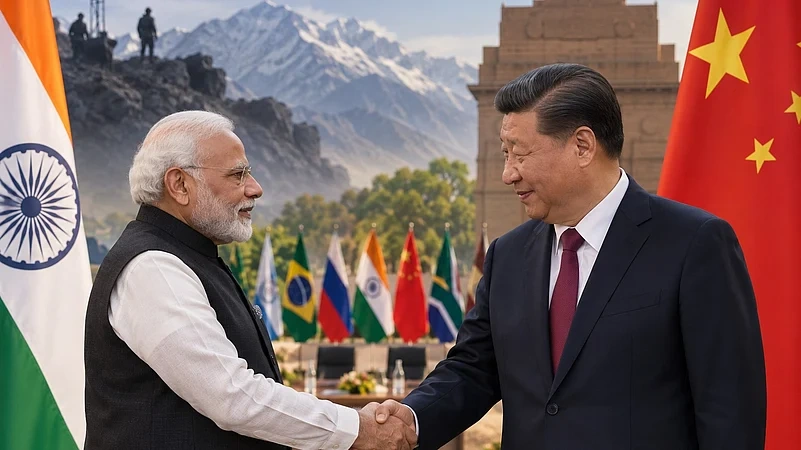

Chinese President Xi Jinping is expected to attend the BRICS Summit 2026 in New Delhi, his first trip to India in seven years. Beijing has not formally confirmed his participation as yet, and no bilateral meeting with Prime Minister Narendra Modi has been announced. Even so, Xi’s expected presence has added diplomatic weight to the summit and renewed attention on the gradual improvement in ties between Asia’s two largest powers.
India is hosting the 18th BRICS Summit under the theme “Building for Resilience, Innovation, Cooperation and Sustainability.” New Delhi is using its presidency to push the expanded bloc towards more practical cooperation on trade, finance, technology and development, while also pressing for a stronger role for emerging economies in global institutions.
That gives the summit significance well beyond its formal agenda. For India, it is also a test of whether BRICS can remain cohesive and relevant despite the differing strategic priorities of its members. The India-China relationship will be central to that test, as both countries seek greater cooperation while continuing to manage unresolved disputes over security, trade and political trust.
BRICS Summit 2026: Xi Jinping’s Expected India Visit Puts a Fragile Thaw to the Test
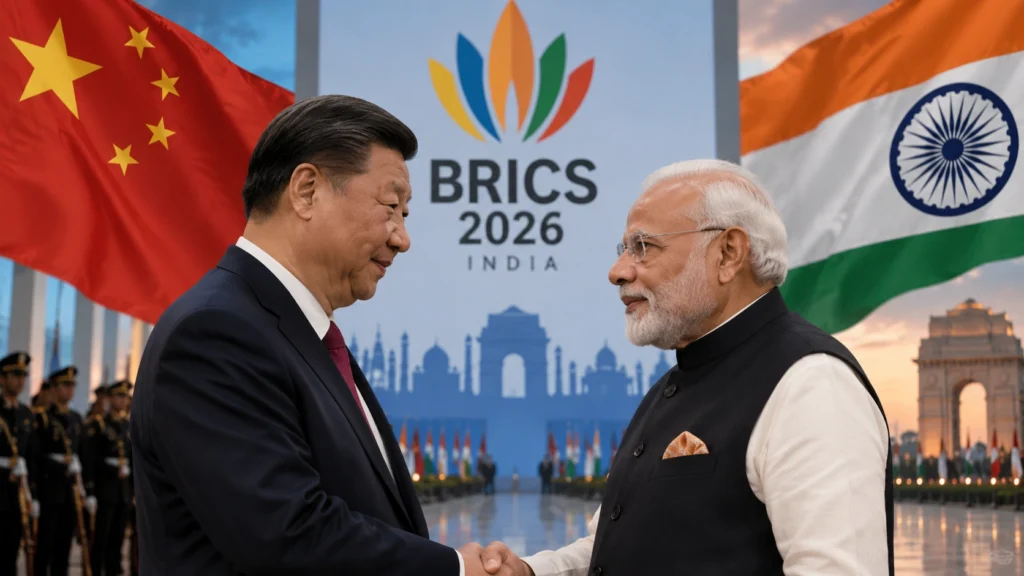
BRICS has changed considerably since Brazil, Russia, India and China first began meeting as a group of major emerging economies, later joined by South Africa. Its expansion has brought more countries from the Global South into the organisation and broadened discussions from trade and development to international security, technology, climate policy and reform of global institutions.
India has used its 2026 presidency to emphasise practical cooperation rather than simply presenting BRICS as a geopolitical counterweight to Western-led institutions.
External Affairs Minister S. Jaishankar said earlier this year that the group should become more “robust, agile and adaptive”, while focusing on development and cooperation among emerging economies. India has also placed reform of global governance high on its BRICS agenda.
One area receiving particular attention is cross-border payments.
Reserve Bank of India Governor Sanjay Malhotra said in August that BRICS countries were discussing ways to connect their fast-payment systems and central bank digital currencies. India has argued that cheaper and more efficient cross-border payments could support trade without requiring the bloc to create a common currency.
The distinction is important.
Debate about BRICS has often centred on whether the group intends to challenge the dominance of the US dollar. Russia, however, has sought to temper that interpretation ahead of the New Delhi summit. Kremlin spokesperson Dmitry Peskov said this week that Moscow was not pursuing “de-dollarisation” and remained open to different acceptable payment methods.
That leaves India room to promote financial connectivity while avoiding the appearance that BRICS is being transformed into an explicitly anti-Western alliance.
Why Xi Jinping’s India visit matters
The possible arrival of Xi Jinping adds another layer of significance to the BRICS Summit 2026.
India-China relations deteriorated sharply after the 2020 confrontation along their disputed Himalayan border, which killed 20 Indian soldiers and four Chinese troops. The clash led India to tighten restrictions on Chinese investment and contributed to a broader decline in political trust.
Relations have improved gradually since then.
Modi visited China last year, diplomatic contacts have increased and some commercial restrictions have been eased. Direct flights have resumed, visa procedures for Chinese business travellers have improved and the two sides have reopened some channels that were frozen following the border confrontation.
China has publicly encouraged the shift. Its foreign ministry has said the two countries should see each other as partners rather than competitors and as opportunities rather than threats.
But that diplomatic language masks persistent problems.
Trade remains strong while trust remains weak
The greatest obstacle to a broader India-China reset may not be the absence of trade but the lack of confidence surrounding it.
India relaxed some restrictions on Chinese investment in March, particularly in areas including electronics, capital goods and solar manufacturing. New Delhi has also considered faster approval mechanisms for selected joint ventures.
There have been signs of progress. India approved a manufacturing venture involving Dixon Technologies and Chinese smartphone company Vivo.
Yet Reuters found little evidence of a broader return of major Chinese investors. Companies including BYD and Great Wall Motor previously shelved planned Indian investments after encountering increased regulatory scrutiny.
Technology and data remain particularly sensitive.
Indian authorities recently stalled a proposal to connect Ant International’s Alipay+ platform with India’s Unified Payments Interface over national-security and data concerns. Separately, India’s Serious Fraud Investigation Office has recommended a detailed investigation into Xiaomi’s operations over possible foreign-investment violations. Xiaomi has said it complies with Indian law.
China has its own restrictions.
Reuters reported that Beijing has increased scrutiny of Chinese investment involving sophisticated manufacturing and advanced technology in India. Indian businesses have also faced delays involving Chinese industrial equipment and technology.
This exposes the central contradiction in the relationship. India wants access to Chinese manufacturing capacity, investment and components in sectors important to its economic growth. At the same time, New Delhi does not want critical industries to become excessively dependent on China.
Beijing, for its part, wants greater access to one of the world’s largest markets but is increasingly protective of technologies that could strengthen a strategic competitor.
BRICS provides common ground — but not complete agreement
The New Delhi summit gives both governments a setting in which cooperation is easier than in a strictly bilateral meeting.
India and China share an interest in increasing the influence of developing economies in institutions created when Western countries held a much larger share of global economic power. Both support reform of international governance and argue that the Global South deserves greater representation.
China has expressed strong support for India’s BRICS presidency. Chinese Ambassador to India Xu Feihong said this week that Beijing was ready to work with India and other members to strengthen BRICS cooperation. China is due to take over the BRICS chairmanship next year.
Yet their visions are not identical.
India has traditionally sought to preserve its strategic independence, maintaining close relations with the United States and other Western countries while continuing partnerships with Russia, China and developing economies.
That makes New Delhi cautious about allowing BRICS to develop into a bloc defined primarily by opposition to Washington or the West.
China, meanwhile, sees BRICS as an increasingly important platform for advancing a more multipolar international system.
For the organisation to remain cohesive, those different priorities must coexist.
A Modi-Xi meeting could be the summit’s most closely watched moment
If Xi attends and holds formal talks with Modi, the meeting could become one of the most important events on the sidelines of the BRICS Summit 2026.
A breakthrough on the border dispute is unlikely. Nor would a single meeting remove years of economic and security concerns.
The more realistic measure of progress would be smaller steps: easier business travel, more predictable investment approvals, fewer restrictions on equipment, expanded flights and measures to prevent future border tensions from escalating.
That may appear modest, but the consequences extend far beyond the two countries.
India and China together represent an enormous share of the world’s population and economic output. Their relationship affects Asian security, global manufacturing, technology supply chains and the ability of BRICS to act collectively.
The New Delhi summit will therefore test two things at once.
For BRICS, it will show whether an expanded and increasingly diverse organisation can move from broad declarations towards practical cooperation.
For India and China, it will reveal whether the diplomatic thaw that has developed over the past year can survive the deeper disputes that still divide them.
The BRICS Summit 2026 is unlikely to resolve those differences. But if Xi travels to New Delhi and the two leaders use the meeting to rebuild confidence, the summit could become an important point in a relationship that both countries now appear determined to manage more carefully.
Don’t forget to follow us on Facebook | Instagram | Twitter | LinkedIn to get the latest updates from Cape Town Tribune