
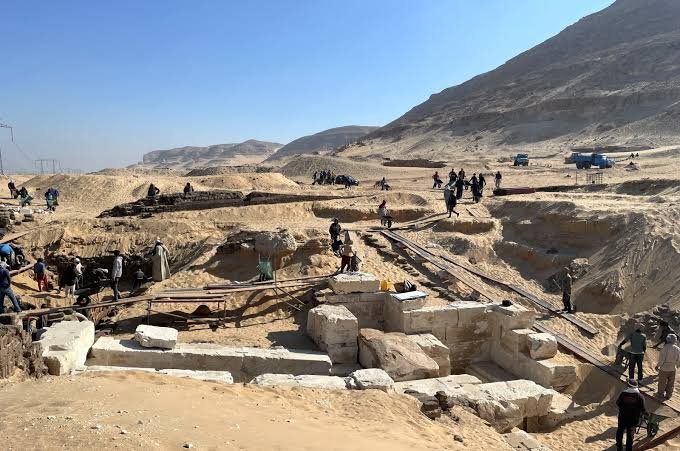
An ancient cemetery in Egypt is giving archaeologists an extraordinary window into thousands of years of life along the Nile Delta, with graves, homes and everyday objects documenting communities that occupied the region from prehistoric times through later periods of Egyptian civilisation.
The discoveries at Kom El-Khalgan in Egypt’s Dakahlia Governorate include some of the site’s earliest burials, dating to the first half of the fourth millennium BCE, as well as tombs and settlement remains from the Second Intermediate Period, New Kingdom, and Ptolemaic era.
Rather than representing a single cemetery continuously used for 6,000 years, the site preserves multiple archaeological layers that show how burial customs, architecture, and daily life changed across dramatically different periods of Egyptian history.
Egypt’s Ministry of Tourism and Antiquities said the discoveries provide important new evidence about the development of human settlement in the eastern Nile Delta. Excavations at the site are continuing.
A Cemetery With Roots in Prehistoric Egypt
The oldest graves discovered at Kom El-Khalgan belong to the prehistoric cultures of Lower Egypt known as Buto I and Buto II, which flourished during the first half of the fourth millennium BCE.
That places the earliest material at the site roughly 6,000 years ago, before the emergence of the unified Egyptian state and centuries before the construction of the great pyramids.
These early graves are strikingly simple. Archaeologists found oval burial pits cut into sandy soil, with bodies placed in different positions. The variation suggests that communities living in the region did not follow a single burial practice.
The objects placed alongside the dead were also modest. Researchers recovered handmade pottery vessels and seashells rather than the elaborate funerary treasures associated with later pharaonic Egypt.
Yet the number of burials is important. Archaeologists believe their density suggests that a substantial community once occupied the area, offering new clues about life in the Nile Delta before Egypt became one of the ancient world’s great kingdoms.
Why Kom El-Khalgan Matters
Ancient Egyptian archaeology is often dominated by spectacular discoveries connected with pharaohs, royal tombs, and monumental temples.
Kom El-Khalgan tells a different story. Its importance lies partly in the fact that archaeologists can trace ordinary human settlement across several very different historical periods at the same location.
The graves reveal how people treated their dead. Residential structures show where they lived and worked. Pottery, tools, animal remains, and storage facilities provide evidence of what they ate and how communities organised everyday life.
That combination allows researchers to examine cultural change over a far longer period than a single tomb or monument could provide.
Hisham El-Leithy, secretary-general of Egypt’s Supreme Council of Antiquities, has described the finds as an important contribution to understanding the Delta’s history and cultural development.
Later Tombs Reveal a Very Different Egypt
Thousands of years after the earliest burials were created, people were still living and burying their dead around Kom El-Khalgan.
Archaeologists uncovered another group of tombs dating from the Second Intermediate Period into the New Kingdom.
By then, burial traditions had become considerably more elaborate. Researchers identified mastabas, rectangular funerary structures with sloping sides, as well as tombs decorated with architectural cornices.
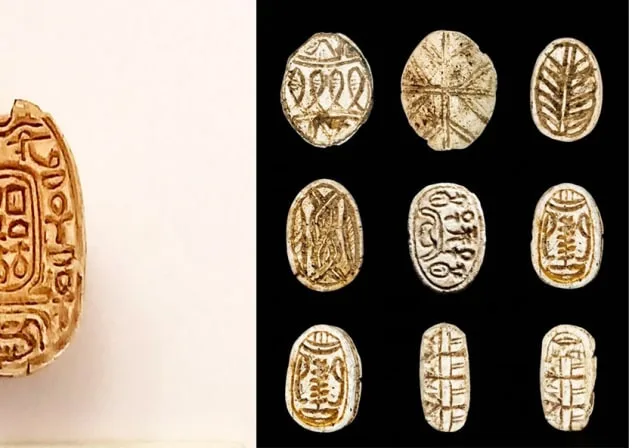
The objects accompanying the dead were also more varied. Finds include jewellery, amulets, scarabs, pottery, bronze tools and weapons, as well as distinctive Tell el-Yahudiyeh-style vessels associated with the wider eastern Mediterranean during the Second Intermediate Period.
These objects provide archaeologists with far more than attractive museum pieces. Their styles and materials can help reconstruct trade connections, cultural exchange, and changing beliefs surrounding death.
The Site Offers New Evidence About the Hyksos Period
One of the most significant chapters represented at the ancient cemetery in Egypt concerns the Hyksos.
The Hyksos ruled parts of northern Egypt during the Second Intermediate Period, with their capital at Avaris in the eastern Nile Delta.
Kom El-Khalgan lies within the wider region influenced by Avaris, making the burials and settlement remains particularly useful for understanding how communities lived during the Hyksos era.
Researchers say the new discoveries strengthen evidence that the area remained inhabited during the 15th Dynasty.
The Hyksos period remains one of the most fascinating and historically complicated phases of ancient Egyptian history.
For generations, popular accounts portrayed the Hyksos largely as foreign invaders. Modern archaeology has produced a more complex picture involving migration, cultural interaction, political change, and long-standing connections between Egypt and neighbouring regions.
Sites such as Kom El-Khalgan can help archaeologists move beyond accounts centred on rulers and warfare by showing what life looked like for the people occupying the Delta itself.
Homes, Ovens, and Grain Silos Reveal Everyday Life
The discovery is not limited to tombs.
Archaeologists also uncovered a residential area dating to the Second Intermediate Period, giving researchers a rare opportunity to examine life alongside death at the same archaeological site.
Remains include mudbrick buildings, grain-storage silos, ovens, and hearths.
Researchers also discovered pottery, stone tools, and substantial quantities of fish, bird and animal bones.
These seemingly ordinary finds can be exceptionally valuable.
Animal remains can help reveal what people ate. Storage structures provide evidence about agriculture and food management. Ovens and hearths offer clues about domestic activity, while pottery can help researchers establish dates and identify trade relationships.
The team also uncovered unusual wavy or sinusoidal walls, an architectural form known from Egyptian sites between the Middle Kingdom and the New Kingdom.
Together, these remains begin to reconstruct a community rather than merely a collection of graves.
Archaeologists Also Found an Early New Kingdom Tomb
The archaeological layers continue into another crucial period of Egyptian history.
Researchers uncovered a mudbrick tomb dating to the beginning of the 18th Dynasty, the dynasty that ushered in the New Kingdom.
Pottery vessels and bronze objects were found inside. Nearby, archaeologists identified the foundations of another building with thick mudbrick walls. Pottery fragments and stone tools found on its floor also date the structure to the beginning of the New Kingdom.
The transition is especially significant because the rise of the 18th Dynasty followed the end of Hyksos rule. Kom El-Khalgan therefore preserves archaeological evidence from both sides of one of ancient Egypt’s major political transformations.
Instead of relying only on written histories of kings and military campaigns, archaeologists can examine changes in buildings, burial practices and material culture as political power shifted.
A Child Was Buried Inside Two Amphorae
One of the site’s most striking later discoveries comes from the Ptolemaic period.
Archaeologists uncovered simple burial pits dating to the era, including the burial of a child placed inside two reused amphorae.
Amphorae were large ceramic vessels commonly used for storing and transporting products such as wine, oil, and other goods.
Using pottery vessels for child burials is known from different parts of the ancient Mediterranean and offers researchers another example of how burial traditions changed over time.
The Ptolemaic graves are separated by thousands of years from the earliest prehistoric burials at Kom El-Khalgan. Their presence at the same archaeological site is precisely what makes the discovery so valuable.
One Site, Many Different Versions of Egypt
The popular image of ancient Egypt can sometimes make its history feel like a single civilisation frozen in time: pyramids, hieroglyphs, pharaohs, and monumental temples.
In reality, Egyptian history unfolded over thousands of years.
Communities migrated. Political systems rose and collapsed. Burial practices changed. New religious ideas emerged. Trade connected Egypt with neighbouring societies, and foreign dynasties sometimes ruled parts of the country.
Kom El-Khalgan captures fragments of several of those transformations in one location.
Its earliest inhabitants lived before dynastic Egypt had fully emerged. Later communities experienced the upheavals of the Hyksos period. Others lived as the New Kingdom began. Still later, residents buried their dead during the Ptolemaic era, when Egypt was ruled by a Greek-speaking dynasty centuries after the age of the great pyramid builders.
That extraordinary chronological depth turns the site into something close to an archaeological timeline of the eastern Nile Delta.
Excavations at Kom El-Khalgan Are Not Finished
The latest discoveries are also unlikely to be the final chapter.
Kom El-Khalgan has produced significant archaeological material before. In 2021, Egyptian authorities announced the discovery of 110 graves at the site dating to several periods, including the Buto cultures, Naqada III, and the Second Intermediate Period.
The current excavation has expanded that picture considerably by revealing additional funerary phases and residential structures.
Researchers are continuing to document and analyse the newly uncovered remains, meaning further study could refine the chronology of the site and reveal more about the people who occupied it.
For archaeologists, the significance of this ancient cemetery in Egypt is therefore not simply its age.
It is the way one place records radically different chapters of human life across millennia.
From simple prehistoric graves containing handmade pottery and seashells to Hyksos-era tombs filled with scarabs and bronze objects, and finally to a child’s Ptolemaic burial inside reused amphorae, Kom El-Khalgan preserves something unusually difficult to find in archaeology: thousands of years of cultural change layered into the same landscape.
And with excavations still underway, more of that history may still be buried beneath the Nile Delta.
Don’t forget to follow us on Facebook | Instagram | Twitter | LinkedIn to get the latest updates from Cape Town Tribune