
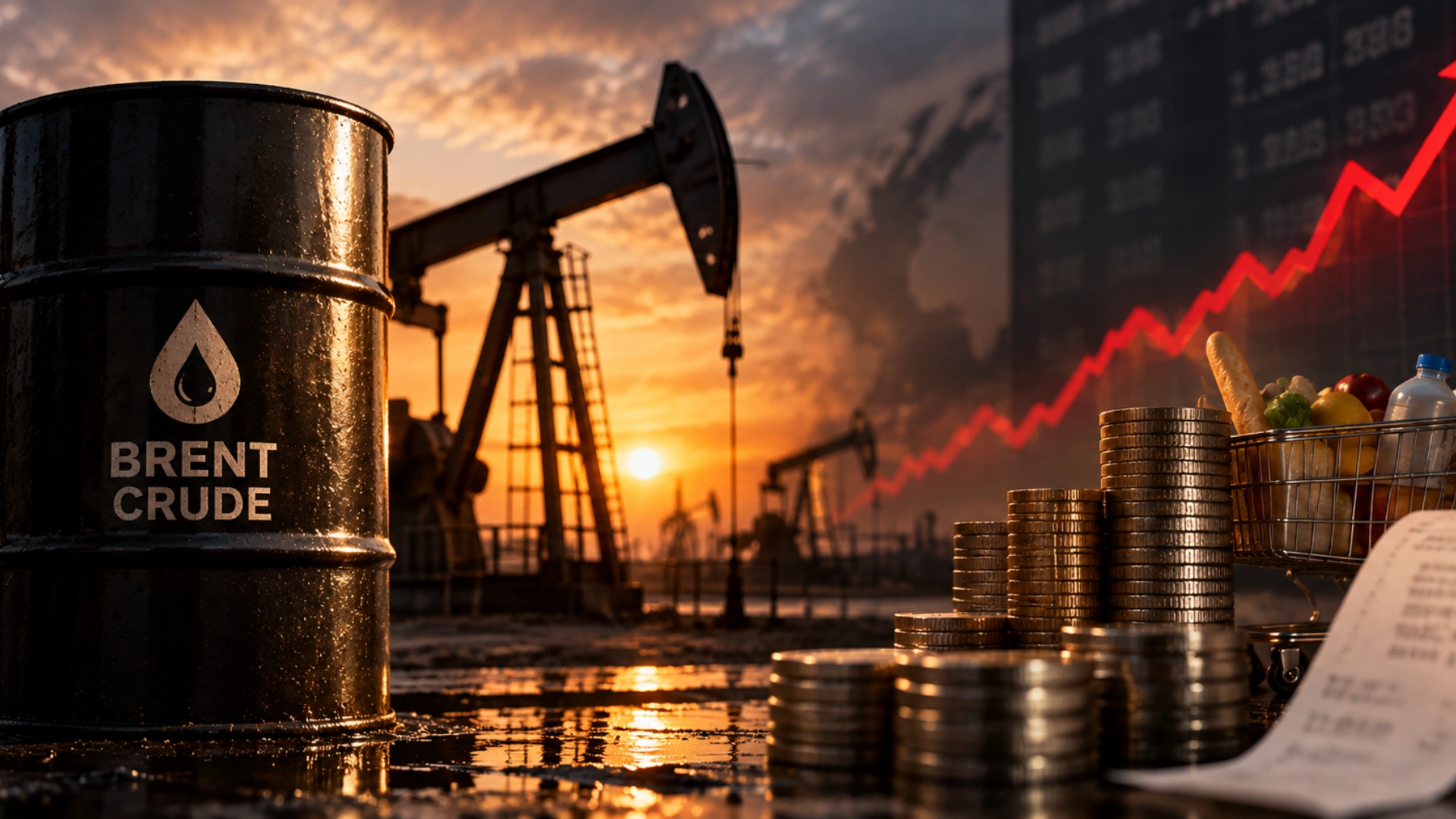

Brent crude is once again approaching $100 a barrel, turning a regional security crisis into a broader test for governments and central banks already struggling to bring inflation fully under control. Brent crude near $100 traded around $99.3 to $99.7 a barrel during Asian hours on Wednesday, September 9, while U.S. West Texas Intermediate crude moved above $94. The rise followed another escalation in the Middle East, including attacks on Saudi energy facilities, U.S. strikes on Iranian oil tankers and an Iranian attack targeting a U.S. base in Jordan.
The immediate market reaction has gone well beyond energy. U.S. stocks fell on Tuesday, with the Dow Jones Industrial Average losing 1.2% and the S&P 500 dropping 0.6%, while several Asian markets traded cautiously on Wednesday. Bond yields remain elevated, currencies in oil-importing economies are under pressure, and investors are reassessing whether central banks will have room to ease borrowing costs.
The central question is no longer simply whether Brent crosses $100. What matters is whether elevated oil prices persist long enough to raise transport, industrial and household costs across major economies, making inflation harder to contain.
Why Brent Crude Near $100 Matters for Inflation
Oil affects the global economy through several channels at once. Higher crude prices can feed directly into petrol, diesel and aviation fuel, but the effects also move through freight, agriculture, manufacturing, chemicals and other industries that depend heavily on energy.
Those costs do not reach consumers immediately or uniformly. A short rise in crude can fade before companies adjust prices. A prolonged increase is much more difficult to absorb, particularly when businesses are already facing higher financing, labour or trade-related costs.
That is why the latest move has gained the attention of policymakers. Brent has risen by roughly a quarter since early August, according to Reuters, as expectations for a lasting resolution to the Middle East conflict have weakened.
For central banks, the problem is particularly uncomfortable because an oil shock can create two opposing economic forces. It raises inflation, which can argue for higher interest rates, while simultaneously reducing household purchasing power and increasing costs for businesses, which can weaken economic growth.
Raising interest rates cannot produce more oil or reopen a shipping route. Policymakers instead have to decide whether the initial increase in energy prices is likely to spread into broader inflation through wages, services and expectations. That judgment is now becoming more difficult.
The Middle East Conflict Is Increasing the Supply Risk
The latest oil move reflects more than market nervousness. The physical routes through which Middle Eastern crude reaches world markets are under increased pressure.
Yemen’s Iran-aligned Houthis attacked several locations in Saudi Arabia on Tuesday, including energy facilities, in strikes that Saudi authorities said wounded 73 people. The attacks came as the wider U.S.-Iran conflict intensified, with U.S. forces striking Iranian oil tankers and Iran targeting American military assets.
The concern for oil markets is that instability is affecting multiple parts of the regional energy system at the same time.
Saudi Arabia has sought to divert some crude away from the Strait of Hormuz, one of the world’s most important oil transit routes. But attacks affecting Saudi infrastructure create additional uncertainty over the alternative routes that producers may need if Hormuz remains constrained.
Reuters reported that Middle Eastern crude exports have fallen substantially from levels seen before the Iran war. At the same time, flows through Hormuz have continued rather than stopping completely, helping explain why Brent has approached $100 without moving decisively above it.
That is an important point. The oil market is tight, but it is not without alternatives.
Why Oil Has Not Already Moved Far Above $100
Given the scale of the geopolitical disruption, a reasonable question is why Brent remains below $100. Several factors are limiting the rise.
Some Gulf producers have shifted exports through alternative pipelines and ports. Production growth outside OPEC, including additional supply from the United States, Canada and Guyana, has also provided a buffer. Reuters reported that non-OPEC production is increasing by about 1.4 million barrels a day.
Demand conditions are also different from previous oil crises. China’s growing use of electric vehicles and changes in industrial demand are reducing some of the pressure that rapid Chinese oil consumption once placed on global markets. Large inventories also provide a degree of protection against short-term disruptions.
These factors mean $100 should not be treated as an inevitable gateway to an uncontrolled price surge.
The more serious risk would be a prolonged disruption that reduces exports faster than other producers and inventories can compensate. In that scenario, the price consequences could extend well beyond a temporary move through a symbolic threshold.
ECB Faces the First Major Test
Europe will provide an early indication of how central banks intend to respond.
The European Central Bank is widely expected to raise its deposit rate by a quarter percentage point on Thursday, from 2.25% to 2.50%. A Reuters poll of 65 economists found broad expectations for that increase as eurozone inflation remains above the ECB’s 2% objective. Inflation was running at 3.3% when the poll was conducted, with energy prices a major source of renewed pressure.
Until recently, many economists expected the September increase to mark the end of the ECB’s current tightening phase. That view is becoming less certain.
Deutsche Bank, JPMorgan and BNP Paribas have all revised their expectations to include the possibility of another increase later in the year as higher energy costs threaten to persist. Deutsche Bank now expects an additional quarter-point rise in December.
The ECB therefore faces a familiar but difficult choice: respond forcefully enough to prevent an energy shock from becoming broader inflation without tightening so aggressively that it damages an already modest growth outlook.
The Federal Reserve’s Decision Has Become Less Predictable
The Federal Reserve faces a similar decision when it meets on September 15 and 16.
Its benchmark interest rate has remained in a range of 3.50% to 3.75% since December. Strong U.S. employment data have increased the case for another rise, but Fed officials remain divided over whether inflation is persistent enough to justify immediate action.
Markets were close to evenly divided on Wednesday over whether the Fed would raise rates by a quarter point or leave them unchanged, according to Reuters. That makes Friday’s U.S. consumer inflation report particularly important.
Economists surveyed for AP expect annual consumer inflation for August to ease slightly to around 3.3%, from 3.4% in July. Even that would remain well above the Federal Reserve’s 2% target.
The rise in oil complicates the picture because policymakers must determine whether it represents a temporary external shock or the beginning of a renewed inflation cycle.
New York Federal Reserve survey data offer some reassurance: longer-term consumer inflation expectations have not moved sharply higher. But respondents expect higher petrol prices, while concerns about personal finances and employment have increased.
That combination illustrates the economic cost of expensive energy. Consumers can face higher living costs at the same time that confidence in the economy weakens.
India Shows How the Oil Shock Reaches Importing Economies
The consequences are particularly visible in countries heavily dependent on imported energy.
India’s rupee has come under renewed pressure as Brent approaches $100. The currency recorded its sharpest decline in more than a month on Tuesday, falling to 94.8175 against the dollar, despite market intervention associated with the Reserve Bank of India.
The pressure comes from a basic economic reality. When crude becomes more expensive, Indian importers need more dollars to pay for energy purchases. That can weaken the rupee, which in turn makes dollar-priced oil even more expensive in local currency terms.
Reuters reported Wednesday that traders were watching whether the rupee could weaken towards 95 per dollar if oil remained elevated.
For India and other large energy importers, the issue is therefore not limited to inflation. Higher oil can also affect currencies, government finances, trade balances and the cost of subsidies.
Japan faces a similar exposure because of its dependence on imported energy, although the yen has recently strengthened for a different reason: investors increasingly expect the Bank of Japan to raise interest rates.
$100 Is a Political Threshold as Well as an Economic One
There is nothing mechanically different about oil at $100 compared with $99.50. The significance is psychological and political.
A three-digit oil price becomes an easily understood measure of geopolitical risk. It attracts greater public attention, influences business expectations and can increase pressure on governments to respond through fuel subsidies, tax changes, strategic reserves, or diplomatic efforts aimed at stabilising supply.
It also changes the political environment surrounding monetary policy. Governments facing higher household energy bills generally want relief from borrowing costs. Central banks worried about inflation may conclude that rates need to remain high.
Those objectives can move in opposite directions.
The risk for the global economy is therefore not simply expensive oil. It is expensive oil arriving at a moment when inflation remains above target in several major economies, and governments have limited room to offset the shock without creating new fiscal pressures.
What Happens Next
Three developments will determine whether Brent’s move towards $100 becomes a temporary market episode or a more serious global economic problem.
The first is the Middle East conflict itself. Any credible movement towards de-escalation could remove part of the geopolitical premium embedded in crude prices. Further attacks on major energy infrastructure or shipping routes could have the opposite effect.
The second is the ability of producers outside the most affected areas to maintain supply. Alternative export routes, rising non-OPEC production and existing inventories have so far prevented the disruption from producing a more severe price spike.
The third is inflation data. The ECB’s decision on Thursday, U.S. consumer-price figures on Friday and the Federal Reserve meeting next week will show whether central banks increasingly view the oil shock as a persistent threat.
For now, Brent’s approach to $100 is best understood as a warning rather than a prediction of an inevitable new energy crisis. The global oil system is still moving significant volumes, and additional production is providing some protection.
But the margin for error has narrowed. If Middle East disruptions persist while oil prices remain near or above $100, policymakers will face a more difficult balance between controlling inflation and protecting economic growth. That is why the oil price has moved from the commodities pages back to the centre of global economic and geopolitical policy.
Don’t forget to follow us on Facebook | Instagram | Twitter | LinkedIn to get the latest updates from Cape Town Tribune