


Germany has formally accused Russia of orchestrating an attempted attack using an explosives-laden drone at one of Europe’s most strategically important cargo airports, escalating concerns that the confrontation between Moscow and the West is increasingly extending beyond the battlefields of Ukraine.
German authorities say the Leipzig airport drone attack was not an isolated act but part of a broader pattern of Russian hybrid operations targeting European infrastructure and support for Ukraine.
The drone was discovered near a Ukrainian aircraft at Leipzig/Halle Airport on August 4 and was safely defused. After weeks of investigation, German Interior Minister Alexander Dobrindt announced on September 1 that police evidence, intelligence findings and similarities with previous operations had led the government to attribute the attempted attack to Russia.
Moscow has categorically denied responsibility and accused Berlin of fabricating the case. But the consequences are already spreading well beyond the airport.
Germany has ordered the closure of Russia’s consulate general in Bonn and is moving to shut the Russian House cultural centre in Berlin. European officials are considering additional sanctions, while NATO has publicly backed Germany’s assessment.
Russia has now begun retaliating diplomatically, announcing that Germany’s Goethe-Institut cultural centres in Moscow, St Petersburg and Yekaterinburg will be closed.
What began with a drone discovered beside a runway has therefore developed into something significantly larger: a test of how Europe responds when alleged Russian hybrid warfare moves from cyberattacks and sabotage into an attempted explosive attack on critical infrastructure inside a NATO country.
What happened at Leipzig/Halle Airport?
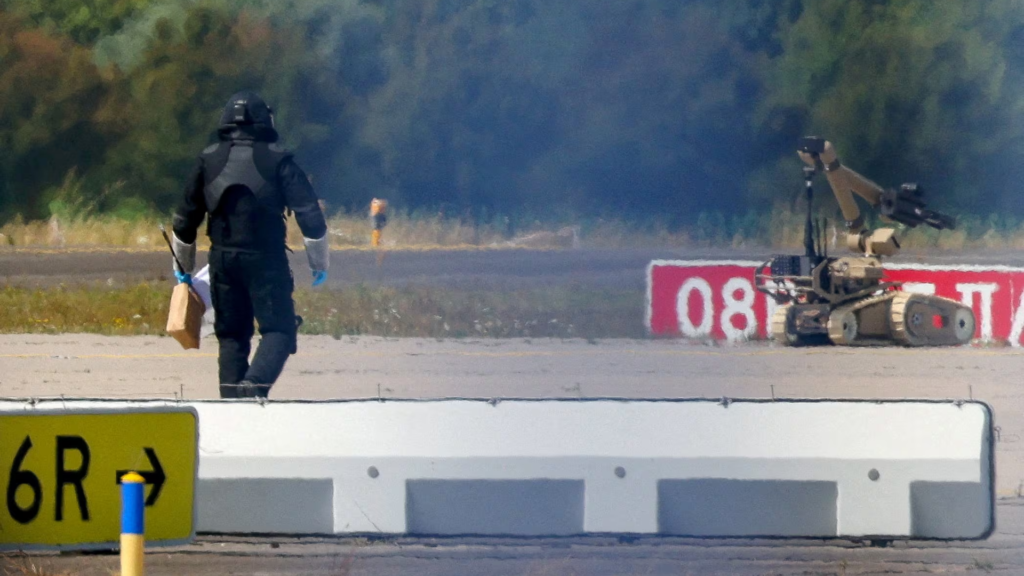
The incident dates to the night of August 4 at Leipzig/Halle Airport, a major freight hub in eastern Germany.
Authorities discovered a drone carrying explosives near a Ukrainian aircraft. Bomb disposal experts removed the detonator and rendered the device safe.
German officials initially stopped short of publicly identifying who was responsible. Dobrindt nevertheless described the incident at the time as a new level of threat and said its preparation appeared too sophisticated to be dismissed as amateur activity. Federal prosecutors later took over the investigation because of the potential implications for Germany’s national security.
On September 1, Berlin went considerably further. Dobrindt said investigators had examined the drone’s configuration, its components, the explosives and the detonator.
According to the German government, those elements corresponded with methods known from previous Russian hybrid operations and from Russia’s war against Ukraine.
He said intelligence findings also pointed to people involved in the attempted operation acting on behalf of Russian state entities. Germany has not publicly released all of the intelligence underlying its attribution.
That distinction is important. Berlin says its combined police and intelligence assessment establishes Russian responsibility. Moscow rejects that conclusion and says Germany has failed to produce convincing public evidence.
Why Leipzig/Halle Airport matters far beyond Germany
The location of the alleged attack is one reason European governments are treating the case so seriously. Leipzig/Halle is not simply another regional passenger airport.
It is one of Europe’s major freight centres and has become an important logistical location for support flowing toward Ukraine. Ukrainian Antonov transport aircraft regularly operate from the airport.
The airport is also connected to NATO’s Strategic Airlift International Solution, known as SALIS, which gives participating countries access to heavy airlift capacity for transporting oversized military and humanitarian cargo.
NATO says its SALIS base of operations has been located at Leipzig/Halle since 2019. The programme supports alliance missions and provides strategic transport capacity that European countries cannot always supply with their own aircraft.
That makes the airport strategically valuable. An attack there could potentially disrupt civilian freight operations, Ukrainian logistical support and NATO transport activity at the same location.
For European security officials, that combination turns the Leipzig airport drone attack into more than an aviation security incident.
It raises the possibility that infrastructure supporting Ukraine and NATO could itself become a target of covert operations inside Western Europe.
Germany says the attack fits a wider pattern of Russian hybrid warfare
German Foreign Minister Johann Wadephul has explicitly placed the Leipzig incident inside what Berlin describes as a broader Russian campaign involving destabilisation, disinformation, threats and sabotage across Europe.
“It fits into a broader pattern of Russian hybrid operations in Europe,” Wadephul said when the attribution was announced.
Western intelligence and security agencies have accused Moscow of involvement in a growing range of covert activities since Russia launched its full-scale invasion of Ukraine in February 2022.
Those accusations have included cyberattacks, suspected arson, interference with transport and energy infrastructure, surveillance by drones and alleged plots against individuals.
The Associated Press has tracked roughly 200 incidents of sabotage and other malign activity across Europe that Western officials have blamed on Russia since the invasion began. Russia has denied conducting such a sabotage campaign.
The Leipzig case is particularly sensitive because explosives were involved.
German authorities are effectively arguing that the threat is evolving from disruption and intelligence operations toward acts capable of causing physical destruction and potentially casualties.
That is why Dobrindt has described Germany as facing a new category of risk.
Europe’s uncomfortable position: not at war, but facing hostile acts
The central geopolitical problem is that hybrid warfare is designed to operate below the threshold of conventional war.
A cyberattack can disrupt a railway without missiles crossing a border. An incendiary device can destroy a warehouse without soldiers entering another country. A covert drone can threaten an airport without an identifiable military unit appearing on the scene. This ambiguity makes retaliation difficult.
A conventional military attack on a NATO member could raise questions about the alliance’s collective defence commitments under Article 5. Hybrid activity is deliberately harder to classify.
European governments therefore have to demonstrate that such operations carry consequences without allowing individual incidents to trigger uncontrolled military escalation with a nuclear-armed Russia.
The European Union’s foreign policy chief Kaja Kallas said the Leipzig incident had “all the hallmarks of state-sponsored terrorism” as European foreign ministers met in Ireland to discuss their response.
She said work was already underway on sanctions listings connected to Russia’s military-industrial complex, while several European ministers called for additional economic pressure on Moscow.
European Commission President Ursula von der Leyen has described the incident as a new escalation on EU territory.
The challenge now is deciding what measures would genuinely deter further operations.
Germany is already imposing consequences on Russia
Berlin’s immediate response has focused heavily on diplomatic and economic pressure rather than military action. Germany announced that Russia’s consulate general in Bonn will close, with the measure taking effect on September 18.
The government is also terminating the arrangement that allows the Russian House cultural centre to operate in Berlin.
Germany plans to seek additional EU sanctions against Russian individuals connected with hybrid activity, strengthen entry restrictions and push for further measures against Russia’s so-called shadow fleet of oil tankers used to circumvent Western restrictions.
The Russian ambassador was also summoned by Germany’s Foreign Ministry.
At the European level, foreign ministers have discussed measures including further sanctions, visa restrictions and additional restrictions on Russian diplomatic facilities.
Germany’s Foreign Office said European governments were examining further listings and sanctions aimed at increasing the cost of hybrid operations.
These measures indicate that Berlin wants to establish a principle: attacks below the level of conventional warfare should still generate tangible political and economic consequences.
Russia denies the accusation and retaliates
Moscow has rejected Germany’s account from the beginning.
The Russian Embassy described the allegations as baseless and accused Berlin of escalating already severely damaged relations between the two countries.
President Vladimir Putin went further, claiming evidence against Russia had been planted. He did not provide evidence supporting that assertion.
Russia warned that Germany’s measures would not go unanswered. That retaliation began to become clearer on September 3.
Russian Foreign Minister Sergei Lavrov announced that Moscow would close the Goethe-Institut’s centres in Moscow, St Petersburg and Yekaterinburg in response to Germany’s decision to terminate the Russian cultural centre’s operations in Berlin.
Lavrov said Berlin’s decision effectively meant the end of Germany’s cultural presence in Russia. The move is symbolically significant.
The Goethe-Institut has operated in post-Soviet Russia since the early 1990s and has historically served as one of Germany’s most important institutions for cultural and educational engagement abroad.
Its closure shows how quickly the security dispute is spilling into the remaining channels of German-Russian civilian relations.
NATO backs Germany after Leipzig drone accusation
NATO has publicly sided with Berlin. Secretary-General Mark Rutte said the alliance stood in full solidarity with Germany following what he described as the Russian hybrid attack in Leipzig.
Speaking alongside European Commission President Ursula von der Leyen, Rutte said Russia had become increasingly reckless and pointed to drones, missiles and malign activities targeting NATO territory.
He specifically referenced the Leipzig case as part of that wider threat. The alliance’s response is significant even though NATO has not treated the incident as a conventional armed attack.
It signals that European states increasingly view hybrid operations not as isolated law-enforcement matters but as part of the wider security confrontation between Russia and NATO.
That shift has been developing for years. Russian drones and aircraft have repeatedly entered or approached NATO airspace along Europe’s eastern flank, while governments across the continent have increased protection around military bases, energy facilities, ports, communications networks and transport infrastructure.
Leipzig now adds airports to the centre of that discussion.
The attack exposes Europe’s infrastructure problem
One of the most important questions raised by the incident is whether European infrastructure can realistically be protected against inexpensive and increasingly adaptable drones.
Germany already operates anti-drone systems at important sites.
But Dobrindt said the device involved in the Leipzig incident appeared to have been designed specifically to circumvent existing drone defences.
That is a troubling development for governments across Europe.
Airports cover enormous areas. Power grids stretch across thousands of kilometres. Railway systems contain countless vulnerable junctions. Undersea cables, ports, warehouses and military factories cannot all be physically guarded at every moment.
Hybrid warfare exploits precisely that problem. An adversary does not need to destroy an entire transport network.
A relatively small incident at the right location can force closures, disrupt logistics, generate fear and impose significant security costs.
Europe is now being forced to rethink how it protects infrastructure built for an era in which the primary threats were accidents, terrorism and conventional military attack.
Low-cost drones add an entirely different problem.
Could the Ukraine war be spilling further into Europe?
The Leipzig case does not mean Russia and NATO are entering a conventional war.
Neither Germany nor the alliance has described the incident in those terms.
But the political significance lies in the increasingly blurred boundary between the war in Ukraine and security inside the European Union.
European countries are supplying Ukraine with weapons, ammunition, intelligence, training and financial support.
Russia has repeatedly condemned that assistance and accused NATO countries of participating indirectly in the conflict.
European governments, meanwhile, increasingly argue that Moscow is attempting to weaken that support by applying pressure inside their own societies.
If Germany’s attribution of the Leipzig airport drone attack is correct, the incident would fit squarely into that strategy.
Rather than attacking NATO forces directly, a covert operation could target the infrastructure that enables Western support for Ukraine while remaining below the threshold of open military confrontation.
That is what makes hybrid warfare so difficult to counter. The actions can be serious enough to cause damage, yet ambiguous enough to complicate any proportional response.
What happens next?
The immediate confrontation is likely to remain diplomatic and economic.
Germany is pursuing additional sanctions and security measures. Russia has begun retaliating against German institutions.
European governments are discussing how to make hybrid attacks more costly, while NATO is increasing its focus on protecting critical infrastructure.
But the larger question will not be resolved by closing consulates or cultural institutes. Europe now has to determine how it responds if incidents of this kind continue.
If suspected sabotage produces only limited sanctions, Moscow may calculate that the cost remains manageable. If European governments respond too aggressively, they risk contributing to an escalation they are trying to prevent.
That dilemma explains why the Germany-Russia drone dispute matters far beyond Leipzig.
A small unmanned aircraft found beside a runway has become a test of one of the most difficult questions facing European security today: how do you deter an adversary when the confrontation exists somewhere between peace and war?
For Germany and its allies, the answer may shape Europe’s relationship with Russia long after the investigation at Leipzig/Halle Airport is complete.
Don’t forget to follow us on Facebook | Instagram | Twitter | LinkedIn to get the latest updates from Cape Town Tribune