Nepal floods triggered by a massive glacial collapse have left nearly 1,50a’s Tibet region, including hundreds of foreign tourists and pilgrims, as rescuers race against time in one of the Himalayan region’s worst recent disasters.
Nearly 1,500 people remain missing across Nepal and Tibet after a catastrophic wall of water, mud, rock and ice tore through Himalayan valleys, burying settlements, destroying roads and sweeping away critical infrastructure.
The scale of the disaster became dramatically clearer on Thursday, August 27, as rescue teams reached areas that had been cut off since the Nepal floods struck a day earlier.
Reuters reported that nearly 1,500 people were unaccounted for across Nepal and China’s Tibet region, including almost 800 foreign nationals. In Nepal alone, 826 people were listed as missing. Chinese state broadcaster CCTV said another 558 were missing in Tibet’s Gyirong county.
The Associated Press reported at least 165 confirmed deaths in Nepal and three in Tibet, taking the combined known toll to at least 168. Authorities have warned that the number is expected to rise substantially as search operations move deeper into devastated communities.
The disaster was initially suspected to have been triggered by an earthquake. Scientists now say something very different happened.
A huge section of Himalayan glacier, ice and rock collapsed into a river system near the Nepal-China border, creating a violent debris-filled surge that travelled downstream at extraordinary speed.
What caused the Nepal floods?
The Nepal floods began on Wednesday morning after part of a glacier collapsed in the mountainous border region north of Kathmandu.
Initial reports described a magnitude 4.4 earthquake near the area. But after examining seismic information and satellite imagery, the U.S. Geological Survey said no earthquake had occurred.
Instead, the shaking detected by seismic instruments came from the enormous collapse of glacial rock and ice itself.
The USGS subsequently characterised the event as a magnitude 5.2 seismic signal generated by the glacial collapse and debris flow.
Ice and rock surged into the Lhende Khola river system, sending water, sediment and boulders towards downstream communities.
Reuters reported that the resulting mudslide struck Gyirong Port in Tibet before catastrophic flooding travelled into Nepal, destroying roads, bridges, homes and power projects along its path.
The International Centre for Integrated Mountain Development, or ICIMOD, said hydrological observations illustrated just how rapidly the disaster developed.
Water levels on the Trishuli River rose by as much as nine metres in around 30 minutes at one monitoring point. ICIMOD said an ice-rock avalanche likely temporarily blocked the Lhende Khola before a sudden release created the devastating downstream surge.
For communities below, there was little warning and almost no time to escape.
Nearly 1,500 remain missing across Nepal and Tibet
The scale of the missing-person crisis makes the Nepal floods an international disaster.
Reuters reported Thursday that 826 people were missing in Nepal, including almost 500 foreigners. Another 558 people were reported missing in Tibet, including 260 foreign nationals.
Because casualty and missing-person lists are being compiled by separate authorities in Nepal and China, totals are continuing to change as people are located and information reaches rescue centres.
Among the people reported missing in Nepal were nationals from more than two dozen countries. The latest Reuters tally included 177 Indians, 63 Americans, 53 Ukrainians, 34 Australians, 33 British nationals, 28 Malaysians, 25 Canadians
Nine South Korean workers employed at a hydropower facility were also reported missing.
Many foreign visitors were travelling through the region on pilgrimages to Kailash Mansarovar, one of Asia’s most important religious destinations.
Mount Kailash and nearby Lake Mansarovar are sacred to several faiths, including Hinduism and Buddhism, and attract pilgrims from across Asia and farther abroad.
That international tourism traffic helps explain why so many foreigners were caught in the disaster.
Rescue teams search for survivors
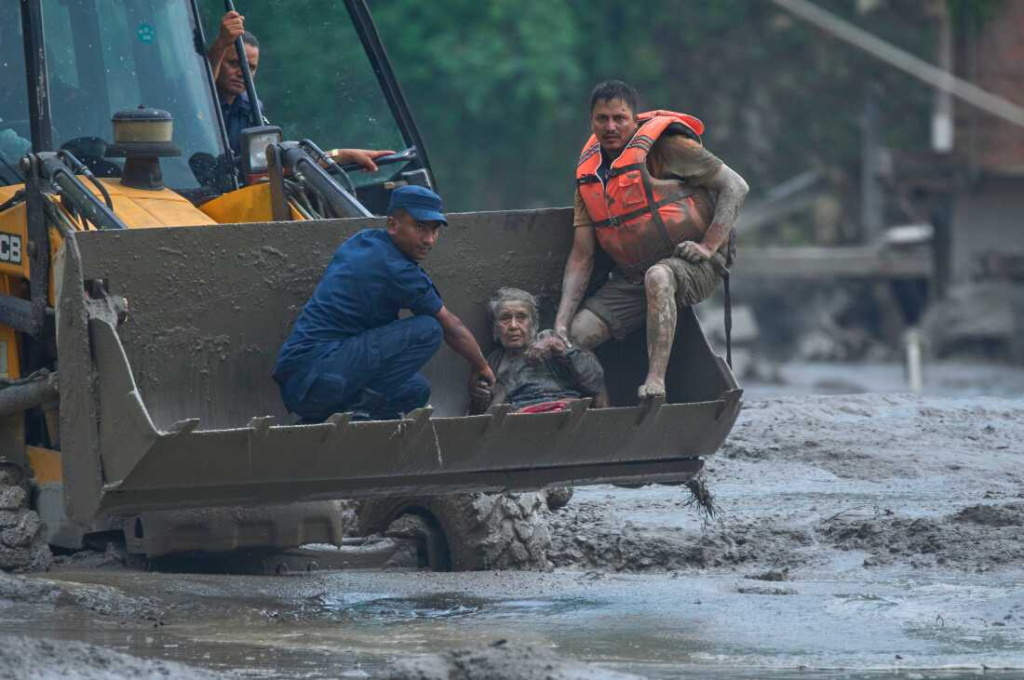
More than 5,000 Nepali army and police personnel have joined rescue operations as helicopters attempt to reach communities inaccessible by road.
By Thursday, rescuers had retrieved 125 people, including 20 foreigners, according to Nepal’s army. Helicopters were also dropping tents, food and other emergency supplies into isolated areas.
The geography is making the operation exceptionally difficult.
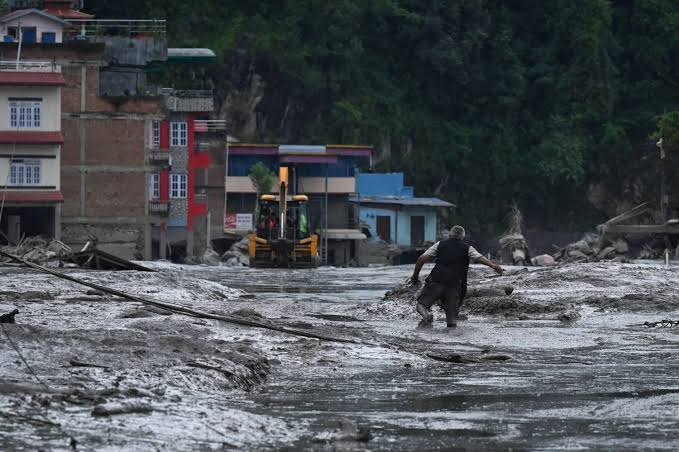
The Himalayan valleys hit by the Nepal floods contain steep mountainsides and narrow transport corridors. Roads and bridges connecting settlements have been destroyed, communications have been interrupted and thick deposits of mud have buried buildings and vehicles.
AP reported that some bodies had been recovered around 100 kilometres downstream from the initial disaster zone, demonstrating the extraordinary force of the floodwaters.
Army and private helicopters have transported injured survivors to Kathmandu for advanced treatment.
In Tibet, rescue conditions are similarly dangerous.
Chinese state media said mud around parts of Gyirong Port averaged more than 1.5 metres deep, while some roads were buried beneath more than two metres of debris.
Communication links and access roads were also damaged.
A barrier lake creates fears of another disaster
Rescuers are also monitoring a potentially dangerous development upstream.
Chinese authorities have identified a barrier lake in the Gyirong area, created where debris blocked the normal movement of water.
If such a blockage becomes unstable or suddenly fails, it can release another powerful surge downstream.
Reuters said authorities warned that the lake could significantly complicate search-and-rescue operations around the already devastated Nepal-Tibet border crossing.
Continued rain has also increased the risk of secondary landslides and collapses in unstable terrain.
That means rescuers face a difficult balance: searching quickly for survivors while remaining alert to the possibility of further flooding.
Entire communities have been buried in mud
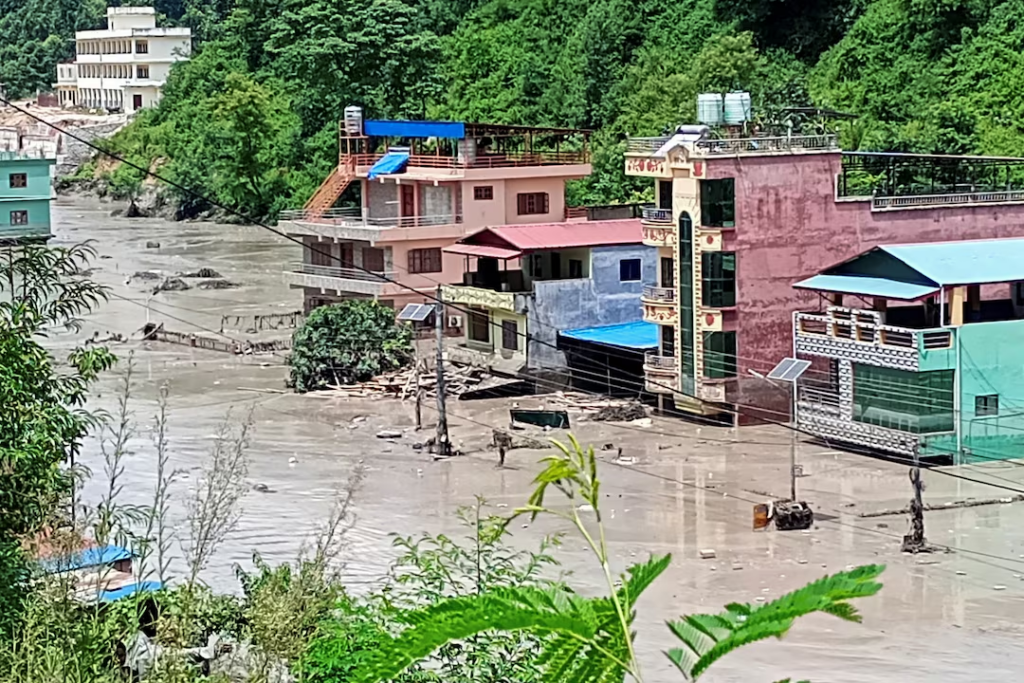
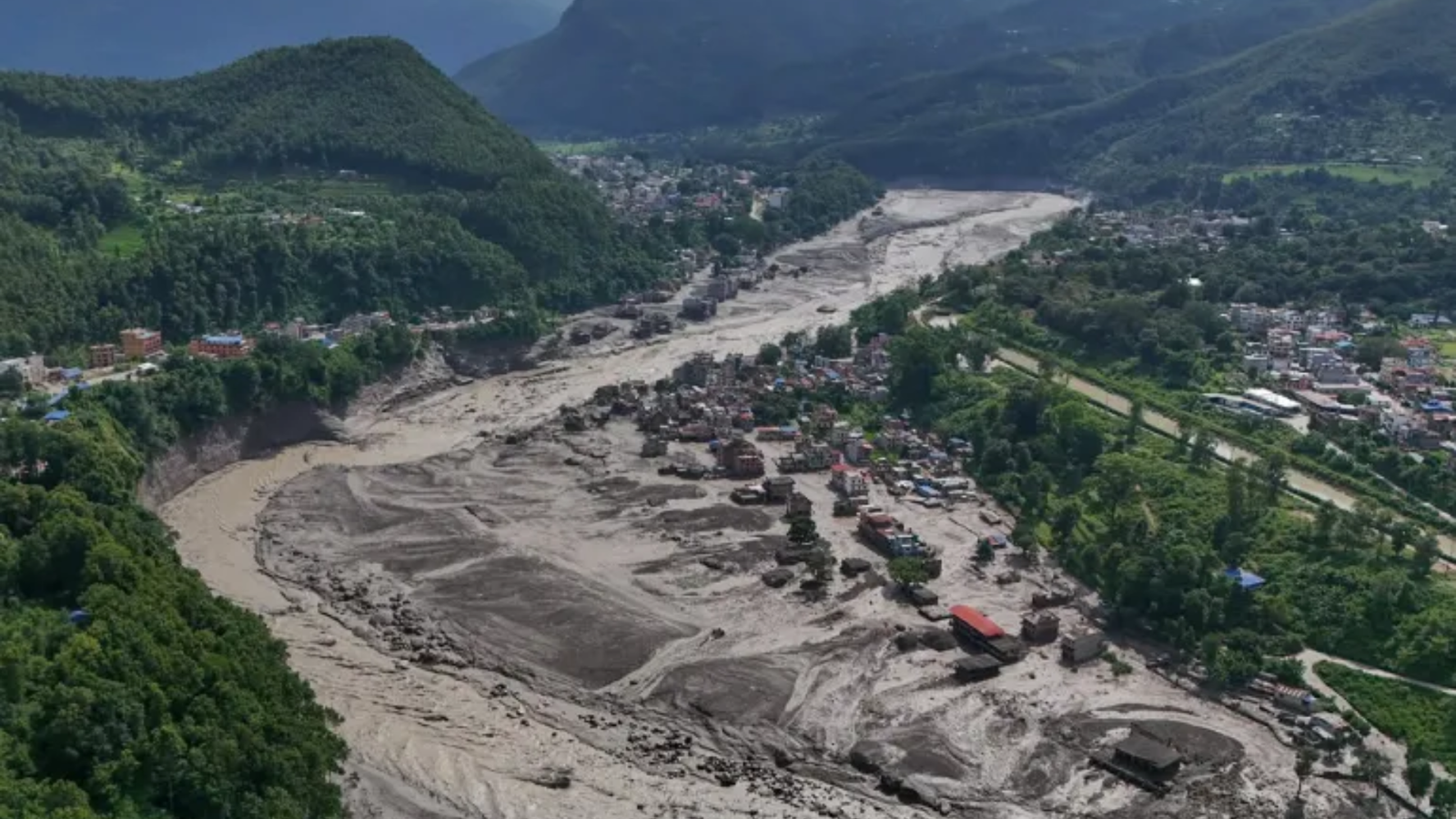
Images emerging from the disaster zone reveal the physical scale of the destruction.
Homes have been left surrounded or partly buried by mud. Vehicles were swept away or entombed under debris. Sections of highway have disappeared, while bridges and electricity infrastructure have been destroyed.
Reuters drone footage from Trishuli showed large areas covered by thick grey-brown sediment.
In some of the hardest-hit locations, residents described settlements beside rivers as almost completely erased.
The devastation has extended into Nepal’s energy system.
Hydropower projects along the affected river corridors were damaged or cut off, adding electricity and infrastructure problems to an already difficult humanitarian response.
Foreign governments begin sending aid
As the scale of the Nepal floods became apparent, governments and international organisations began mobilising assistance.
India sent 10 metric tons of disaster-relief supplies, including temporary shelters, blankets, medicines, hygiene kits and solar lamps.
The United States announced $500,000 in emergency assistance and said it was sending a disaster-response adviser.
The International Federation of Red Cross and Red Crescent Societies released 1 million Swiss francs in emergency funding to support the Nepal Red Cross response.
The World Health Organization has dispatched medicines, emergency medical supplies and multipurpose tents, while the European Union said it was prepared to mobilise additional assistance.
UN Secretary-General António Guterres said United Nations teams and partners were mobilising personnel and supplies for affected communities.
Several countries are also trying to establish the whereabouts of their citizens.
Australian Foreign Minister Penny Wong said at least 34 Australians from pilgrimage and tour groups were missing. Malaysia has also been trying to contact dozens of citizens as damaged infrastructure makes communication difficult.
Are the Nepal floods linked to climate change?
Scientists are still investigating the precise chain of events, and it would be premature to say that climate change directly caused this individual disaster.
What researchers can say with greater confidence is that the Himalayan environment in which it occurred is becoming increasingly unstable as temperatures rise.
The Hindu Kush Himalayan region contains enormous quantities of snow and ice that feed some of Asia’s most important rivers.
But its glaciers are retreating rapidly.
AP cited research showing that glacier ice loss across the Hindu Kush Himalaya has accelerated significantly, with rates of ice loss roughly doubling since 2000.
Warmer conditions can contribute to glacier retreat, unstable slopes and the expansion of glacial lakes, increasing the potential for sudden floods and landslides.
The Lhende Khola system itself has now experienced major flooding twice within 14 months, according to ICIMOD.
In the earlier incident, extreme temperatures contributed to a glacial lake overflowing in the region, killing nine people and damaging infrastructure linking Nepal and China.
Scientists have therefore warned that the latest Nepal floods expose a much broader Himalayan vulnerability rather than an isolated geological event.
Why Himalayan glacial disasters are so dangerous
The geography of the Himalayas amplifies the destructive potential of sudden glacial failures.
A large mass of rock and ice can fall hundreds of metres or more into a confined valley.
That material can temporarily dam a river, displace water or mix with sediment to create fast-moving debris flows.
As the surge travels downstream, narrow valleys can concentrate its energy rather than allowing it to spread harmlessly across a wider landscape.
Settlements, roads, bridges and hydropower projects are often built along the same rivers because flatter land is scarce.
That places essential infrastructure directly in the path of extreme flooding.
The latest disaster demonstrates how a geological event high in the mountains can become a humanitarian catastrophe many kilometres downstream within minutes.
Death toll expected to rise as searches continue
The immediate priority remains finding people who are still missing.
Nepalese police have warned that the confirmed death toll is likely to increase as rescuers search destroyed settlements and enormous deposits of mud and debris.
The true scale may take days to establish.
Authorities must reconcile missing-person lists from hotels, trekking companies, pilgrimage groups, workplaces and local communities while restoring communications to areas that remain isolated.
The figures should therefore be treated as provisional.
As of the latest reports on August 27, Reuters put the missing at nearly 1,500 across Nepal and Tibet, while AP reported more than 1,300 based on the separate official counts available to it. The difference reflects rapidly changing information rather than a settled final toll.
What is already clear is that the Nepal floods have become one of the most serious Himalayan disasters in recent years.
Hundreds of families are waiting for news, international governments are searching for missing citizens, and rescue teams are working through devastated valleys where roads, homes and entire communities have been transformed within minutes.
With nearly 1,500 people still unaccounted for, the human cost of the disaster may not be fully known for some time.
Don’t forget to follow us on Facebook | Instagram | Twitter | LinkedIn to get the latest updates from Cape Town Tribune