
President Donald Trump’s push to scale back US South Korea military drills has opened a consequential new phase in Korean Peninsula diplomacy, placing military readiness, alliance management, and renewed engagement with North Korea in the same frame.
On August 18, U.S. Forces Korea commander Gen. Xavier Brunson visited South Korea’s Defence Ministry to discuss plans to reduce the ongoing Ulchi Freedom Shield exercise, according to media reports cited by Reuters. The discussions followed Trump’s instruction to the Pentagon to “substantially reduce” the drills, which began this week and are scheduled to continue through August 27.
At the same time, Trump said North Korean leader Kim Jong Un had responded to his efforts to re-establish contact, although the U.S. president offered no details about the substance or form of that response. The combination of possible military adjustments and renewed leader-to-leader outreach has revived memories of Trump’s first-term diplomacy with Kim, when major exercises were also suspended or redesigned in an attempt to support negotiations.
For Seoul, the calculation is more complicated. President Lee Jae-myung supports efforts to reduce tensions with Pyongyang, but he is also calling for stronger independent defence capabilities, continued alliance coordination, and progress toward transferring wartime operational control to South Korea.
The developments leave Washington and Seoul facing a delicate question: can they use changes to military exercises to create room for diplomacy without weakening the deterrence that has anchored the alliance for decades?
Why US-South Korea Military Drills Are Being Reconsidered
The immediate trigger for the debate is Trump’s decision on August 16 to order the Pentagon to reduce US-South Korea military drills. He criticised the cost of the exercises and argued that they send an unnecessarily hostile signal toward North Korea at a moment when he wants to reopen communication with Kim Jong Un.
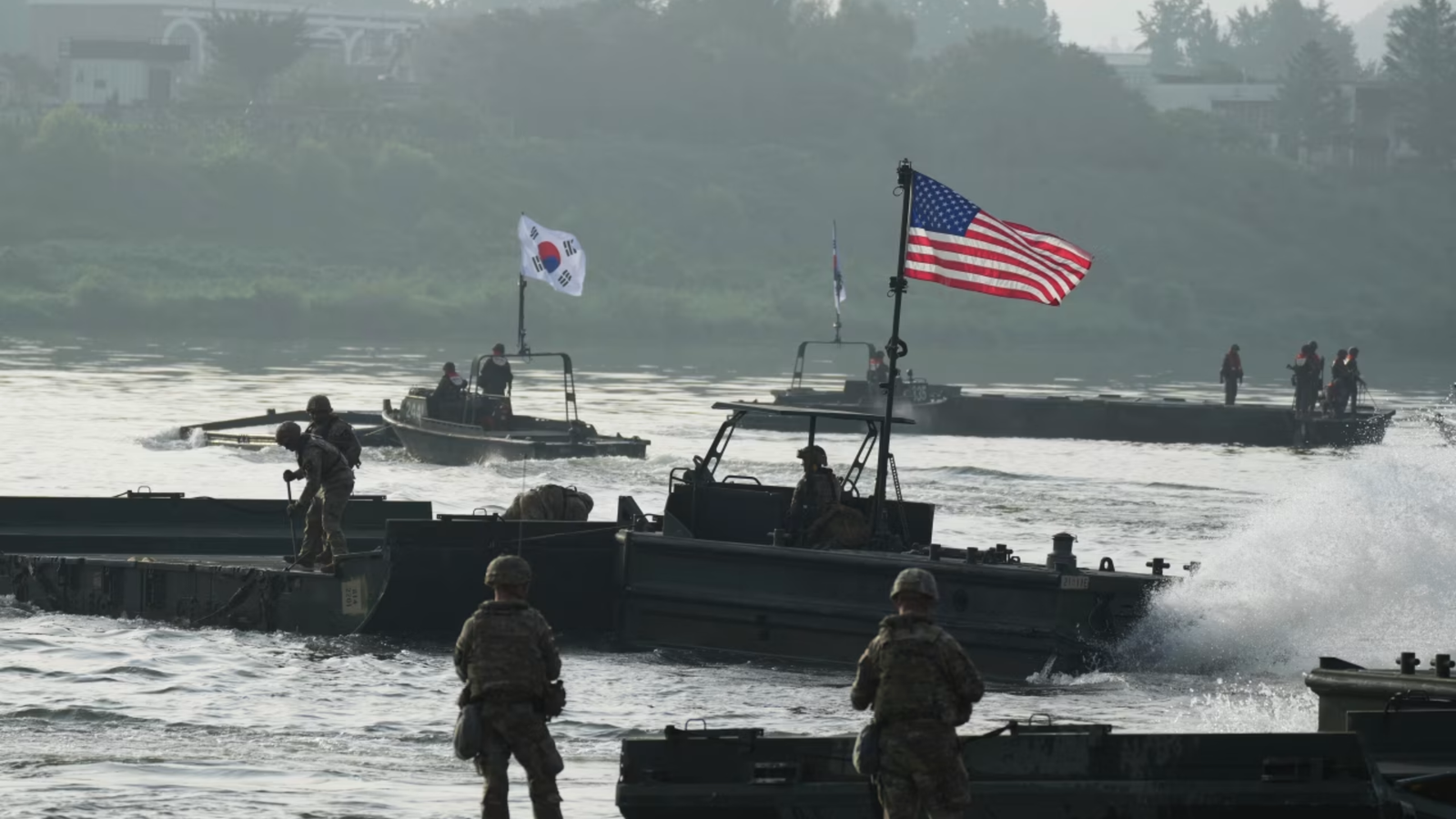
Ulchi Freedom Shield is one of the alliance’s principal annual exercises. The 2026 iteration began on August 17 and is scheduled to continue through August 27, with about 18,000 South Korean military personnel participating. U.S. Forces Korea describes Ulchi Freedom Shield as a combined, joint, all-domain exercise intended to strengthen the allied defence posture and improve the ability of American and South Korean forces to respond to a range of security threats.
North Korea has long condemned such exercises as preparations for military action. Days before this year’s drills began, Pyongyang denounced the exercise and warned that it would strengthen its nuclear deterrence in response. North Korea also launched a ballistic missile from the Wonsan area on August 11, adding to an already tense security environment.
Trump’s intervention therefore changes the political meaning of US South Korea military drills even if Ulchi Freedom Shield is not cancelled outright. Any reduction can be interpreted simultaneously as a diplomatic signal to Pyongyang, a change in Washington’s approach to its alliance with Seoul, and a test of how much military activity the United States is willing to adjust in pursuit of negotiations.
What Xavier Brunson’s Meeting With Seoul Signals
Gen. Xavier Brunson commands U.S. Forces Korea, the Combined Forces Command, and the United Nations Command, placing him at the centre of any operational changes to the exercise.
Reuters reported that Brunson visited South Korea’s Defence Ministry on Tuesday to discuss scaling back the Ulchi Freedom Shield. Neither the ministry nor U.S. Forces Korea immediately provided detailed public comments on what specific reductions were being considered.
That makes the practical scope of the proposed changes one of the biggest unanswered questions surrounding US South Korea military drills.
Combined training between the allies has already evolved considerably over time. The exercise is not simply a mass movement of troops and armour. Modern training can include command-post operations, computer simulations, communications exercises, cyber scenarios, missile responses, and specialised field activities designed to test how both militaries operate together. U.S. Forces Korea describes Ulchi Freedom Shield as involving live, virtual, constructive, and field-based training.
A reduction could therefore take several forms. Washington could limit particular field exercises, reduce participating units, shorten selected components or move activities to other dates.
Until the Pentagon and South Korean authorities publish a formal plan, it would be premature to describe the exercise as suspended or cancelled.
The distinction is important because military readiness is measured by much more than the number of troops visible in a single exercise. Communications, logistics, command integration, cyber defence, and the ability of American and South Korean forces to operate under a combined structure are all central to the alliance’s deterrence posture.
Trump Says Kim Jong Un Has Responded to His Outreach
The military debate is unfolding alongside a potentially significant diplomatic development.
On August 17, Trump said Kim Jong Un had responded to his overtures, correcting a reporter who suggested that the North Korean leader had not replied. Trump did not explain what the response involved, and neither the White House nor North Korea’s mission to the United Nations immediately provided further details when contacted by Reuters.
That leaves a crucial distinction between contact and negotiation.
There is currently enough information to say that Trump claims Kim responded. There is not yet enough public evidence to describe the development as a diplomatic breakthrough, a planned summit, or the beginning of substantive nuclear negotiations.
Trump has repeatedly expressed interest in reviving the highly personal diplomacy that defined an important part of his first presidency.
He met Kim in Singapore in 2018, Hanoi in 2019, and at the Demilitarized Zone later that year. Those meetings produced an extraordinary period of direct engagement between the two countries, but the process eventually stalled without an agreement that halted North Korea’s nuclear and ballistic missile development.
The history is important to the current discussion about US South Korea military drills. The future of drills is now closely tied to whether renewed diplomacy produces concrete results.
Following the Singapore summit in 2018, Trump suspended the Ulchi Freedom Guardian exercise and criticised large-scale training as expensive and provocative. Several later drills were cancelled or redesigned, but negotiations ultimately collapsed and North Korea continued developing its strategic weapons.
That history will inevitably shape how Seoul, Washington and Pyongyang assess the latest attempt.
Lee Jae Myung Wants Dialogue and Stronger Self-Defence
South Korean President Lee Jae Myung is attempting to preserve two objectives that can appear to pull in different directions.
His government wants to reduce tensions and create opportunities for dialogue with North Korea. At the same time, Lee wants South Korea to become more capable of carrying responsibility for its own defence.
On Tuesday, Lee called for stronger independent defence capabilities and said Seoul should proceed with the planned transfer of wartime operational control from the United States during his term. He also stressed that the civil-defence exercises conducted alongside US South Korea military drills are defensive and intended to protect the South Korean public rather than threaten North Korea.
For Seoul, US South Korea military drills remain one part of a much wider security strategy that includes national military investment, combined planning with Washington, and preparations for greater South Korean command responsibility.
The operational-control issue has long carried considerable political and military significance.
Under the existing arrangement, the U.S.-led Combined Forces Command has a central wartime command role. South Korea has been pursuing a conditions-based transfer under which a South Korean general would take greater operational responsibility while the alliance itself remains intact. Reuters reports that Lee wants the process to continue during his presidential term.
Lee’s position therefore suggests that reducing an exercise should not automatically be interpreted as a reduction in South Korea’s broader commitment to defence preparedness.
North Korea Remains the Central Security Test
Any change to US South Korea military drills will ultimately be judged against what North Korea does after the adjustment.
Pyongyang has repeatedly presented joint American and South Korean exercises as evidence of hostile intent, but reductions in past drills did not produce a lasting halt to its weapons development.
North Korea’s military position has also changed since Trump first met Kim.
Pyongyang has continued developing missile and nuclear capabilities while deepening its relationship with Russia. U.S. officials have also pointed to the experience gained by North Korean forces through their involvement alongside Russia in the Ukraine war.
That wider context makes the current debate more complex than a straightforward choice between military exercises and diplomacy.
Washington and Seoul have an interest in reducing the possibility of accidental escalation, particularly on a peninsula where military forces remain in close proximity. Yet they also need to maintain credible deterrence against a nuclear-armed North Korea that continues to develop new capabilities.
The debate over US South Korea military drills therefore goes to the heart of modern deterrence policy. Any future change to military drills will be judged against North Korea’s subsequent military behaviour.
The core question is whether the allies can demonstrate genuine openness to negotiations without creating the impression that military pressure alone can produce unilateral concessions.
More Than 28,000 US Troops Are Based in South Korea
The dispute is also significant because the U.S.-South Korea alliance extends far beyond one annual exercise.
Roughly 28,500 American troops are stationed in South Korea, part of a security partnership that has existed for more than seven decades. The alliance also encompasses intelligence cooperation, military planning, missile defence, weapons procurement, and wider Indo-Pacific security coordination.
Trump has repeatedly challenged traditional assumptions within the alliance, particularly over the cost of maintaining American forces overseas.
The United States and South Korea currently have a burden-sharing agreement covering 2026 through 2030. Under that arrangement, Seoul is contributing about 1.52 trillion won, roughly $1.1 billion, in 2026 toward the upkeep of U.S. forces stationed in the country.
That history explains why proposed changes to US South Korea military drills receive such close scrutiny in Seoul.
A temporary tactical adjustment intended to encourage diplomacy can look very different when it occurs alongside wider debates over troop costs, alliance responsibilities and Washington’s strategic priorities.
For South Korea, reassurance therefore matters as much as the size of an individual exercise. The political handling of US South Korea military drills can influence public confidence in the alliance alongside the operational details themselves.
Could Smaller Military Drills Help Trump Restart Diplomacy?
There is a plausible diplomatic argument for reducing the visibility or scale of the exercises.
North Korea has consistently portrayed major allied drills as a hostile act. Scaling back some activities could therefore remove one recurring source of tension and give Kim Jong Un political space to explore renewed communication with Washington.
Trump appears to believe his personal relationship with Kim can once again create an opening. His statement that Kim has responded gives the administration a basis for continuing that effort, although no concrete negotiating process has yet been announced.
The risk is that Pyongyang could accept the reduction without offering anything substantive in return.
That was one of the central criticisms surrounding earlier reductions in US South Korea military drills. Training changed, but the diplomatic process ultimately broke down, and North Korea’s strategic weapons programmes continued expanding.
For that reason, the future of US South Korea military drills will be only one measure of whether Trump’s renewed approach works.
The larger test will be whether Washington can connect military restraint to measurable diplomatic progress, whether that involves talks, confidence-building steps, missile restraint, or eventually renewed negotiations over North Korea’s nuclear programme.
China and Russia Add Another Layer to the Korean Peninsula
The Korean Peninsula does not operate in strategic isolation.
North Korea’s closer relationship with Russia and its longstanding ties with China mean that any renewed U.S. diplomatic initiative will unfold within a much broader contest over influence and security in Northeast Asia.
Reuters reported on Tuesday that Chinese Foreign Minister Wang Yi was expected to visit South Korea, placing the latest U.S.-North Korea developments alongside another important diplomatic track.
Seoul must maintain its military alliance with Washington while managing a deeply important economic and political relationship with Beijing.
Japan is another major part of the equation. North Korean missile development directly affects Japanese security, while Washington, Seoul, and Tokyo have strengthened trilateral cooperation around missile warnings and regional deterrence.
A significant reduction in drills would therefore be watched not only in Pyongyang. Officials in Beijing, Moscow, and Tokyo would also study the decision for clues about American priorities and the future direction of regional security arrangements.
What Trump’s First-Term Kim Diplomacy Can Tell Us
Trump’s first attempt at direct diplomacy with Kim remains essential context because it demonstrated both the possibilities and limitations of leader-driven negotiations.
The 2018 Singapore summit was historic. A sitting U.S. president and a North Korean leader met face to face, something that had once seemed almost unimaginable.
Yet the diplomatic process also revealed how difficult it is to translate high-level political gestures into detailed agreements on nuclear weapons, sanctions relief, inspections, and security guarantees.
The Hanoi summit in 2019 ended without an agreement. North Korea subsequently expanded its missile and nuclear capabilities, while large allied exercises eventually returned.
That experience suggests that reducing US South Korea military drills may help create an atmosphere for dialogue, but it cannot by itself resolve the underlying security dispute.
Washington and Pyongyang still have fundamentally different expectations about denuclearisation, sanctions and the long-term security architecture of the Korean Peninsula.
What Happens to Ulchi Freedom Shield Now?
The first issue to watch is whether the Pentagon and South Korea’s Defence Ministry formally announce changes to Ulchi Freedom Shield before it ends on August 27.
Brunson’s reported discussions show that potential reductions are being examined, but their exact scale remains unclear. The current exercise had already begun when Trump ordered the Pentagon to reduce the drills.
The second issue is whether Trump’s reported contact with Kim develops into something more substantial.
A message could lead to direct talks, an envoy-level channel or eventually another summit. It could also go no further. At this stage, the public record supports only the narrower conclusion that Trump says Kim has responded to his outreach.
The third track is South Korea’s effort to strengthen its independent capabilities.
Lee’s support for wartime operational-control transfer, greater defence responsibility, and continued readiness will become increasingly important if US South Korea military drills are reduced in size or frequency.
These three tracks are connected, and US South Korea military drills sit at the intersection of all three.
Military readiness, alliance management, and diplomacy with Pyongyang can no longer be treated as entirely separate policy questions.
Why US South Korea Military Drills Matter Globally
US South Korea military drills can sound like a narrow bilateral defence issue, but their strategic implications extend far beyond the peninsula.
The exercises involve two treaty allies facing a nuclear-armed North Korea in a region where China, Russia, and Japan all have major security interests.
A carefully managed reduction that helps restart credible diplomacy could reduce tensions and create space for negotiations over nuclear risk.
A poorly managed reduction could instead raise questions about allied readiness or encourage Pyongyang to seek additional concessions without changing its own military posture.
That is why the current debate deserves attention beyond the details of the Ulchi Freedom Shield.
It concerns the balance between deterrence and diplomacy, the future shape of the U.S.-South Korea alliance, Seoul’s ambition to take greater responsibility for its own defence and Trump’s attempt to revive a relationship with Kim Jong Un that once transformed the diplomatic landscape.
For now, the exercise is continuing, South Korea is emphasising defence readiness, and Trump is signalling renewed contact with Kim.
Whether those developments remain separate events or become the opening moves of a new Korean Peninsula strategy may become clearer in the coming days.
Frequently Asked Questions
What are US South Korea military drills?
US South Korea military drills are combined exercises designed to improve military coordination, readiness, and the ability of American and South Korean forces to operate together. Ulchi Freedom Shield is one of the alliance’s major annual exercises.
Is Ulchi Freedom Shield 2026 being cancelled?
No cancellation had been announced as of August 18. Trump instructed the Pentagon to substantially reduce the exercises, and Gen. Xavier Brunson reportedly discussed potential changes with South Korea’s Defence Ministry while Ulchi Freedom Shield continued.
Did Kim Jong Un respond to Donald Trump?
Trump said on August 17 that Kim Jong Un had responded to his efforts to make contact. He did not disclose details, and no new summit or formal negotiation had been publicly announced at the time.
Why does North Korea oppose the military exercises?
North Korea regularly characterises U.S.-South Korean exercises as hostile and has accused the allies of preparing for conflict. Washington and Seoul describe the exercises as defensive and necessary for maintaining military readiness.
When does Ulchi Freedom Shield 2026 end?
The current Ulchi Freedom Shield exercise is scheduled to continue through August 27, 2026.
How many US troops are stationed in South Korea?
Approximately 28,500 U.S. military personnel are stationed in South Korea as part of the longstanding security alliance between Washington and Seoul.
Don’t forget to follow us on Facebook | Instagram | Twitter | LinkedIn to get the latest updates from Cape Town Tribune