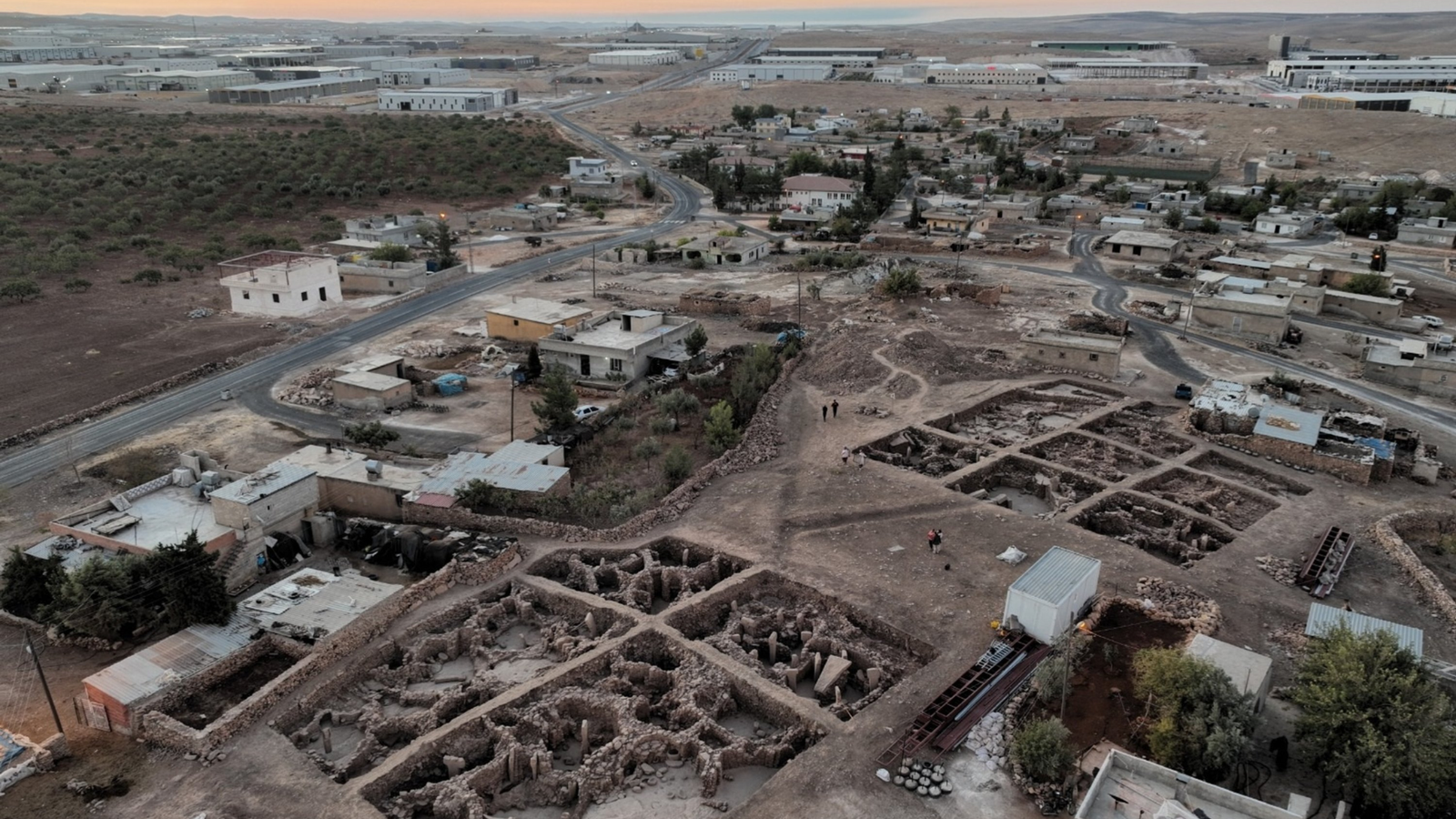

A prehistoric settlement in southeastern Türkiye where archaeologists have uncovered about 70 residential and special-purpose structures is being prepared for a new future as an open-air museum, offering visitors a rare opportunity to walk through a community created during one of the most consequential periods in human history.
The Sayburç archaeological site, located in Türkiye’s Şanlıurfa province, has now yielded approximately 70 structures across an excavated area of about 2,700 square metres, according to Culture and Tourism Minister Mehmet Nuri Ersoy. The announcement was made on August 19 as officials reviewed the latest work at Sayburç and the wider Taş Tepeler, or Stone Hills, archaeological project.
The discoveries date primarily to the middle of the ninth millennium BCE, when communities across this part of Southwest Asia were undergoing fundamental changes in how they lived, built settlements, organised social life and obtained food.
Plans now call for the Neolithic remains at Sayburç to be presented as an open-air museum, while surviving traditional village buildings are expected to be restored as part of a separate village museum. The result would bring together thousands of years of human occupation within one cultural landscape, stretching from the earliest settled communities through the Roman period and into modern rural life.
The significance of the Sayburç archaeological site, however, extends well beyond the number of structures uncovered. Archaeologists are using the settlement to investigate one of prehistory’s defining transformations: how mobile hunter-gatherer communities gradually became people who constructed permanent houses, organised communal spaces and developed increasingly complex forms of collective life.
About 70 Structures Have Now Been Exposed at Sayburç
The latest announcement marks a major expansion in what is known about the scale of the settlement.
Ersoy said excavations in their sixth season had exposed approximately 70 residential and special structures across 2,700 square metres. The remains are described as particularly well preserved, giving archaeologists an unusually detailed view of settlement organisation during the Neolithic period.
The Sayburç archaeological site is not composed of a single monumental building surrounded by empty ground. Instead, excavation has revealed a much broader settlement landscape in which houses, specialised structures and communal areas existed in close proximity.
That distinction matters because early archaeological research in the Şanlıurfa region initially attracted worldwide attention through spectacular monumental sites such as Göbeklitepe. Sayburç increasingly allows researchers to examine another part of the story: how ordinary living spaces developed alongside symbolic and communal architecture.
Archaeologists can therefore study not simply what people believed, but how they organised households, prepared food, constructed walls, divided interior space and lived beside one another.
The site is also preserving evidence of architectural change.
Researchers have identified both circular and increasingly rectangular forms of construction, providing material evidence from a period when more permanent domestic architecture was becoming a defining part of settled life.
Why the Sayburç Archaeological Site Matters to Human History
The Neolithic transformation did not occur in a single moment, nor did communities wake up one morning and decide to become farmers.
It unfolded across generations.
The broader Stone Hills project focuses precisely on this long period of change, from the beginnings of permanent settlement to the development of communities increasingly dependent on food production. The official Taş Tepeler research programme examines archaeological sites dating broadly between the 10th and seventh millennia BCE across the Şanlıurfa region.
Sayburç occupies an important position within that landscape.
The Sayburç archaeological site contains evidence from communities living at a time when people were becoming increasingly sedentary but had not yet developed the fully established agricultural societies that would later dominate the region.
This makes the settlement particularly valuable for understanding what archaeologists sometimes describe as the transition to sedentism.
Permanent settlement changed far more than architecture.
Living year-round in one place required communities to negotiate ownership, access to resources, waste disposal, storage, household boundaries and relationships between families. It also encouraged new forms of social memory because buildings, gathering spaces and burial places could remain connected with communities across generations.
The structures emerging at Sayburç therefore represent more than stone walls. They are physical traces of people learning how to live permanently together on a scale that would eventually help produce villages, towns and cities.
Sayburç Is Part of Türkiye’s Extraordinary Stone Hills Project
Any explanation of Sayburç needs to place it within the wider archaeological landscape of southeastern Türkiye.
The Stone Hills project, known in Turkish as Taş Tepeler, brings together excavations at a network of Neolithic sites around Şanlıurfa, including Göbeklitepe, Karahantepe, Sayburç, Sefertepe, Çakmaktepe, Gürcütepe and several others.
Türkiye’s Culture and Tourism Ministry has described the programme as one of the country’s largest archaeological initiatives. By late 2025, excavations were being conducted at 12 locations with participation from dozens of Turkish and international academic institutions.
The project seeks to understand a region that underwent profound social transformation after the end of the Ice Age.
Göbeklitepe became internationally famous because of its monumental T-shaped pillars and sophisticated symbolic imagery dating back roughly 12,000 years. Its discovery forced archaeologists to reconsider older assumptions that complex monumental construction could only emerge after fully developed farming societies.
The Sayburç archaeological site contributes a different type of evidence.
While its monumental and symbolic remains are important, Sayburç also contains closely connected residential architecture that offers archaeologists a clearer window into everyday settlement life.
This makes it especially valuable when trying to understand how symbolic culture, social organisation and domestic life developed together.
An Extraordinary Carved Scene Made Sayburç Famous
Long before the latest announcement about 70 structures, Sayburç had already attracted international attention because of one exceptional archaeological discovery.
A communal building at the site contains a carved relief depicting five human and animal figures arranged in what researchers interpret as a connected scene.
The carving includes human figures, leopards and a bull, with the figures positioned in a way that suggests interaction rather than functioning as isolated symbols.
Archaeologist Eylem Özdoğan, who directs research at Sayburç, published the discovery in the journal Antiquity in 2022. She argued that the relief represents the earliest known example of a narrative scene, providing rare evidence that Neolithic communities were depicting events or stories through connected visual compositions.
The research is especially significant because prehistoric symbolic art often survives without any written explanation of its meaning.
Nobody can confidently reconstruct the precise story represented in the Sayburç relief.
What archaeologists can observe is its composition.
The humans and animals appear together in a connected sequence, suggesting that the people who carved the scene were doing more than producing decorative images. They may have been representing a remembered event, oral tradition, myth, ritual narrative or another form of collective storytelling.
The Sayburç archaeological site therefore provides evidence not only for the architecture of early settled communities but also for the ways those communities may have communicated ideas and preserved shared memory.
Archaeologists Have Found Communal and Residential Areas
Research at Sayburç has identified two principal areas of Neolithic occupation.
In the northern sector, archaeologists uncovered a large circular structure cut partly into the limestone bedrock. The official Taş Tepeler project describes it as approximately 14 metres in diameter, with a stone wall constructed directly on the bedrock and a bench running along its interior. The famous narrative reliefs were carved into part of that bench.
The southern area contains a more extensive cluster of residential structures built close to one another.
Some include architectural elements familiar from other Stone Hills settlements, including T-shaped pillars, while the overall arrangement provides evidence for increasingly regular domestic architecture.
The relationship between these areas is one of the most interesting questions surrounding the Sayburç archaeological site.
If communal buildings and houses belonged to the same functioning settlement, they could help researchers reconstruct how public ritual, household organisation and daily activity were connected within an early permanent community.
This is important because older interpretations sometimes separated the monumental architecture of the Şanlıurfa Neolithic from ordinary settlement life.
Sayburç is helping complicate that picture.
The evidence increasingly suggests that symbolic activity and everyday life may have been deeply intertwined rather than existing in entirely separate spaces.
From Circular Buildings to Rectangular Homes
One of the most important architectural stories emerging from Sayburç concerns the changing shape of buildings.
Early structures in the region frequently followed circular or oval plans. Over time, rectangular buildings became increasingly common.
This might sound like a minor change in architectural preference, but it had significant practical consequences.
Rectangular structures can be placed directly alongside one another, extended more easily and divided efficiently into separate rooms. These characteristics make them particularly suitable for dense permanent settlements.
At the Sayburç archaeological site, archaeologists can examine this transition within a landscape where early communities were experimenting with increasingly permanent forms of domestic architecture.
The change also reflects a broader social transformation.
A permanent rectangular house is not simply a shelter. It can become associated with a particular household, family group, inheritance pattern or set of activities.
As settlements became more stable, buildings could acquire histories of their own.
A house might be repaired, expanded, rebuilt or remembered across generations.
For archaeologists trying to understand when the concept of a recognisable household began to take shape, Sayburç provides unusually valuable material evidence.
Why an Open-Air Museum Makes Sense at Sayburç
Transforming the Sayburç archaeological site into an open-air museum would allow visitors to understand something that display cases alone struggle to communicate: the relationship between individual buildings and the wider settlement.
Archaeological objects removed from the ground can tell powerful stories inside museums, but architecture is often best understood in its original landscape.
At Sayburç, visitors could potentially see where people lived, where communal activities took place and how buildings related spatially to one another.
The museum plan also fits a wider trend in archaeological heritage management that seeks to preserve sites in situ where conservation conditions allow.
Instead of transporting every significant discovery into a conventional museum, an archaeological park or open-air museum can allow the landscape itself to become part of the interpretation.
The latest announcement indicates that Sayburç’s Neolithic structures would form the heart of that experience.
No final opening date has yet been announced in the reporting surrounding the August 19 plan, so visitors should not interpret the announcement as meaning that the completed museum is immediately ready to open.
The Museum Plan Will Also Preserve Traditional Village Life
What makes the proposed Sayburç museum particularly unusual is that it will not focus exclusively on prehistory.
The settlement has been occupied or used during multiple periods, including the Roman era and modern village life.
Earlier museum plans outlined by excavation director Eylem Özdoğan proposed restoring interconnected stone houses and a traditional village room dating from the mid-20th century. These buildings would contain objects associated with everyday Şanlıurfa life, including tools connected with cooking, food storage and household activity.
The concept therefore creates two parallel forms of preservation.
The Sayburç archaeological site would protect the remains of a community from the ninth millennium BCE, while the village museum would preserve a much more recent way of rural life that is itself disappearing.
That combination is culturally significant.
Archaeological tourism sometimes creates the impression that history ends once an ancient civilisation disappears. In reality, landscapes continue accumulating human stories.
Sayburç preserves precisely that kind of continuity.
Neolithic communities occupied the area thousands of years ago. Roman-period activity followed. Modern villagers later built homes and created their own traditions within the same landscape.
Presenting those layers together could make Sayburç one of the more unusual archaeological visitor experiences in the region.
The New Announcement Builds on Earlier Museum Plans
There is an important distinction in the latest news.
The idea of creating an open-air archaeological museum at Sayburç was discussed before August 2026. In September 2025, excavation officials were already describing plans to present the Neolithic remains outdoors and restore traditional village buildings as a museum.
What makes the August 19, 2026 announcement newsworthy is the scale of archaeological progress now being reported.
Officials say roughly 70 structures have been exposed across about 2,700 square metres, giving the planned museum a substantially more developed archaeological landscape to present.
That context matters because it prevents an inaccurate impression that the museum idea appeared for the first time this week.
The latest development instead represents a significant new stage in a longer conservation and interpretation project.
For an international audience, the distinction also illustrates how archaeological sites move gradually from excavation to public presentation.
Researchers first need to uncover structures, document them scientifically and determine how they can be stabilised. Conservation specialists must then protect exposed stonework from weathering and visitor pressure before paths, interpretation systems and protective infrastructure can be designed.
An open-air archaeological museum is therefore not simply an excavation with a ticket booth. It requires years of planning if the remains are to survive continued exposure.
Sayburç Could Become a Major Stop Beyond Göbeklitepe
Şanlıurfa already occupies an exceptional position on the global archaeological map because of Göbeklitepe.
The UNESCO World Heritage site has become one of Türkiye’s most recognisable cultural attractions, drawing visitors interested in the origins of monument building, ritual and permanent settlement.
The expansion of research under Taş Tepeler is gradually revealing that Göbeklitepe was not an isolated phenomenon.
The Sayburç archaeological site, Karahantepe and other nearby settlements show that the region contained a broader network of communities experimenting with architecture, imagery, social organisation and increasingly settled ways of life.
Turning Sayburç into an open-air museum could help visitors understand that wider context.
Rather than viewing Göbeklitepe as a mysterious monument standing alone in prehistory, travellers could begin to see the Şanlıurfa plateau as an interconnected archaeological landscape.
That shift would also support a more nuanced historical narrative.
Humanity’s move toward permanent settlement did not happen at one famous site. It involved numerous communities responding differently to changing environments, social pressures and new possibilities.
Sayburç is becoming one of the places where that complicated process can be studied in unusually fine detail.
What Archaeologists Still Hope to Learn From Sayburç
Despite the approximately 70 structures already reported, research at the Sayburç archaeological site is far from complete.
One of the central questions concerns the relationship between domestic and communal architecture.
Researchers want to understand whether particular buildings served entire communities, specific households or smaller social groups.
Another major issue involves food production.
The ninth millennium BCE was a period when communities in Southwest Asia were increasingly experimenting with plant cultivation and animal management. Archaeological remains at Sayburç could contribute to wider debates about when and how domesticated food systems became central to permanent settlements.
Researchers are also studying technology, architectural development and changing social relationships.
The official project emphasises that Taş Tepeler is designed to investigate the period from the beginnings of sedentary life through the development of fully established agricultural societies.
Sayburç provides an unusually valuable laboratory for that research because it preserves both domestic and symbolic evidence.
The carved reliefs reveal something of the community’s imaginative world.
The houses reveal something of its practical world.
Studied together, they can help archaeologists move beyond the simplistic question of when people first settled down and instead examine what permanent community life actually meant.
Why the Sayburç Discovery Is More Important Than the Number 70
The figure of 70 structures makes an effective headline, but the archaeological importance of Sayburç lies in what those buildings collectively reveal.
A settlement is a social system preserved in stone.
The arrangement of buildings can show whether households valued privacy, how movement was organised, where communal activities occurred and whether different structures had specialised functions.
Changes in building shapes can indicate transformations in social organisation.
Food remains can reveal shifts in diet and subsistence.
Tools can show how labour was organised.
Burials and symbolic objects can offer clues about identity, memory and belief.
At the Sayburç archaeological site, all of those questions converge within a period when human societies were undergoing profound change.
The people who lived there were not building cities in the modern sense, but they were participating in developments that eventually made urban civilisation possible.
Permanent houses required new forms of cooperation.
Dense settlements created new social pressures.
Stored food changed relationships with resources.
Communal buildings provided places for collective activity.
Visual narratives could preserve stories and shared identities.
The archaeological importance of Sayburç lies precisely in its ability to show several parts of that transformation within the same settlement.
The Bottom Line
Türkiye’s plan to transform the Sayburç archaeological site into an open-air museum could give the public an unusually direct view of one of the most important transitions in human history.
Officials now say excavations have exposed roughly 70 residential and special structures across 2,700 square metres, substantially expanding the picture of a Neolithic settlement dating to the middle of the ninth millennium BCE.
The numbers are impressive, but Sayburç’s real significance lies in the questions those structures allow archaeologists to ask.
How did hunter-gatherers become permanent neighbours? How did circular communal architecture develop alongside increasingly regular houses? When did households acquire recognisable physical boundaries? How were stories, rituals and shared memories preserved as communities became more sedentary?
The famous reliefs at Sayburç have already provided what researchers describe as the earliest known narrative scene, depicting humans and animals as participants in a connected composition. The growing settlement around those images now gives archaeologists an opportunity to understand more about the society that created them.
The proposed open-air museum would eventually allow visitors to experience that story where it unfolded rather than encountering it only through artefacts removed from their archaeological context.
For a region already transformed by the international success of Göbeklitepe, Sayburç represents another important chapter in a much larger archaeological story.
The Stone Hills are revealing that the beginnings of settled life were neither simple nor sudden. They involved communities experimenting with architecture, social relationships, food, memory and symbolism across generations.
At Sayburç, around 70 structures are now helping bring that transformation back into view.
Frequently Asked Questions
What is the Sayburç archaeological site?
The Sayburç archaeological site is a Neolithic settlement in Şanlıurfa province in southeastern Türkiye. Excavations began in 2021 and have revealed domestic buildings, communal structures, T-shaped pillars, sculpture and an important carved narrative scene.
How many structures have archaeologists uncovered at Sayburç?
Türkiye’s Culture and Tourism Minister said in August 2026 that approximately 70 residential and special-purpose structures had been uncovered across an excavation area of about 2,700 square metres.
How old is Sayburç?
The principal Neolithic settlement is dated to around the middle of the ninth millennium BCE, making it more than 10,000 years old.
Is Sayburç becoming an open-air museum?
Yes. Turkish officials are planning to present the Neolithic remains as an open-air museum. Traditional village buildings are also expected to be restored as part of a complementary village museum, although a final public opening date has not yet been announced.
Why is Sayburç important?
Sayburç preserves both communal and residential architecture from a crucial stage in the transition toward settled life. Its archaeological evidence helps researchers study early households, architecture, symbolism and changing social organisation.
What are the Sayburç reliefs?
The Sayburç reliefs are a group of human and animal figures carved into a bench inside a communal building. Archaeologist Eylem Özdoğan has described the connected composition as the earliest known narrative scene.
Is Sayburç connected to Göbeklitepe?
Sayburç and Göbeklitepe are separate archaeological sites, but both belong to the wider Taş Tepeler, or Stone Hills, research landscape centred on the Şanlıurfa region.
Don’t forget to follow us on Facebook | Instagram | Twitter | LinkedIn to get the latest updates from Cape Town Tribune