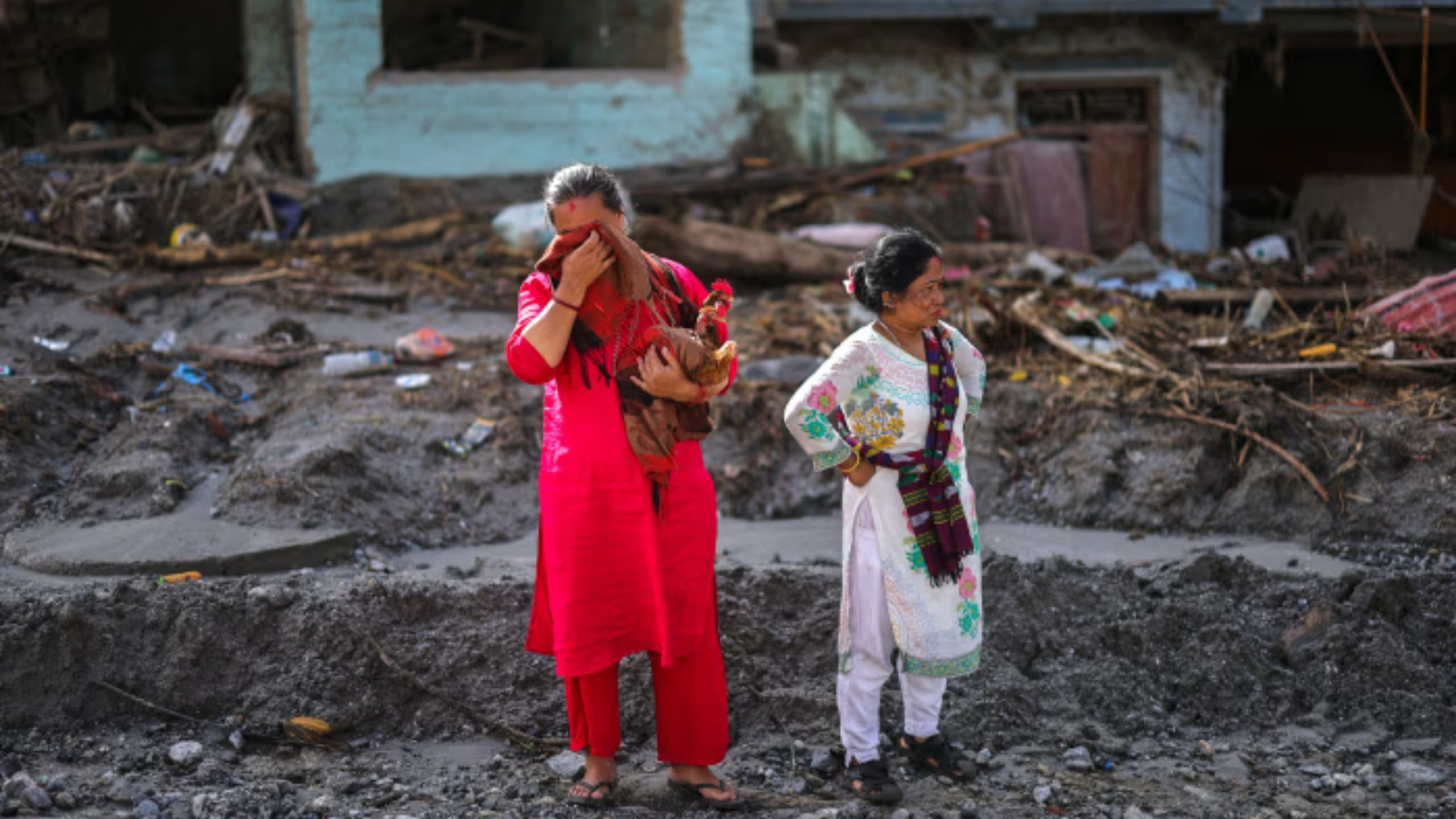

More than 4,400 people remain missing after a catastrophic Himalayan glacier collapse sent rock, ice, mud and water through communities on both sides of the Nepal-China border, destroying roads, bridges and hydropower facilities.
The death toll from the Nepal-Tibet floods has risen above 1,000 as rescue teams push deeper into remote Himalayan valleys nearly a week after a glacier collapse unleashed a devastating torrent across the Nepal-China border.
Nepal’s disaster agency said on Tuesday that 987 people had been confirmed dead in the country and 3,916 remained missing, including 583 foreign nationals, according to the Associated Press. Chinese authorities have separately reported 16 deaths in Tibet, taking the combined confirmed toll above 1,000. China’s latest official update said another 546 people remained missing in Gyirong County, meaning more than 4,400 people are still unaccounted for across the disaster zone.
The numbers have changed repeatedly as rescuers reach previously inaccessible communities and authorities reconcile lists of the dead, missing and rescued. Reuters reported earlier on Tuesday that Nepalese Prime Minister Balendra Shah had put the country’s confirmed death toll at at least 939, illustrating how quickly the figures are being revised as recovery operations expand.
For families still searching for relatives, however, the central reality has barely changed: thousands of people remain missing in one of the worst natural disasters to strike the Himalayan region in recent years.
Rescue teams reach areas cut off by the Nepal-Tibet floods
Rescuers have begun reaching isolated parts of Nepal after temporary bridges were constructed and some damaged roads, power lines and communications networks were restored.
Nepalese authorities said more than 11,000 people had been rescued from affected areas by Tuesday. India and China are assisting efforts to restore access, including through the construction of temporary Bailey bridges over waterways where permanent crossings were swept away.
The operation remains extraordinarily difficult.
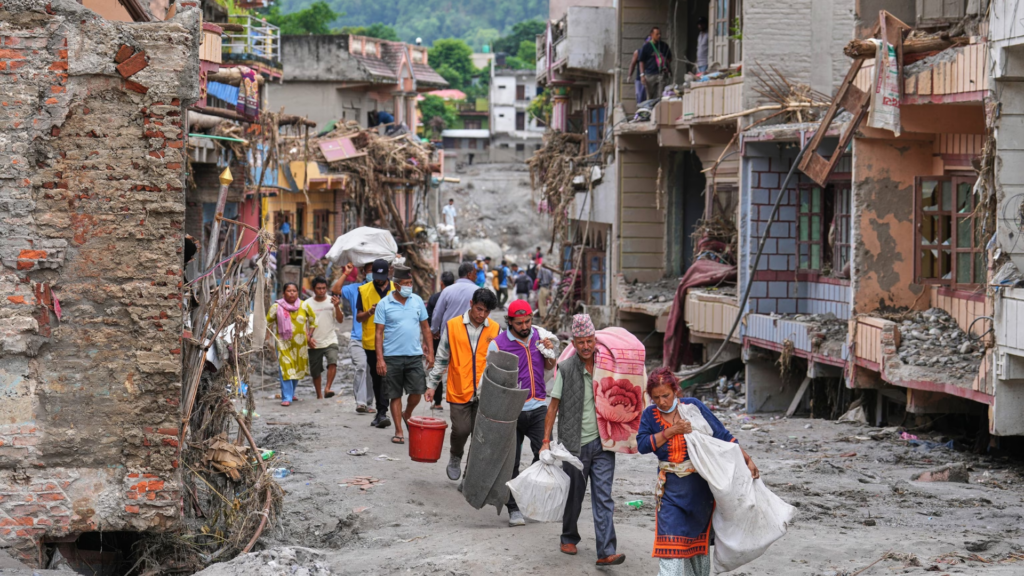
Entire stretches of road have disappeared beneath mud and debris. Landslides have isolated mountain settlements, while damaged bridges have forced rescue teams to rely on helicopters, military aircraft and difficult journeys on foot to reach some communities.
In Nuwakot district, one of the areas hardest hit, police said rescuers recovered 24 bodies from a single house in Betrabati village after teams gained access to the area.
The widening search means the final scale of the disaster may not be known for some time.
Hundreds remain trapped around hydropower projects
Some of the most urgent rescue operations are centred on Nepal’s hydropower industry.
The floods struck a region containing numerous dams, tunnels, powerhouses and construction sites built along steep Himalayan river valleys.
Prime Minister Shah said 279 workers had been rescued from hydropower projects, while about 600 people remained stranded at damaged facilities. Authorities initially estimated that close to 1,000 people had been trapped at project sites.
Other assessments have placed the number of hydropower workers still unaccounted for at around 900 across a dozen damaged projects, with hundreds feared to have been inside large water-control tunnels when the flood struck.
Rescuers have been using heavy machinery, searchlights and specialised equipment to dig through thick deposits of rock and mud around tunnel entrances.
The disaster has also exposed the vulnerability of infrastructure central to Nepal’s economic strategy. The country has invested heavily in hydropower over the past two decades, both to meet domestic electricity demand and to expand power exports to neighbouring India.
Several major projects were damaged when the flood surge tore through the Trishuli river system.
What caused the catastrophic Himalayan flood?
The disaster began on August 26 high in the Himalayas near the Nepal-Tibet frontier.
Initial reports raised questions over whether an earthquake had triggered the catastrophe. Subsequent satellite analysis and scientific assessments instead indicated that a massive glacier and rock collapse itself generated the seismic activity recorded at the time.
Reuters reported that satellite imagery showed a substantial portion of a glacier at an elevation of roughly 5,200 metres breaking away and plunging about 1,200 metres into the valley below. The collapse generated an enormous ice-rock avalanche and debris flow that entered mountain waterways and surged downstream.
Scientists examining the event told AP that the sequence appears to have involved the failure of bedrock beneath the glacier. The collapse produced seismic energy equivalent to roughly a magnitude 5.2 event, rather than necessarily being caused by an earthquake of that size.
The resulting mass of ice, water, rock and mud moved through river valleys towards settlements, roads, border facilities and hydropower installations below.
Along parts of the affected river system, water levels rose extraordinarily rapidly, leaving some communities with only minutes to respond.
That distinction matters because it changes the understanding of what happened: this was not simply a conventional monsoon flood. It was a cascading high-mountain disaster in which unstable ice and rock generated an enormous downstream debris flow.
Climate change questions grow after glacier collapse
The disaster is also intensifying scrutiny of the risks facing the Himalayas as temperatures rise.
Chinese state media has attributed the glacier instability to the long-term effects of global warming, while Nepal’s prime minister has called for greater international attention to climate-related threats confronting Himalayan countries.
Researchers have warned for years that warming is transforming high-altitude environments across the region. Rising temperatures can contribute to glacier retreat, thawing permafrost and changing snow and ice conditions, all of which can destabilise steep mountain landscapes.
Scientists analysing this particular event have also pointed to unusually warm conditions and rapid snowmelt as possible contributing factors.
However, attributing an individual glacier collapse entirely to climate change requires detailed scientific analysis. The immediate physical mechanism of the August 26 disaster is becoming clearer, but researchers will need more data to establish precisely how warming affected the sequence of failures that led to the flood.
South Korea sends 44-member emergency team to Nepal
International assistance is expanding as the search enters a critical phase.
South Korea announced on Tuesday that it would deploy a 44-member emergency relief team to Nepal following a formal request from Kathmandu for search-and-rescue assistance.
The team includes personnel from South Korea’s Foreign Ministry and fire agency and is travelling aboard a military transport aircraft. It is expected to operate in Nepal for approximately 10 days.
Seoul had already sent a smaller rapid-response team after nine South Korean workers went missing at a hydropower project during the flood. Its initial aerial search efforts were delayed by flight restrictions before missions over the suspected disaster site began on August 29.
India and China have also contributed personnel, equipment and engineering assistance, while humanitarian aid from international partners continues to arrive.
Nepal’s prime minister said aid worth more than $42 million had already been committed or received by Tuesday, with further contributions expected.
Nepal faces a reconstruction bill of up to $5 billion
Even as the search for survivors continues, attention is beginning to turn towards the enormous cost of reconstruction.
Nepalese Finance Minister Swarnim Wagle told Reuters that the country could require between $4 billion and $5 billion to rebuild following the disaster, an amount equivalent to almost one-tenth of Nepal’s economy.
Wagle stressed that the figure was an initial estimate and that a full assessment of losses was still underway.
The distinction is important: the $4 billion-to-$5 billion figure is a preliminary estimate of reconstruction requirements, rather than a completed assessment of direct economic damage.
Roads, bridges, border facilities and electricity infrastructure have all suffered severe damage. Hydropower is particularly important because Nepal has increasingly relied on the sector as both a source of domestic energy and export revenue.
Reuters previously reported that damaged power projects represented more than 12% of Nepal’s generating capacity.
The rebuilding challenge will therefore extend well beyond replacing homes. Restoring transport links, electricity generation, communications and economic activity across mountainous terrain could take years.
A humanitarian disaster whose full scale is still emerging
The physical destruction tells only part of the story.
Thousands of survivors have lost homes, businesses and relatives. Schools and other public buildings are being used as temporary shelters, while communities whose roads and communications were destroyed remain dependent on emergency relief.
The affected region also includes communities with deep Buddhist and Indigenous cultural traditions. Survivors have expressed fears that the destruction of villages, monasteries, family possessions and community spaces could result in cultural losses that cannot simply be reconstructed once the emergency is over.
For now, rescue remains the priority.
Every restored bridge, cleared road and reopened communications line is allowing authorities to obtain a clearer picture of what happened in places that were effectively cut off after the Nepal-Tibet floods.
That clearer picture has so far brought a steadily rising toll.
Nearly a week after the Himalayan glacier collapse, more than 1,000 people are confirmed dead, more than 4,400 remain missing, hundreds of workers are still the focus of searches around devastated hydropower facilities, and thousands of families are confronting the prospect that their communities may never look the same again
Don’t forget to follow us on Facebook | Instagram | Twitter | LinkedIn to get the latest updates from Cape Town Tribune