
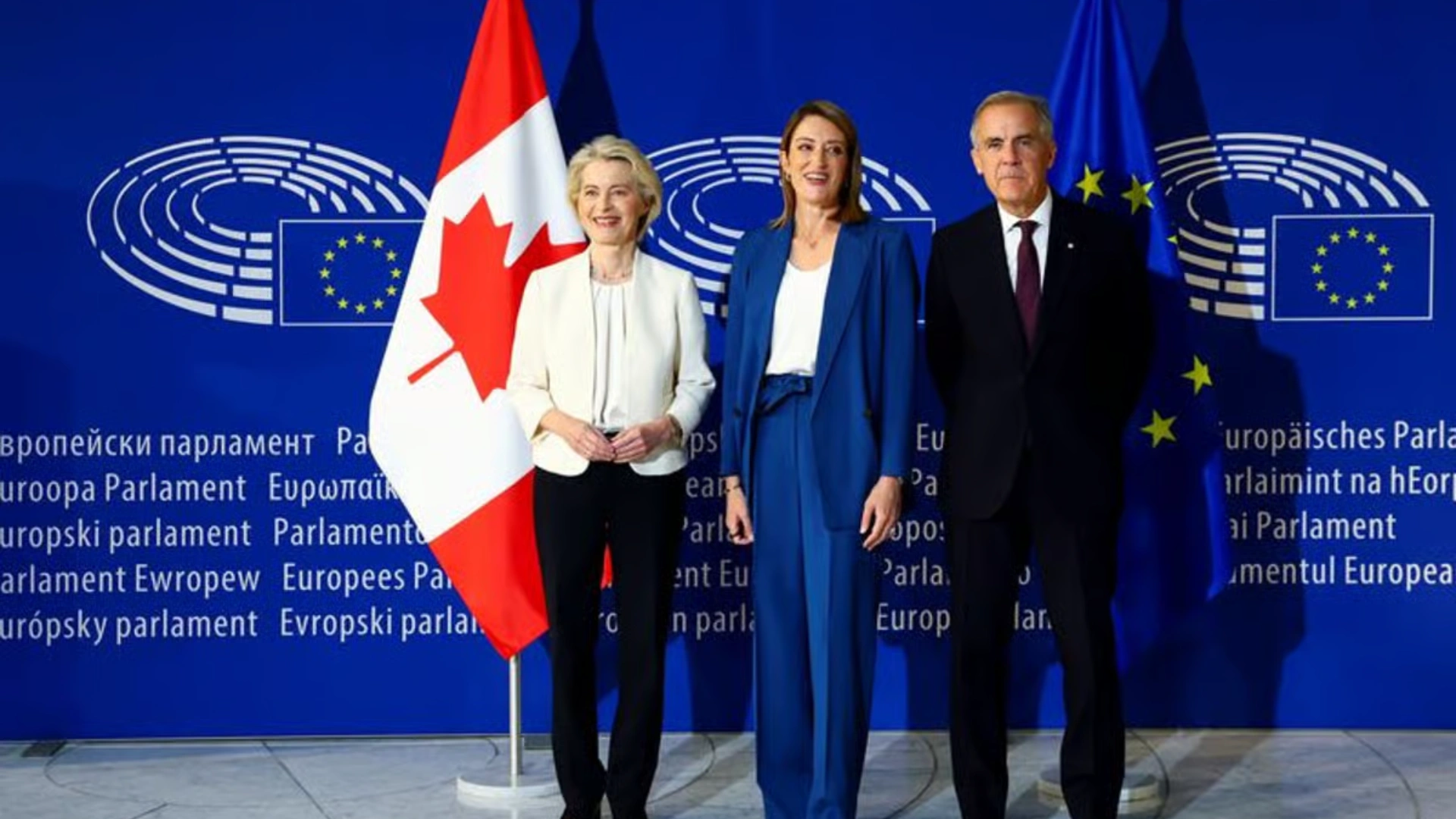

Canada EU relations are moving into a potentially historic phase after European Commission President Ursula von der Leyen proposed making Canada the European Union’s first “associate member”, a new status that does not currently exist in EU treaties.
The proposal, announced during von der Leyen’s State of the Union address in Strasbourg on September 16, came with Canadian Prime Minister Mark Carney in attendance. It reflects a broader effort by Ottawa and Brussels to deepen economic and security ties at a time when both are seeking more reliable partners in trade, defence, technology and critical minerals.
For Canada, the idea offers a possible route to reduce its heavy dependence on the United States without seeking full EU membership. For Europe, it could create a new model for working with close democratic partners outside the bloc.
But Canada EU relations are not about to become a conventional membership process. Carney has said Canada wants a “unique alliance” with the EU, not full membership, and the legal meaning of “associate member” has yet to be defined.
What Would EU Associate Status Actually Mean?
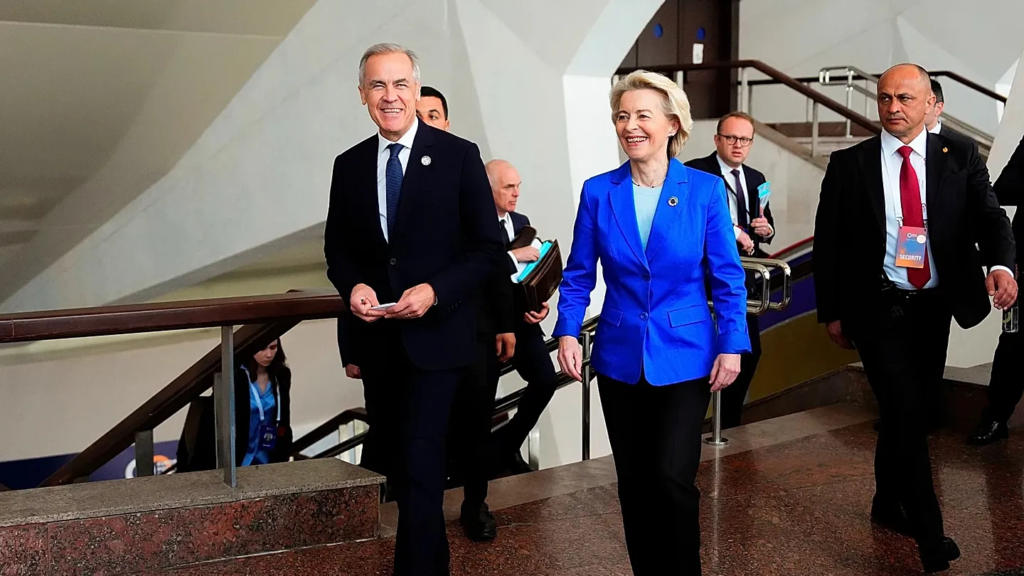
The European Union has no formal category called associate membership in its treaties. Canada is therefore not entering the normal accession process used by countries seeking full membership. Instead, Ottawa and Brussels would have to design a new framework.
Reuters reported that creating such a status would require extensive negotiation and agreement among EU governments because there is currently no established legal route for Canada to become an associate member.
The most likely result would be deeper integration in selected areas rather than access to every part of the EU system. Cooperation could expand across defence procurement, research, technology, energy, critical minerals, digital trade and possibly professional or educational mobility.
Canada EU relations could therefore move beyond a conventional free-trade partnership without giving Ottawa voting rights inside EU institutions.
The comparison with Norway and Iceland is useful, although imperfect. Both countries participate extensively in the European single market while accepting many EU rules without voting on how those rules are made. Canada would not necessarily follow the same model, but the example shows the trade-offs that deeper integration can create.
Canada and Europe Already Have Deep Economic Ties
The proposal builds on a substantial economic relationship. The European Union is Canada’s second-largest trading partner for goods and services after the United States.
Canadian government figures show combined trade in goods and services between Canada and the EU reached C$178.6 billion in 2025.
Canadian direct investment in the EU stood at C$297 billion in 2024, while EU investment in Canada was estimated at C$194 billion.
Much of the commercial relationship is governed by the Comprehensive Economic and Trade Agreement, or CETA, which has been provisionally applied since 2017.
Canadian government data shows bilateral merchandise trade increased by more than 77% between 2016 and 2025, illustrating how quickly commercial links have expanded under the agreement.
But Canada EU relations now reach well beyond trade. In June 2025, Canada and the EU signed a Security and Defence Partnership covering areas including crisis management, defence industry cooperation, hybrid threats and military mobility.
Canada later became the first non-European country approved to participate in the EU’s €150 billion Security Action for Europe, or SAFE, defence instrument. The programme is designed to support joint defence procurement and strengthen European defence production.
That means the associate-member proposal is not appearing in isolation. It is the latest stage in a relationship already moving toward deeper economic and security cooperation.
Why Canada EU Relations Matter More to Ottawa Now
The immediate political and economic background is Canada’s effort to reduce its overwhelming dependence on the United States.
The American market still absorbs most Canadian exports, making the United States impossible to replace in the foreseeable future. But repeated trade disputes and tariff tensions have increased pressure on Ottawa to expand access to other major markets.
Carney has framed that effort as greater economic and strategic autonomy rather than a complete break with Washington.
Canada EU relations fit that strategy because Europe offers a large consumer market, major pools of investment capital, advanced industrial capacity and growing demand for resources Canada can provide.
Critical minerals are particularly important. European governments are trying to reduce dependence on China for materials needed in batteries, electric vehicles, defence systems and advanced manufacturing.
Canada possesses large reserves of minerals including lithium, nickel, cobalt and rare earth elements. The two sides are already cooperating on critical mineral supply chains through their strategic partnership on raw materials.
Energy, artificial intelligence, digital trade, space and Arctic security are also becoming larger parts of the relationship.
Canada and the EU formally launched negotiations for a digital trade agreement in March 2026, another sign that the partnership is extending into sectors far beyond traditional goods trade.
Why Europe Wants Canada Closer
Europe’s interest is equally practical. The EU is trying to strengthen supply chains, increase defence production and build partnerships with countries that can provide energy, critical minerals, advanced technology and industrial capacity.
Canada meets many of those requirements while already sharing extensive political and security ties with European countries through NATO and other institutions.
For Brussels, stronger Canada EU relations could provide another way to reduce economic vulnerabilities without the political complications involved in expanding full EU membership.
Von der Leyen’s proposal also came as part of a wider effort to deepen security relationships with countries outside the bloc, including Canada, Britain, Norway and Ukraine.
Canada’s participation in SAFE already provides an example of how deeper cooperation can work without EU membership.
Canadian defence firms gain greater opportunities to participate in European procurement, while EU governments gain access to additional manufacturing capacity and suppliers.
The Arctic provides another shared interest. Canada and several European countries are paying greater attention to Arctic infrastructure, security and resources as strategic competition in the region grows.
Taken together, these areas make Canada EU relations increasingly about economic security rather than trade alone.
The United States Remains the Unavoidable Factor
Any significant shift in Canada EU relations will be closely watched in Washington.
Canada and the United States have deeply integrated economies, particularly in autos, energy, agriculture, defence and manufacturing. Greater engagement with Europe does not change that geography.
President Donald Trump has criticised the proposed Canada-EU association and warned of possible additional trade measures if he regards the arrangement as hostile to U.S. interests.
Ottawa and Brussels, however, have presented their cooperation as diversification rather than an attempt to create an anti-American bloc.
There is no indication that the proposed arrangement would require Canada to reduce trade with the United States or choose between Europe and North America.
The more realistic objective is to give Canada additional options so that access to markets, defence partnerships, investment and strategic technology is not concentrated so heavily in one bilateral relationship.
Europe is pursuing a similar strategy. The EU wants to preserve transatlantic relationships while developing more independent capacity in defence, energy, technology and critical supply chains.
Major Legal and Political Questions Remain
Turning the idea into an agreement will not be simple. Because associate membership has no established legal meaning, EU governments must first decide what rights and responsibilities Canada would receive.
Would Canadian companies gain greater access to the single market?Would Ottawa have to adopt more EU regulations? Could Canadians receive broader rights to study or work in Europe? Would Canada contribute financially to EU programmes? And if Canada were required to follow additional European rules, would it receive any formal influence over how those rules are made?
These questions go to the centre of the proposal. Reuters reported that some EU governments were surprised by von der Leyen’s announcement and that significant uncertainty remains over both its legal basis and practical advantages.
Canada would also face difficult domestic decisions. Many Canadian supply chains and regulations are closely linked to U.S. standards.
Aligning more closely with European rules could create new opportunities for some Canadian companies while increasing costs for businesses that depend heavily on the American market.
That is where Canada EU relations could become a much more complicated domestic economic debate.
What Happens Next for Canada EU Relations?
The next test will be whether political enthusiasm develops into a detailed negotiating framework.
Canada and the European Union are preparing for their next summit in Canada on October 29 and 30, 2026. Officials are already working on defence cooperation, digital trade, economic security and critical minerals.
Canada EU relations could eventually produce a formal associate status, but the label itself matters less than what any agreement actually contains.
If Canada receives wider access to European defence procurement, digital markets, research programmes, energy partnerships and professional mobility, the relationship could change substantially without resembling full membership.
If negotiations produce only modest additions to CETA and existing cooperation agreements, the phrase “associate member” may remain more political than institutional.
The wider significance is that Canada and the EU are openly discussing a type of partnership neither has previously attempted.
For Ottawa, the goal is greater room to manoeuvre in a less predictable international trading system.
For Brussels, Canada offers critical resources, defence capacity, investment and a politically stable partner outside Europe.
The debate over associate status is therefore about more than institutional terminology. It will test whether Canada EU relations can evolve into a new model of strategic partnership, one deeper than a trade agreement but still well short of membership.
Don’t forget to follow us on Facebook | Instagram | Twitter | LinkedIn to get the latest updates from Cape Town Tribune