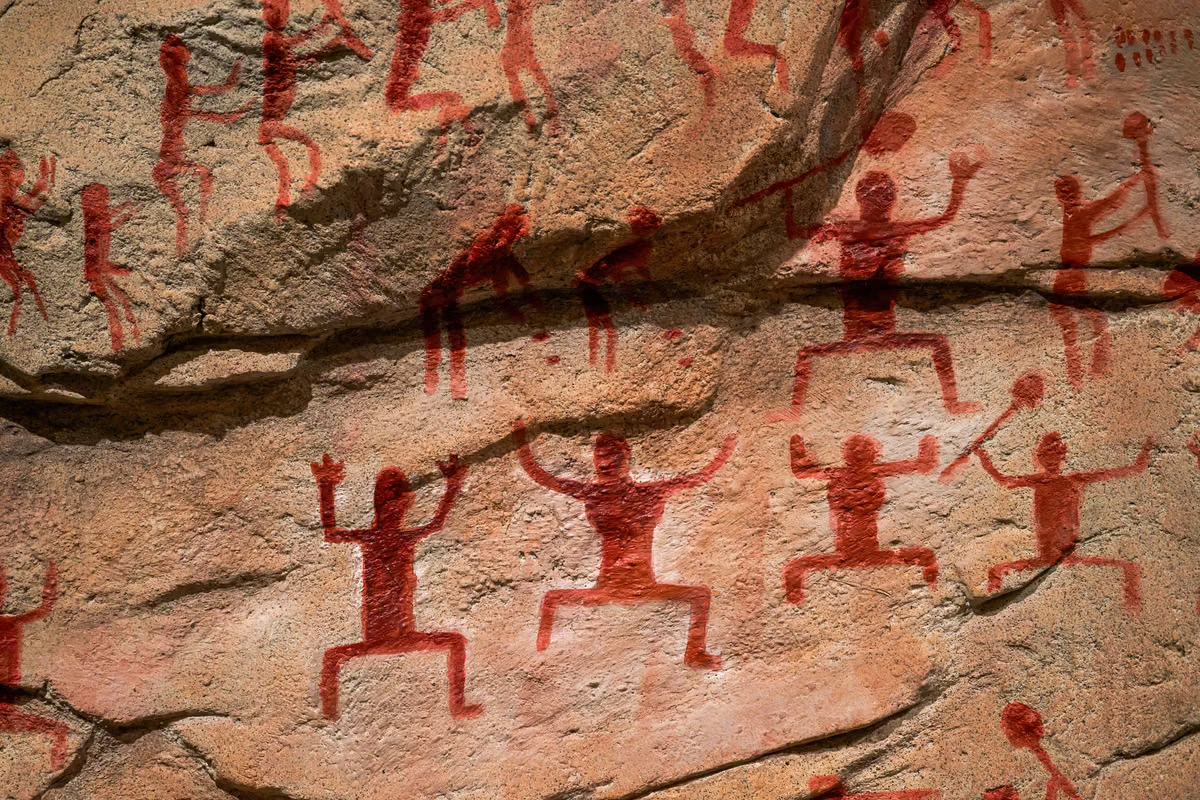

For more than 2,000 years, thousands of red figures have remained visible on limestone cliffs above the rivers of southern China. They have endured intense heat, monsoon rain, humidity, and repeated weathering in conditions that would normally be expected to damage exposed paintings.
New research suggests that part of the reason ancient Chinese rock art has survived for so long may lie in an unusual ingredient used by its creators: blood.
Researchers led by Meng Wu of Shandong University examined fragments from the Zuojiang Huashan rock art landscape in Guangxi and found evidence of a carefully constructed painting system involving red clay rich in extremely small hematite particles, a lime-based mortar, and blood proteins. The team argues that this combination helped form a durable layer of calcium carbonate around the pigment, binding it closely to the limestone cliff.
The findings do more than offer a possible explanation for the remarkable preservation of the paintings. They suggest that the communities responsible for ancient Chinese rock art possessed a sophisticated understanding of materials and how they behaved, even if their knowledge was developed through experience rather than modern chemistry.
The study also raises a more provocative possibility. Researchers detected proteins that led them to suggest that some human blood may have been associated with childbirth or the postpartum period. That interpretation, however, remains much less certain than the evidence showing blood was present in the painting material. Outside specialists have cautioned that the proteins are not exclusive to childbirth and that the study sampled only a small part of the enormous rock-art complex.
Why Ancient Chinese Rock Art Has Survived for 2,000 Years
The Zuojiang Huashan paintings occupy one of the most demanding environments imaginable for ancient outdoor art.
The rock art is spread across steep limestone cliffs in Guangxi in southern China, close to the Vietnamese border. The region has a subtropical monsoon climate, bringing heavy rainfall, high humidity, intense summer heat, and exposure to severe weather. Yet many of the red figures remain clearly visible after roughly two millennia.
UNESCO says the 38 sites included within the Zuojiang Huashan Rock Art Cultural Landscape date from around the fifth century BCE to the second century CE. The paintings are associated with the Luoyue people and depict ceremonies, human figures and objects connected to the bronze-drum culture that was once widespread across southern China.
Researchers have long been interested in how ancient Chinese rock art could remain attached to open cliff faces for such an extraordinary length of time.
Ordinary organic binders can deteriorate in hot, wet environments. The new research proposes that the Huashan painters used something considerably more complex.
Scientists Found a Carefully Built Three-Layer System
The research team studied naturally detached fragments rather than removing material directly from intact paintings. Samples came from three sites within a much larger rock-art belt containing more than 80 known locations.
Researchers used a combination of electron microscopy, infrared spectroscopy, Raman spectroscopy, and proteomic analysis to examine the structure and composition of the material. Shandong University says the analysis revealed a three-layer system consisting of the natural limestone surface, a mortar containing lime, bone ash and blood, and an outer pigment layer rich in nanoscale iron oxide.
The red colour appears to have come from local clay containing nano-hematite, a form of iron oxide responsible for the pigment’s distinctive colour.
Rather than simply rubbing this red material directly onto the rock, the ancient artists appear to have prepared the cliff surface with a specially formulated mortar.
That distinction changes the way researchers understand the creation of ancient Chinese rock art. The paintings were not necessarily produced by applying a basic mixture of pigment and glue. The evidence points toward a carefully sequenced process in which the surface, binder, and pigment interacted chemically.
What Blood May Have Done to the Paint
Blood appears to have served a practical chemical function in the painting process.
According to the researchers, blood proteins within the lime mixture encouraged the formation of biomineralised calcium carbonate. As the mortar cured, calcium carbonate crystals formed around the nano-hematite pigment and connected the painted layer with the limestone underneath.
In effect, the chemistry may have helped the colour become part of a mineral structure closely compatible with the cliff itself.
Shandong University’s description of the process says the resulting material had physical and chemical characteristics similar to the limestone substrate. The researchers argue that this helps explain why the paintings were able to resist physical, chemical and biological weathering far better than a conventional organic binder might have.
There was another protective process at work. Researchers also identified a thin layer of calcium oxalate created through biological activity on the surface, which may have offered additional protection.
For ancient Chinese rock art exposed directly to monsoon conditions, those layers could have been crucial to its survival.
The Artists May Have Processed Local Materials With Remarkable Precision
The study also attempts to reconstruct how the paint was made.
According to Shandong University’s account, the creators may have burned limestone or shells together with small amounts of bone to produce quicklime and calcium phosphate. That material was then combined with water and a small quantity of blood to create the mortar.
For the red pigment, iron-rich clay could have been mixed with water. Larger soil particles would settle, while much smaller iron-oxide particles remained suspended in the liquid. The red suspension could then be separated and used as pigment.
The mortar was applied to the limestone before it fully hardened, with the red pigment painted onto the wet surface. As moisture evaporated and the lime reacted with carbon dioxide from the air, calcium carbonate formed and hardened.
Blood proteins appear to have influenced the way those crystals developed.
The researchers estimate that very little blood would have been required. Shandong University says the process may have needed no more than around eight millilitres of blood for each square metre of painted surface.
That detail is important because it means the presence of blood does not imply that enormous quantities were needed to create ancient Chinese rock art. Small amounts may have been enough to alter the behaviour of the mortar.
Was Human Blood Really Used?
The proteomic evidence points to both animal and human proteins in the sampled material.
Shandong University says researchers identified blood linked to cattle and other large herbivores, as well as evidence consistent with human blood. Animal blood could potentially have been obtained through hunting or other routine activities.
The more striking claim concerns two proteins detected in one group of samples: prolactin and lactoferrin. The research team noted that these proteins can occur at elevated levels during late pregnancy and after childbirth, and suggested that some blood used in the paintings could have come from women during childbirth or the postpartum period.
That possibility has generated much of the attention around the study, but it needs to be treated cautiously.
Archaeologist José Miguel Pérez Gómez told The Art Newspaper that this is the weakest part of the interpretation. The proteins involved are not found exclusively in women who have recently given birth; no ancient DNA was recovered, and samples came from only three locations within a rock-art network containing more than 80 sites.
So there is an important distinction.
The research provides evidence that blood formed part of the material used in the paintings. The more specific claim that childbirth blood was deliberately collected for ancient Chinese rock art remains a hypothesis that requires further evidence.
Could the Blood Have Had a Ritual Meaning?
The possibility of human blood opens another question: was it selected only because it improved the paint, or did it also carry symbolic meaning?
The imagery at Zuojiang Huashan is strongly connected with ceremony. UNESCO describes the paintings as representations of the life and rituals of the Luoyue people, including scenes interpreted as relating to the bronze-drum culture of southern China.
The research team has proposed that blood associated with childbirth could have reflected ideas about fertility, reproduction, and renewal.
Some motifs within the larger Huashan tradition have also been interpreted in relation to reproduction, strengthening the researchers’ interest in a possible ritual connection. But chemistry alone cannot establish why ancient people chose a particular material.
Perez Gomez argued that stronger archaeological links would be needed between the detected proteins, the images painted at those exact locations, and the wider ritual landscape before a firm conclusion could be reached.
That caution is important when interpreting ancient Chinese rock art. Scientific testing can establish what a substance contains far more confidently than it can reconstruct the beliefs of the people who used it two millennia ago.
Who Created the Zuojiang Huashan Paintings?
UNESCO attributes the paintings to the Luoyue people, who lived along the Zuojiang River and its tributaries between roughly the fifth century BCE and the second century CE.
The 38 UNESCO-listed rock-art sites are embedded within a landscape of rivers, limestone formations, and tablelands. Human figures dominate many of the compositions, often shown participating in ceremonial scenes. Drums and related objects are particularly important to UNESCO’s interpretation of the site as evidence of southern China’s historic bronze-drum culture.
UNESCO considers the cultural landscape the only surviving witness to this particular tradition and inscribed it on the World Heritage List in 2016.
The paintings are also positioned high on steep cliffs, sometimes in places that would have required substantial planning and physical effort to reach.
That has encouraged earlier interpretations that focused heavily on the labour required to create them.
The new study argues that there was another kind of sophistication involved.
Ancient Chinese Rock Art May Have Been a Technical Project
One of the researchers’ broader conclusions is that the Huashan paintings should be understood as technically demanding works rather than simply enormous labour projects.
The materials involved were largely available in the surrounding environment. Limestone, shells, bone, clay, and blood did not necessarily require long-distance trade. But turning those ordinary materials into a coating capable of surviving centuries of subtropical weather required an effective process.
The Luoyue people were already associated with bronze technology, according to the research team’s account, meaning the high temperatures necessary for processing lime would not necessarily have been beyond their technical capabilities.
From that perspective, the importance of ancient Chinese rock art lies partly in what it reveals about practical knowledge.
The people who produced the paintings did not need to understand proteins, ionic bonds, or calcium carbonate biomineralisation in modern scientific terms. What mattered was knowing that a particular recipe worked.
Such knowledge could have developed through generations of experimentation with local materials.
Why the Discovery Matters for Archaeology
Rock art is one of archaeology’s most direct forms of visual evidence, but interpreting how it was made can be difficult.
Pigments may survive while organic materials disappear. Paintings can be altered by mineral deposits, microbes, water, and thousands of years of chemical reactions.
Modern analytical methods are increasingly allowing archaeologists to examine those microscopic layers in far greater detail.
In the Huashan study, researchers combined mineral analysis with proteomics, which looks for proteins associated with biological material. That approach allowed them to investigate not only the source of the red pigment but also substances incorporated into the binding material.
For researchers studying ancient Chinese rock art, this creates a new way of thinking about prehistoric painting technology.
Instead of concentrating only on what the images depict, scientists can investigate the material recipe behind them and what that recipe says about knowledge, resources, and cultural practice.
There Are Important Limits to the New Findings
The study does not settle every question surrounding the Huashan paintings.
Only fallen fragments from three sites were examined, while the broader Huashan rock-art belt contains more than 80 locations, and the UNESCO World Heritage property alone contains 38 designated sites.
That means researchers cannot yet assume that every painting across the landscape was made with exactly the same formula.
Different communities, periods, or individual painting sites could have used variations in pigment or binding materials.
The interpretation of human blood also deserves particular restraint. The outside expert interviewed by The Art Newspaper noted that the protein evidence is not enough to prove the blood came specifically from childbirth.
Future sampling could test whether the same biological signatures appear at more sites and whether different pigment recipes correspond to particular images or locations.
That next stage may determine whether blood was a standard technical ingredient across ancient Chinese rock art or something used selectively.
What the Paintings Still Cannot Tell Us
Science can increasingly reconstruct the physical process behind the paintings, but the motives of their creators remain much harder to recover.
Researchers may be able to identify minerals, proteins, and microscopic structures. They can compare those findings with the landscape, archaeological evidence, and surviving traditions.
What they cannot do is ask the Luoyue artists why a specific material was chosen.
Blood may have been useful because it strengthened the mortar. It may also have carried ritual meaning. Both explanations could even be true at the same time.
That uncertainty is not a weakness in the story of ancient Chinese rock art. It is part of what makes the discovery significant.
The new study provides a credible material explanation for a mystery that has lasted for generations while opening new questions about the people who painted the cliffs.
A 2,000-Year-Old Recipe Comes Into Focus
The most compelling part of the discovery is not simply that researchers found blood in ancient paint.
It is the interaction between materials.
Red clay supplied the colour. Lime created a mineral base. Blood proteins appear to have affected the formation of calcium carbonate. The resulting structure bonded closely with the limestone and may have helped the paintings withstand an environment of heat, moisture, and monsoon rain.
That process points to a level of practical experimentation that is easy to underestimate when looking at prehistoric technology through a modern lens.
More than 2,000 years later, ancient Chinese rock art remains visible across the cliffs of Guangxi because its creators did more than make images. They appear to have understood how to make those images endure.
The chemistry is becoming clearer. The cultural meaning behind the recipe remains an open question.
Frequently Asked Questions
What is ancient Chinese rock art at Zuojiang Huashan?
Ancient Chinese rock art at Zuojiang Huashan consists of thousands of painted figures spread across limestone cliffs in Guangxi, southern China. UNESCO’s designated cultural landscape includes 38 sites associated with the Luoyue people and dates from approximately the fifth century BCE to the second century CE.
Did ancient Chinese artists really use blood in their paint?
The new study found protein evidence indicating that blood was incorporated into a lime-based mortar used beneath or alongside the red pigment. Researchers identified evidence associated with both animal and human blood.
How did blood help preserve the paintings?
Researchers propose that blood proteins encouraged calcium carbonate to form around nanoscale hematite pigment particles. This produced a stable mineral structure that bonded closely with the limestone surface and may have increased resistance to weathering.
Was the human blood collected during childbirth?
Researchers have suggested this possibility after detecting proteins associated with pregnancy and lactation. However, experts caution that those proteins are not exclusive to childbirth, and no ancient DNA was recovered, so the interpretation remains unproven.
How old is the Zuojiang Huashan rock art?
UNESCO dates the World Heritage rock-art landscape from around the fifth century BCE to the second century CE, meaning many of the paintings have survived for more than 2,000 years.
Why is Zuojiang Huashan a UNESCO World Heritage Site?
UNESCO says the landscape preserves unique evidence of the spiritual and social life of the Luoyue people and represents the only surviving testimony to the region’s historic bronze-drum cultural tradition. It was inscribed on the World Heritage List in 2016.
Don’t forget to follow us on Facebook | Instagram | Twitter | LinkedIn to get the latest updates from Cape Town Tribune